
When regular folk talk about Alberta canola, the mind turns to those vibrant yellow carpets of blooming crops that accent the early summer prairie-scape.
But when politicians discuss the iconic cash crop worth billions to Canada’s economy, you’d be excused for also thinking of a pawn on an intercontinental chessboard.
It’s no coincidence that China takes aim at canola during trade and diplomatic battles, given that producers here have traditionally relied heavily on access to the Asian superpower’s massive market.
“As we look ahead, let’s continue to stand with Alberta’s canola growers,” Deputy Speaker Glenn van Dijken implored his colleagues from the floor of the legislature on Nov. 24.
“Let’s support their innovation, champion their sustainability efforts and ensure that this world-class industry remains strong for generations to come,” continued van Dijken, the UCP member for Athabasca-Barrhead-Westlock.
Canola had landed on the legislature’s agenda to mark Alberta Canola Advocacy Day, a chance for MLAs to emphasize the made-in-Canada oilseed’s impact on the Alberta economy since becoming a Prairie player about five decades ago.
Canada’s other oil
Before rapeseed transitioned to canola in the mid-1970s, its oil was used solely for industrial purposes. It tasted bitter and was unsafe for human and animal consumption because of high levels of erucic acid and glucosinolates.
But those limitations were addressed through breeding at the University of Manitoba, and fields of yellow soon spread across the Prairies in impressive numbers. Eventually, canola surpassed wheat and barley as the agricultural region’s highest-earning crop.
China became Canada’s largest canola seed destination, with more than 5.9 million tonnes of it worth $4 billion exported there in 2024, the federal government published in an August statement.
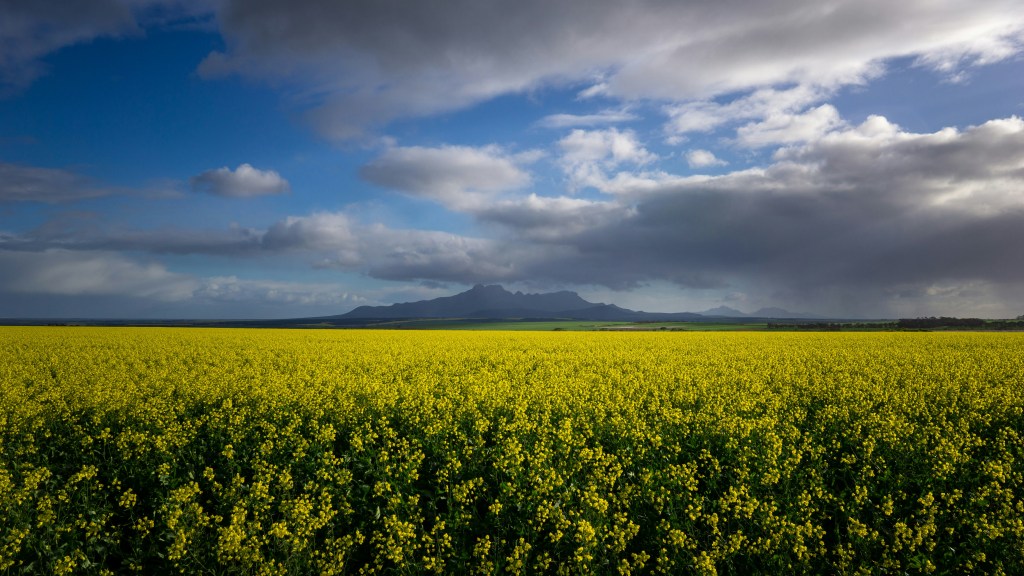 Alberta Premier Danielle Smith hopes a joint effort with the federal government can reopen Canola exports to China. PHOTO: SUPPLIED MICHAEL MILVERTON, UNSPLASH
But Kyle Kasawski, the NDP’s agriculture and irrigation critic and the member for Sherwood Park, classified a new situation as a “market access crisis,” thanks to recently introduced Chinese tariffs. He called on his counterpart to explain what the Alberta government is doing to support growers.
R.J. Sigurdson, the UCP minister, concurred that “this is a really big issue.” However, the federal government is the problem’s originator and needs to act, he said.
“It’s time for Ottawa to step up and support our canola producers,” said Sigurdson, the member for Highwood. “We’ve been calling on it for over a year. Now is the time.”
Canola producers “have suffered enough. We need action.”
The tech exec, the prisoners and the EVs
The situation had been turning around after China lifted restrictions in 2022. Those were apparently tied to a three-country diplomatic row, although China claimed it was due to pests found in Canadian canola.
The trigger was almost certainly Canada’s arrest of a Chinese tech executive in 2018. Meng Wanzhou of Huawei Technologies was facing U.S. wire fraud and other charges.
Stats from the Canola Council of Canada show that canola seed exports to China fell from $2.8 billion in 2018, before the restrictions, to $800 million after they came into effect in 2019.
Alberta’s numbers for the oilseed show a similar pattern, crashing by 73 per cent to $224 million in 2019 from $831 million in 2018, the province has calculated. Alberta’s China-bound canola eventually recovered to new heights of $1.2 billion in 2023 and $1.4 billion in 2024.
In September 2021, China welcomed home Meng. Two Canadian prisoners in China caught up in the fight — who’d become known as “the two Michaels” — were returned to their home country, too. And the restrictions were lifted about eight months later.
As expected, Canada’s canola seed exports to China rose again. In 2022, they totalled 2.6 million tonnes worth $2.2 billion, compared with 2.3 million tonnes worth $1.8 billion the year before, according to statistics from the Canola Council of Canada.
But trouble struck again.
The latest saga involves the communist superpower punishing Canada in March for Canada’s earlier tariffs of 100 per cent on China’s electric vehicles and 25 per cent on its aluminum and steel.
China used identical percentages in a suite of retaliatory tariffs: 100 per cent on canola oil, canola meal and peas, and 25 per cent on fish, other aquatic products and pork.
Further complicating matters is a 76 per cent charge on raw canola seed that the Chinese imposed in mid-August. A government ministry is investigating alleged dumping by Canada, and China will hold back the money until the investigation is complete, it says.
Dumping is the practice of selling something in a foreign market at a lower price than it sells for at home or below production costs, making it hard or impossible for locals to compete.
The dumping allegation has tit-for-tat roots, because Canada has justified its tariffs on EVs, steel and aluminum as responses to unfair state subsidies and overcapacity in China — effectively allowing China to do its own dumping here.
Homegrown presence
Through it all and despite the market challenges, canola has continued to bloom each summer on Alberta’s prairies. And there’s more to the story than being a pawn in spats with China, the legislature heard.
The industry supports thousands of Alberta jobs, van Dijken said. Beyond its economic impact, canola represents Alberta’s “spirit of innovation and environmental stewardship.”
Continued van Dijken: “Our farmers continue to adapt cutting-edge technologies and sustainable practices that reduce emissions, protect their soils and enhance biodiversity. From biofuels to food production, canola is helping to build a more sustainable future both here in Alberta and around the world.”
Indeed, industry sources say 55 per cent of the raw seed grown here is crushed here, adding value and creating perhaps 1.7 million tonnes of canola oil annually. A byproduct of crushing is canola meal, sold as livestock feed.
 Chinese tariffs continue to crush Canada’s $40B canola industry. PHOTO: SUPPLIED MARVIN ZETTI, UNSPLASH
A renewable diesel project in Strathcona County went online in July. Industry publications say Imperial Oil will need about one billion litres of canola oil per year to produce the biofuel.
Sigurdson highlighted an investment tax credit for agri-processing that he said is attracting $5 billion in investment over three years.
“That is an absolute record,” Sigurdson said. “This government has created the space. We are now the beacon for agri-processing investment, which is a benefit to farmers, ranchers and every agri-processor here in our province.”
In the gallery were representatives of the Alberta Canola Producers Commission, whom Sigurdson shouted out for fighting for the continued success of their industry.
‘Get those markets open’
Premier Danielle Smith and Opposition Leader Naheed Nenshi touched on canola during their back-and-forth in question period.
Smith “doesn’t do the work” to get China and India to lift their tariffs, Nenshi charged.
“Saskatchewan’s premier went to China to fight for his producers, and our premier is nowhere to be found on these files,” Nenshi said.
But Smith said she’s met with the Chinese and Indian consuls general and ambassadors about creating tariff-free relationships.
“We’ll be planning trips in the new year. I’m very excited about that,” the premier said. “Hopefully, we’ll be able to have a federal and provincial co-ordinated effort (and) we’ll be able to get those markets open.”
This report by The Canadian Press was first published Nov. 30, 2025.
Related