
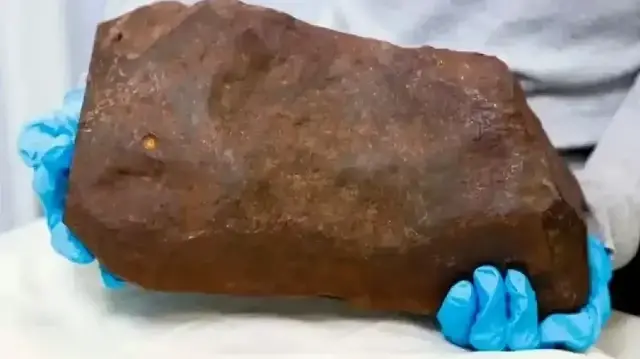
An Australian man’s potential gold discovery has turned out to be something far rarer and more scientifically valuable: an ancient meteorite. David Hole found the unusually heavy, reddish rock while exploring with a metal detector in Maryborough Regional Park near Melbourne. Initially convinced it was a gold nugget trapped in yellow clay, he spent years unsuccessfully attempting to cut or crack it open before finally taking it to the Melbourne Museum for identification.
Geological Analysis Reveals Extraterrestrial Origin
At the museum, geologists Dermot Henry and Bill Birch immediately suspected the rock was not of this world. Upon examination, they identified telltale signs of a meteorite, including a distinctive fused crust caused by intense heating as it plummeted through Earth’s atmosphere. “The surface had this sculpted, dimpled look, which is classic for meteorites,” Henry explained, noting this characteristic forms during atmospheric entry.
Historical Significance and Scientific Value
The meteorite, now named the “Maryborough” after its discovery location, represents a significant find for the region. It is officially recorded as only the 17th meteorite ever confirmed in the state of Victoria. Laboratory analysis determined the space rock to be approximately 4.6 billion years old, meaning it formed during the early stages of our solar system. This age makes it a primordial time capsule, offering scientists clues about the conditions and materials present when the planets were forming.
A Discovery Beyond Monetary Worth
While the finder may have hoped for gold, the scientific community emphasizes the meteorite’s irreplaceable historic value, which far exceeds its weight in precious metal. The rock is a type of chondrite, a stony meteorite that has remained largely unchanged since the solar system’s birth. Such discoveries underscore the importance of public engagement with scientific institutions, as this invaluable specimen was almost overlooked. The rock now resides in the museum’s collection for permanent study and display.