
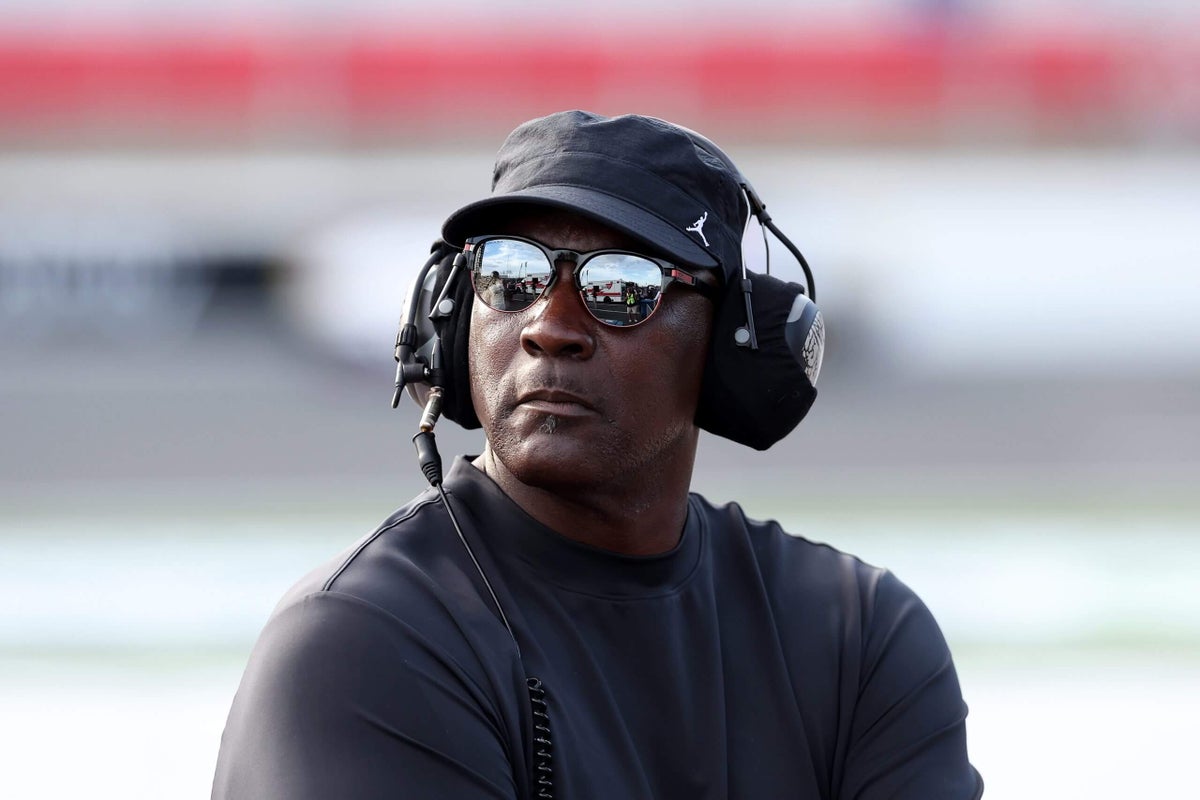
A race team owned by basketball icon Michael Jordan is one of two organizations suing NASCAR in a federal antitrust trial that begins Monday in Charlotte, N.C.
If that’s news to you, or if you just want to catch up on how the parties have arrived at this point, you’ve come to the right place.
Jordan is the majority owner of 23XI Racing, a five-year-old NASCAR team also co-owned by three-time Daytona 500 winner Denny Hamlin. Together with Front Row Motorsports, a race team fielded by fast food franchise owner Bob Jenkins, the two organizations allege NASCAR has illegally used its power within stock car racing in “monopolistic” ways.
NASCAR and co-defendant Jim France, the CEO who is part of NASCAR’s founding family, claims it has done nothing wrong and the teams’ dissatisfaction stems over a business dispute during negotiations for what is known as the franchise-like “charter system.”
The judge in the case, Kenneth D. Bell, has already ruled NASCAR has a monopoly over its market, which is defined as
“premier” stock car racing. Now, in a trial that is expected to last more than two weeks, a six-person jury will decide whether NASCAR abused that power in a way that violated antitrust laws.
Whatever happens next, the outcome will be regarded as one of the biggest stories in NASCAR history.
What is at stake in this case?
If the race teams lose, they will likely go out of business. They cannot afford to run as non-chartered (or “open”) teams because of the difference in the purse structure. Charter teams get certain revenue guarantees, as well as assured starting spots in races, that open teams do not. In a declaration, 23XI co-owner Curtis Polk estimated the organization would lose $24 million in revenue if the team’s cars did not have charters.
If NASCAR loses, the sport of stock car racing could materially change. Bell has already telegraphed that in order to provide a remedy for an antitrust violation, he could force NASCAR to sell its racetracks or dismantle the existing charter system. Ultimately, it could trigger events that result in the France family relinquishing control of the sport or selling off all or part of NASCAR.
And even if a settlement is reached during the trial, damage has been done to NASCAR as a whole — both financially and in the court of public opinion after the emergence of scathing communications between series executives.
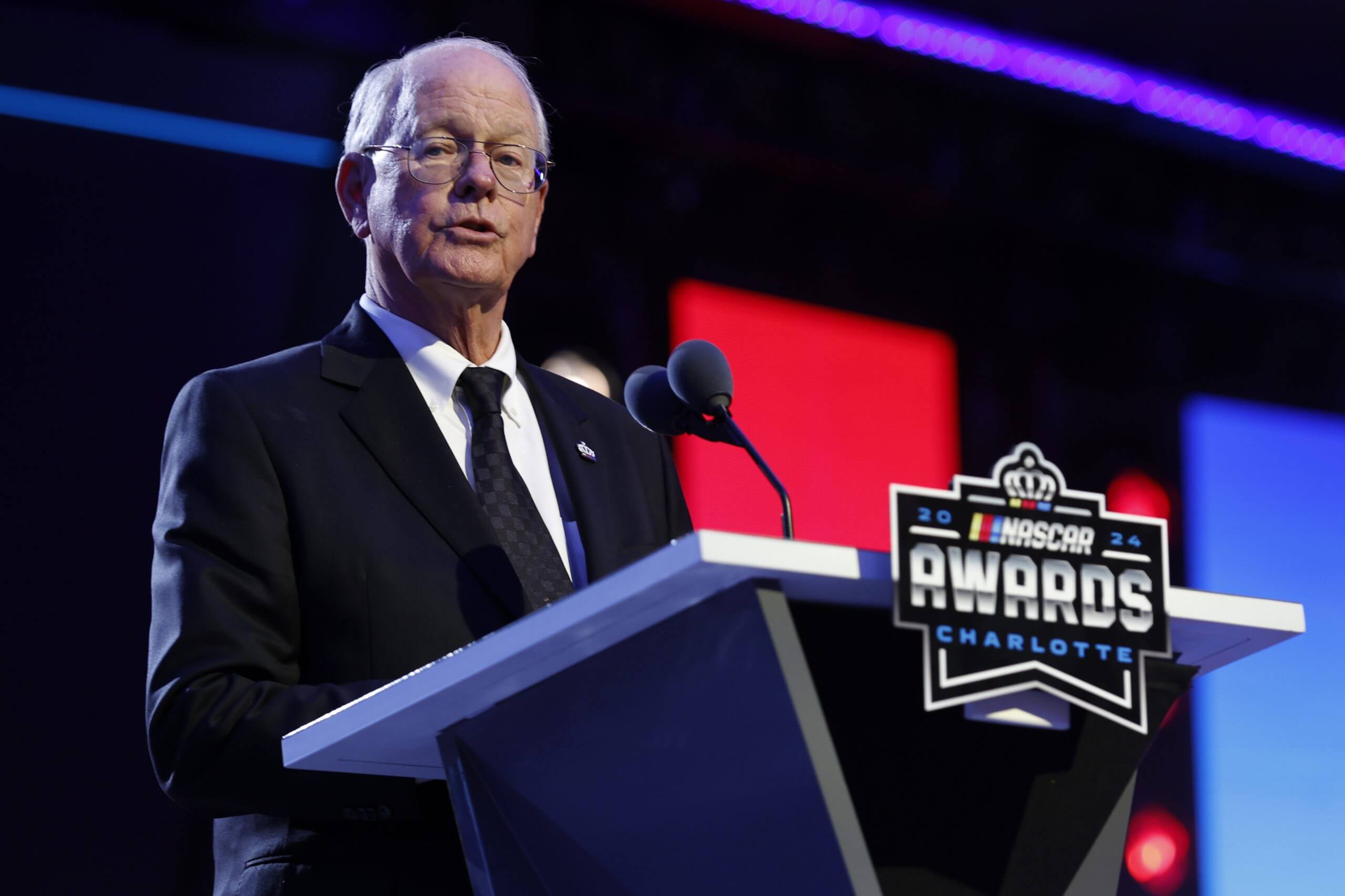
NASCAR chairman and CEO Jim France. (Sean Gardner / Getty Images)
What does the law say?
The focus of this case was once broader but has now been narrowed. The teams were originally suing for violations of two sections of the Sherman Antitrust Act, and NASCAR countersued the teams and Polk, alleging a conspiracy to collude with other teams during the negotiation process.
But Bell threw out NASCAR’s counterclaim, which means the teams’ actions during the negotiations are no longer relevant, and the teams dropped one part of their claim when the judge ruled NASCAR has monopoly power over stock car racing (therefore eliminating the need for the teams to prove that at trial).
Possessing a monopoly is, by itself, not illegal. But the jury will be asked to decide if NASCAR unlawfully abused its monopoly power, therefore causing economic harm to the race teams as a result of the monopoly.
What is the teams’ argument?
23XI and Front Row argue that NASCAR actively participated in exclusionary conduct to maintain its monopoly over stock car racing.
The teams allege NASCAR acquired and controlled racetracks with agreements that blocked other series from using those venues, banned teams from using their Cup Series cars to compete in other series, and acquired another series (ARCA) to prevent potential competition.
What is NASCAR’s defense?
Unlike other major professional sports, NASCAR owners do not have franchises. Instead, they are allowed to purchase limited-term “charters,” which provide guaranteed entry into each points race as well as a substantial financial benefit over cars that do not have charters.
The negotiations were contentious, but 13 of the 15 charter-owning organizations signed the deal by a NASCAR-imposed deadline in September 2024. 23XI and Front Row then sued, which NASCAR said was a result of unhappiness over failed negotiations rather than a sign of an antitrust violation.
NASCAR argues it built the sport through decades of ingenuity, sacrifice and hard work and cannot be a monopoly based on how it has sharply increased payouts to teams from a new media rights deal signed in 2024.
How did the case get to this point?
A combination of ego, money and the principles of two sides who are used to getting most of what they seek in nearly every negotiation they’ve ever had.
For a more precise reason, go back three years to when NASCAR and the charter-holding teams began to negotiate an extension to the charter agreement.
Going into those negotiations, all parties understood the talks would be tense, and they were. There were also some hardliners within the ownership ranks who were adamant NASCAR would finally grant the teams permanent charters — among them, 23XI’s Polk, who multiple times strongly voiced this to other owners as he attempted to rally them.
As all this unfolded, it became increasingly likely legal action would be threatened if teams didn’t get an offer to their liking. When this happened, and with NASCAR refusing to budge on permanent charters, 23XI and Front Row filed their unprecedented lawsuit.
Why did the parties not settle?
For much of the past year, neither side was willing to budge much from their respective stance, effectively muting any chance of a settlement. Even a court-ordered arbitration session in August failed to produce any traction.
The possibility of a settlement arose, though, in October when NASCAR asked the court to mandate a settlement conference, which was granted. Across two days, the parties held lengthy discussions where they were finally able to find some middle ground. A strong belief formed that a settlement could be announced around NASCAR’s championship weekend in Phoenix.
Obviously, such optimism proved fleeting. No settlement was reached. The barbs between the sides continued — including the release of text messages between NASCAR executives criticizing NASCAR Hall of Fame team owner Richard Childress — which, along with recent motions favoring 23XI/Front Row, have further curtailed any hopes a settlement would be reached before the scheduled trial date. (A settlement could still occur after the trial begins.)
What are some of the other notable headlines from this case?
Nearly any high-profile trial is going to generate plenty of headlines — and this one is no exception. This has been especially true lately.
Just last week came the release of several text messages between NASCAR executives unearthed during the discovery process. These messages included NASCAR’s then-president, now commissioner, Steve Phelps saying Childress should be “taken out back and flogged” and also called him a “stupid redneck who owes his entire fortune to NASCAR.”
Another topic of note among NASCAR executives in those revealed messages was several drivers participating in the Superstar Racing Experience (SRX), an “all-star” invitation-only series that held races on short tracks throughout the country. There were aspects of SRX that NASCAR and its media rights holders viewed as competition. Thus, when 23XI co-owner Hamlin announced in 2023 — in the midst of NASCAR and teams negotiating an extension to the charter agreement — that he was planning to compete in an SRX race, Phelps and NASCAR executive Steve O’Donnell expressed their displeasure.
“This is NASCAR. Pure and simple. Enough. We need legal to take a shot at this,” O’Donnell said.
“These guys are just plain stupid. Need to put a knife in this trash series,” Phelps responded.
NASCAR executives aren’t the only ones who’ve had text messages disclosed.
One message from Hamlin said his “despise of the France family runs deep.” 23XI president Steve Lauletta voiced the opinion that Jim France dying “is probably the answer” to resolving the ongoing issues over charters between NASCAR and the teams. And after those 13 teams signed the charter agreement in September 2024, Michael Jordan called Joe Gibbs Racing, a team that signed and has a close alliance with 23XI, “f—rs” and referred to the other 12 teams as “p—ies.”
What do the financial reports say?
NASCAR reported a $102.6 million profit last year on revenues of $1.7 billion. But documents also claim there are significant “member distributions” — payouts to the France Family Trust — which are more than $100 million per year.
In 2024, NASCAR reported $107.3 million in those “member distributions,” and the number was even higher in 2023 ($159.1 million).
Meanwhile, documents claim Cup Series teams lost more than $1 million per car on average from 2021 to 2024 and lost an average of $2.5 million per car last year.
Front Row was included among the teams that lost money while racing; however, 23XI reported a profit from 2021-23 (average of $2.2 million per year) before losing $2.1 million in 2024.
Teams asked for enough revenue from the new TV deal to cover $20 million per car, but the average payout from the new charter deal is roughly $12 million per car (still an increase from $9.7 million in the former charter agreement).