
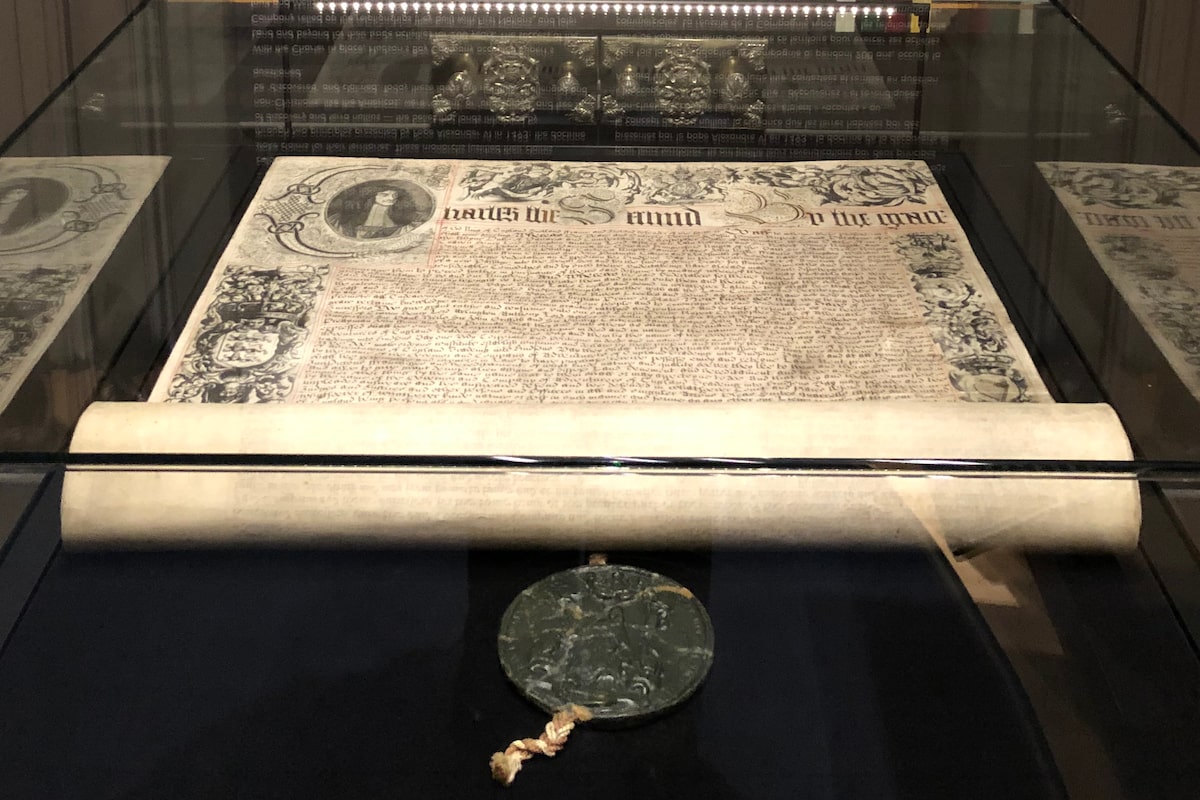
The 1670 royal charter signed by King Charles II establishing Hudson’s Bay on display in a photo supplied by the Manitoba Museum. The Thomson and Weston families are set to prevail in their bid to buy the charter.HO/The Canadian Press
Two of Canada’s most prominent families are set to prevail in their $18-million bid to buy the 1670 Hudson’s Bay charter, and will donate it to four cultural institutions to keep it in Canada and accessible to the public.
The joint bid by the Thomson and Weston families was selected after no other qualified bidders stepped forward with a higher offer by last Friday’s deadline, according to a source with knowledge of the matter.
The Globe is not naming the source because they were not authorized to discuss the matter.
In order to qualify, bidders had to meet a number of conditions, such as committing to permanently donate the charter to a public institution in Canada, and providing funds for consultations with Indigenous groups and other concerned parties on how to present it to the public.
The two families had initially submitted separate bids for the charter before deciding to bid jointly.
Thomson and Weston families submit $18-million joint bid for Hudson’s Bay charter
Opinion: The value, and values, of the HBC charter
The decision likely puts an end to months of uncertainty about the fate of one of the country’s most important historical documents. The 355-year-old parchment, which carries the wax seal of King Charles II, launched the Hudson’s Bay Company and granted its traders a monopoly over a vast territory comprising nearly one-third of what is now Canada. In doing so, it set the stage for colonization of the land.
The charter also carries deep and complicated significance for Indigenous people, because it used the doctrine of terra nullius, or “nobody’s land,” to claim ownership without the knowledge or consent of its inhabitants.
The Thomson-Weston bid comes with an additional $5-million donation to support the preservation of the document and to fund the consultations on its presentation and how it can be shared with other institutions and with Indigenous groups.
The families’ plan calls for four institutions to share the charter: The Archives of Manitoba, the Manitoba Museum, the Canadian Museum of History and the Royal Ontario Museum. Its “official home” will be in Manitoba, Canadian businessman David Thomson said when the bid was first announced. No details have yet been made public about how those institutions will share the document or how often it will be on display in each place.
The successful bid comes from Mr. Thomson’s personal family holding company, DKRT Family Corp., and the billionaire Weston family’s holding company, Wittington Investments Ltd. (The Woodbridge Co. Ltd., another holding company and primary investment vehicle for the Thomson family, owns The Globe and Mail.)
The retailer, Canada’s oldest continuously operating company, was forced to sell off the charter and all of its other assets as part of insolvency proceedings that began in March, when the company was granted court protection from its creditors, faltering under $1.1-billion in debt.
Hudson’s Bay Co. has since sold off a number of assets, including liquidating all of its department stores, selling a handful of its store leases to new tenants and signing a $30-million deal with Canadian Tire Corp. Ltd. for its intellectual property, including brand names, logos and blanket designs. The failed retailer is also in the process of auctioning off its art collection and decades worth of store memorabilia, with proceeds directed to pay down part of the company’s debts.
The Globe revealed in April that the company was also advertising the 1670 charter among its assets listed for sale in a confidential memorandum – the first that government officials, Indigenous groups and many historians and archivists had heard of the plans.
The news triggered an outpouring of concern about the future of the document, including from the Department of Canadian Heritage, which wrote to Hudson’s Bay governor and executive chairman Richard Baker on the day The Globe story was published to note that the charter would fall under the regulations on the Canadian Cultural Property Export Control List.
Since then, the process to decide on the charter’s permanent home has included a number of twists. At first, the company was granted court approval for a separate auction to deal solely with the document. But before the sale could proceed, a $12.5-million offer from the Weston family became public in late July – surprising other potential buyers, who had been told by the advisory firm overseeing the sale, Reflect Advisors LLC, that it would not accept bids ahead of the auction. (That initial offer from Wittington also included a $1-million donation for consultations and would have chosen the Canadian Museum of History as its permanent home.)
The court agreed to a hearing to consider the Weston family offer and set a deadline for other parties to make submissions on the matter. Then in late August, Mr. Thomson signaled his interest in a $15-million bid, plus a $2-million donation for consultations, that would have donated the document to the Archives of Manitoba – the institution that already holds centuries of Hudson’s Bay corporate records bequeathed to it in 1994.
Because of the added interest from Mr. Thomson’s DKRT and other bidders, the company reverted to the plan for an auction. Then, just hours before another court hearing in late September to approve the auction process, DKRT and Wittington submitted a surprise joint bid for $16-million, later increased to $18-million.
Finally, on Nov. 21, the court approved the auction process with the joint bid constituting an opening offer and set a Nov. 28 deadline for other bidders to step forward.
The charter “has profound historical and cultural significance to Canada and its people,” Ontario Superior Court Justice Peter Osborne wrote in a document filed with the court on Sunday outlining his reasons for approving the auction process. He added that the purpose of the process was not only to maximize proceeds that could be used to pay down the company’s debt, but to do so while safeguarding the charter and ensuring its preservation for the public.
The company must still seek court approval before the sale of the charter to the joint bidders can be finalized.