
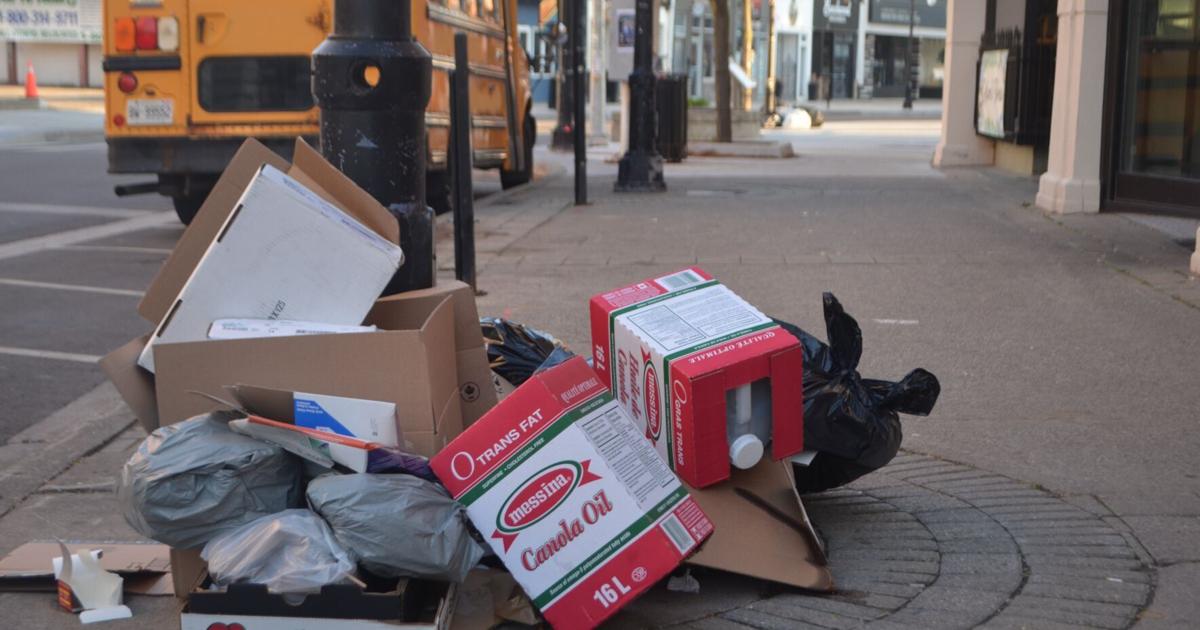
Jennifer McKenna, co-owner of Little Chief and Co. on St. Paul Street in St. Catharines, has visions of bags of recyclable waste piling up on downtown sidewalks near customers as they are eating their lunches at outdoor patios.
But it isn’t just the heaping mess that will repel people from visiting the downtown, she said. It’s watching as pieces of cardboard and plastics of all kinds swirl about the streets, recycling bags ripped apart and waste cluttering storefronts.
“We are going to have a heaping pile of recycling material as tall as our building,” said McKenna. “There will be garbage sitting around in the midst of summer, with no where to go. This will be an additional problem for the downtown and more costs for businesses to deal with.”
The province formally sent a notice to Niagara Region in October saying at the end of this year producer responsibility organizations will no longer collect noneligible source recyclables on the same trucks as residential recyclables.
Those noneligible sources include small businesses — like Little Chief and Co. — institutional properties, daycares, municipalities and churches.
After Dec. 31, downtown property owners will have an unenviable choice: hire a contractor to remove the material, dump the stuff into the trash or truck it to a depot.
Businesses will continue to receive curbside waste and organic collection from the Region.
Because of change made by the province, Circular Materials — Niagara’s producer responsibility organization in charge of recycling — will not permit GFL Environmental and Miller Waste Systems to collect recyclables from noneligible sources, with whom the Region has contracts.
The change is part of legislation passed by the Ontario government in 2016 and which the province said is aimed at “transitioning costs of the blue box program away from municipal taxpayers.”


“A person who owns a business in the downtown area will now likely package up their cardboard,
McKenna, who opened her business with her husband Mike and is also a member of the St. Catharines Downtown Association board of management, said for the past two years the association has raised alarm bells about the potential for the Region to end recycling collection in an effort to “pre-empt” any problems, but without success.
“This issue has kind of been hiding in plain sight,” she said.
Now , all Niagara business improvement associations and chambers are scrambling to inform their members about the fallout .
“It will be shock and awe to businesses,” said McKenna. “It will also be a surprise to patrons. They will want to know what is happening.”
Little Chief and Co., said McKenna, operates on a philosophy of being business-friendly with the environment.
“We focus on sustainability in our business practices,” said McKenna. “We can’t suddenly not be environmental stewards. This is our brand. There will be costs for us.”
If businesses decide to seek private companies to remove their recyclables, it will mean higher costs for them. And without any competition, said McKenna, “(private contractors) can charge what they want.”
McKenna said the loss of recycling services not only has an impact on businesses, but will be detrimental to the community, creating pollution that will affect the air and water.
“It will affect people living and working in the downtown,” she said.
For downtown St. Catharines, said Kat Dodge, executive director for the downtown association, not having recycling services will compound many issues confronting the area.
Dodge and other associations have urged municipalities to continue the service, but so far, there has been no movement by local officials. She has spearheaded opposition to the Region’s decision, submitting petitions and urging the municipality to continue the service.
“Hundreds of businesses have signed the petition,” said Dodge. “It’s hard to believe this is happening. Nobody really understands why.”
A Niagara Region staff report said maintaining a blue and grey box recycling contract to affected groups would cost about $1.5 million to service 4,375 properties, collecting 1,900 tonnes of recyclables annually. The cost to continue providing the service would range from $700,000 to about $3.2 million depending upon the level of service.
The Region for months pressed the Doug Ford government to continue its full recycling program.
Changing the collection contract with Miller Waste Systems and GFL Environmental to keep the same level of service for non-eligible recycling sources would increase the waste management department’s 2026 net budget by 6.95 per cent.
In the fall, regional councillors voted not to continue recycling for the affected properties across Niagara.
Jennifer Blackledge, executive director of Beamsville BIA, said her organization has addressed regional council, worked with local and provincial BIA associations, and contributed to a petition calling for “co-mingling” material as a “practical fix.”
“Despite a year of co-ordinated advocacy, we haven’t been able to secure a commitment, and businesses are understandably frustrated and concerned about what comes next,” said Blackledge.
There was a glimmer of hope that the Region was going to reverse its decision, said Blackledge, but that optimistic view has now vanished.
Dodge said she has held information sessions with her membership, but it’s not enough.
There will also be confusion among residents and businesses, say BIA officials, especially in mixed-use areas where residents living in buildings with businesses, will receive recycling services, but street-level businesses will not.
“It will require a significant education effort to help everyone understand what goes where, and even then, we expect challenges,” said Blackledge.
This is just another problem the region’s downtowns have to deal with, said Dodge. It will raise costs for businesses and contribute to an image problem the downtown doesn’t need, along with impacting the environment.
“It will add a different level of perception of the downtown, as we deal with the social and economic issues here,” said Dodge.
Dodge said most business owners ware unaware of the implications of the Niagara Region decision. It was complicated by what she said was a lack of communication on how it will impact the community.
“Businesses have not heard, or they don’t believe, it is happening,” said Dodge.
Omar Mohammed, owner of the Big Brothers Gourmet Pizza franchise on King Street, was surprised to learn he won’t be receiving recycling services beginning in January .
“I do not know what I will do,” said Mohammed, who has operated the business for five years. “It will cost me more money to get rid of the material. I will have to talk to the mayor and also talk to the building’s owner. We need to have a plan.”
Cory Lang, manager at Wind Japanese and Thai restaurant on King Street, said the business’s cardboard is taken to a bin at the rear of the building. She said it is picked up once a week by a private contractor.
But the restaurant also has some recyclable material, including plastic, that is left curbside for the Region to pick up.
“It’s good to know ,” she said of the change. “I will send the information to the office. We need to arrange our own recycling.”
Osvaldo (Ozzie) Polillo, owner of Salon Oz in the Corbloc building on King Street, said he also didn’t know about the change in recycling services.
Polillo, who will celebrate six decades in business next year, , said the salon dumps any recyclable material in a bin at the rear of the building.
But even though his waste collection is provided by Corbloc , he still said it is “no good” the service is ending for small businesses.
Acting waste management services director Dave Yousif said in an emailed statement issued through the Region’s communications staff, the municipality has deployed a “robust strategy to communicate the impacts of the provincial blue box regulation on noneligible source properties …”
He said the strategy includes communications to the “broader community” such as through news releases and “detailed, direct communication with businesses.”
Blackledge said ending recycling services will “hit our downtown hard.”
“Many independent shops and restaurants simply can’t absorb the sudden cost of private collection or manage their own transport of recyclables,” said Blackledge. “It creates an unfair two-tiered system where residents still receive service, but the small businesses that anchor our main streets are left out.”
Blackledge said along with other BIAs, the Beamsville organization had been warning businesses about the possibility of the end of recycling services since the start of the year.
Greater Niagara Chamber of Commerce said recycling services should include all commercial businesses. It has urged the province to allow recycling services to small businesses, churches and other noneligible sources.
“The goal should be to protect recycling access for small businesses, avoid unnecessary service disruptions and ensure an efficient, co-ordinated collection system that serves both residents and businesses.
BIA officials said the change will mean more recycling material will end up in landfills at a time when the Niagara’s diversion rate was trending upward to 60 per cent in 2023 from 59.7 per cent in 2021. The Region’s diversion rate target had been 65 per cent by 2020.
Blackledge said Beamsville BIA will be co-ordinating a “joint communication plan” so businesses and residents understand what changes they will see.
“Our goal is to provide consistent, accurate information across all channels as soon as possible,” said Blackledge.
But as the end of the year quickly approaches, McKenna said more needs to be done by the community to deal with what will be a detrimental problem for Ontario.
“We need a larger voice to hear our concerns,” she said. “This isn’t just a St. Catharines issue, it is a problem for the entire province. We need people to come together because when it happens, the public will ask why is it happening? How did we get here?”