
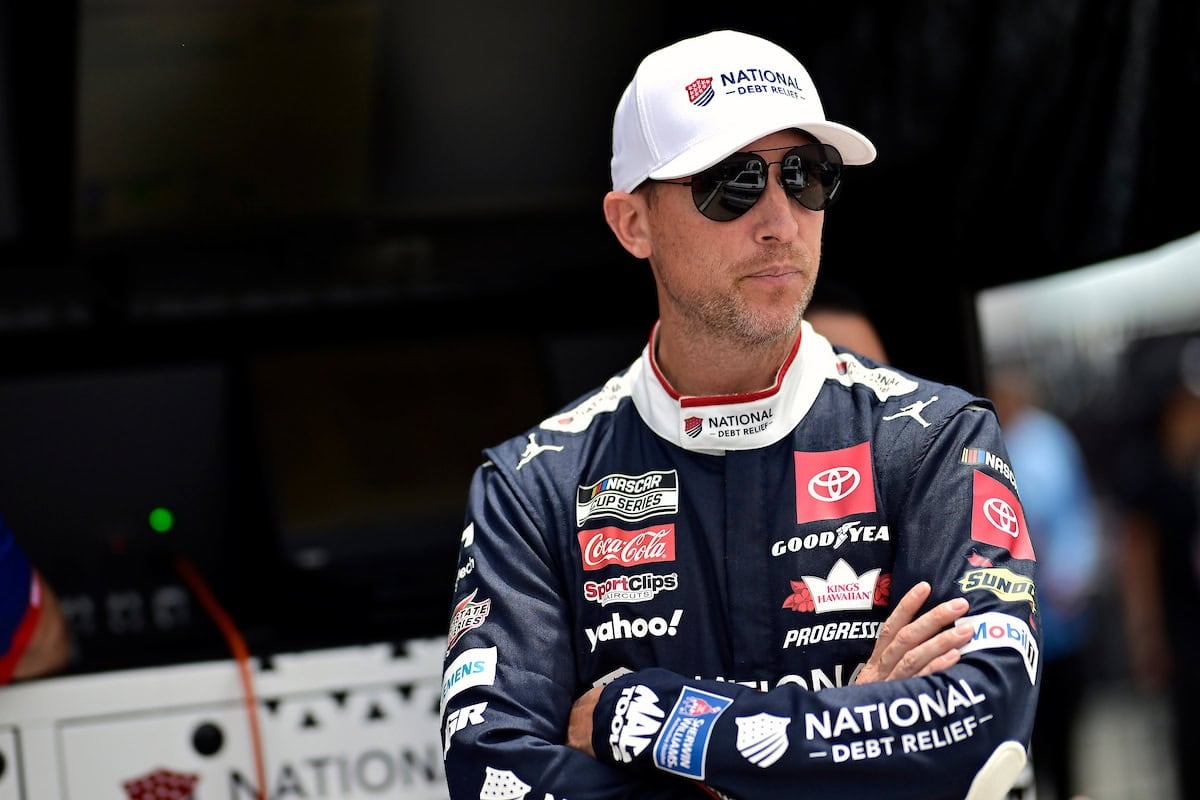
CHARLOTTE, N.C. — Monday (Dec. 1) was day one of the much-anticipated lawsuit between NASCAR and 23XI Racing/Front Row Motorsports.
In attendance on the teams’ side was 23XI co-owners Michael Jordan, Denny Hamlin and Curtis Polk as well as FRM owner Bob Jenkins.
On NASCAR’s side was CEO Jim France, Executive Vice Chair Lesa Kennedy France, Executive Vice President and Chief Venue & Racing Innovations Officer Ben Kennedy, Commissioner Steve Phelps, President Steve O’Donnell and Vice Chairman Mike Helton.
They, as well as family members, employees and media, crammed into a medium-sized courtroom in Charlotte, N.C., to face off in what is being labeled the trial of NASCAR history.”
The trial is expected to last 10 business days, so picking a jury that can commit to that timeframe was crucial. Selecting jury members was the first order of business and took up the first half of the day, as over 30 candidates were narrowed down to nine.
Some were easy to weed out. Two got out of it because they were caretakers for elderly. Then, the remainders were called to the jury box 12 at a time and asked a series of questions by Judge Kenneth D. Bell. His questions ranged from asking about their familiarity and biases for or against NASCAR and its teams and drivers, as well as Michael Jordan and his alma mater, the University of North Carolina. His line of questioning was followed by questions from the attorneys from the two sides: 23XI/FRM’s Jeffrey Kessler and NASCAR’s John E. Stephenson.
Bringing the Heat: Reacting to Day 1 of the NASCAR vs. 23XI/FRM Trial
One jury candidate said that he used to watch NASCAR but that now, “NASCAR is killing NASCAR.” He was cut off by Judge Bell and asked to be removed. On his way out, he pointed at Jordan and smiled.
There were two Jordan fans who were removed as well. One woman worked for someone she said used to be a crew chief and car chief at the NASCAR Cup Series level, while another was a Hendrick Motorsports fan. They were not chosen either. One man worked at Hendrick Automotive, so he wasn’t chosen, as Rick Hendrick is on the witness list. Perhaps the most interesting person not chosen was a lady who said admitted she was a history buff and studied monopolies of the past.
After it was all said and done, five men and four women were chosen as jurors. However, during a 20-minute recess, one of the women noted that she had to pick up her children in the late afternoon, so she couldn’t commit to the trial. She was removed from the jury, and a man who had already left was called back, which led to an additional 30-minute break.
After Judge Bell explained the role of the jury in a civil case, there was an hour break for lunch before opening statements began.
Kessler started the opening statements, spending the next hour-plus explaining how his clients believed NASCAR had abused its status as being a monopoly. He said the two main questions for the jury were, “Did NASCAR maintain its monopoly while engaging in anticompetitive conducts?” and “Were the teams hurt by the monopoly by paying them too little?”
He made sure to explain to the jury that NASCAR teams are independent contractors, but they are allegedly hurt by three anticompetitive acts: tying up the tracks, restricting the teams from supporting other events and making the Next Gen car its intellectual property.
The tracks are tied up because NASCAR owns a large chunk of them and “repeatedly” had private messages about making Speedway Motorsports, the owner of most of the rest of the tracks, exclusive to NASCAR. Kessler noted that NASCAR pays extra money to the Speedway Motorsports tracks to not host anything else.
Dropping the Hammer: So You’ve Been Selected for the NASCAR Lawsuit Jury
Meanwhile, 23XI/FRM got an economist to compare the financials in NASCAR to other racing leagues, such as Formula 1. He said the economist’s reports showed that teams should be getting 45% of all the revenue, but instead they are getting 39%.
Kessler also mentioned that the teams wanted permanent charters and equated the situation to paying rent as opposed to owning a property, that a landlord could boot a tenant out when the terms are up just like NASCAR could take a charter. Stephenson objected to this because it was argumentative, but Bell overruled it.
He said the France trust got over $400 million in a three-year span while 74% of the teams lost money. Kessler also said Jim France treated the negotiations with the teams like a competition with the attitude that he would win.
Then it was Stephenson’s turn for an opening statement on NASCAR’s behalf. Stephenson was new to the trial, as Chris Yates had been leading the charge for NASCAR before. Yates was still there on Monday, but Stephenson did most of the talking. His slick Southern dialect seemed more in common with the jury than Kessler’s New York City accent.
Stephenson started out with the point that the teams asked for the charter system and NASCAR accommodated them, paying “every penny” asked for. He pointed out that “literally none” of the points raised by Kessler had been brought to NASCAR prior to the lawsuit. That 23XI raised eight points when it didn’t sign the new charter agreement in 2024, and not a single one was one of Kessler’s points. Seven of the eight problems in that release were fixed, according to Stephenson.
He gave examples of other owners saying Next Gen lowered the costs and that it was a “homerun,” according to Roger Penske. Stephenson responded to Kessler’s economist report by saying they can’t argue the 2025 deal is bad because they never signed it.
Stephenson went on to say Polk had a playbook since 2022 on turning this situation into a lawsuit and that the lawsuit is his attempt at “negotiation through litigation,” instead of negotiating in good faith. He questioned why the teams wanted the charter system to go on forever if it was so bad. He also detailed all the times 23XI and FRM have bought, sold or leased charters and explained how they benefited from doing so, citing FRM as making $12 million from selling and leasing.
Stephenson argued the teams collectively made $641 million from sponsors and $400 million from NASCAR, equaling over $1 billion. He also threw out there that in 2025, the teams made $100 million more than the previous season, while NASCAR made $41 million less. Stephenson also told how Polk wouldn’t let a New York Times reporter see 23XI’s new shop, Airspeed, because it cost $35 million to build while they were “crying poor.”
As for Kessler’s three anticompetitive instances given, Stephenson said NASCAR locked up the tracks so it could move the schedule around easier to places like the Chicago street course and the Los Angeles Memorial Coliseum. He said it kept the teams from competing elsewhere because it was a goodwill provision as part of the original charter agreement, and that NASCAR spent millions developing the Next Gen car, so that’s why it is restrictive. However, he pointed out no one had asked to use it elsewhere until recently, when 23XI and Legacy Motor Club were able to showcase the car in Japan.
For the most part, though, Stephenson’s opening statement was more about the charters, while Kessler’s leaned on abusing monopoly powers.
After another break, the witness portion of the trial began. To prevent witnesses within the lawsuit from hearing other testimonies from those in their party, only one person per organization was permitted to be in the courtroom following opening statements. Jordan was the representative from 23XI, Jenkins from FRM, Jim France for himself as he is personally listed in the trial and Lesa France Kennedy for NASCAR. Everyone else with the those teams or NASCAR involved on the witness list had to leave.
However, after a witness gives their testimony, the two sides agreed that person could stay. Hamlin was called to be the first witness, so he won’t miss any of the trial.
The teams’ side began questioning Hamlin first, asking him about his background in racing and path from a local racer to Cup superstar. One powerful moment was when Hamlin broke down in tears while discussing what his parents invested in his racing career, given his father’s declining health.
Hamlin was then asked about why he became a team owner, to which he replied that at age 40, it hit him that he needed something after his racing career was over. He detailed how he and Jordan became friends and how 23XI went from a false rumor about he and Jordan buying into Richard Petty Motorsports (Hamlin said he actually was trying to invest in it, but Jordan was not involved) to the two actually starting a team.
4 Takeaways From the NASCAR 23XI/FRM Trial, Day 1
After being asked about the financials, Hamlin said how much they spent on every charter (the first was $4 million, the third was $28 million) and explained that he has paid 40% of it himself each time. He said 23XI pays Joe Gibbs Racing $8 million a year for support on all three cars, but that it saves his team from having to hire 120 more employees. He defended the building of Airspeed, as that was an investment to lure in sponsors and employees.
Hamlin pointed out a couple times how NASCAR has taken sponsors for teams, and he said 11 teams since the original charter agreement have gone out of business. He also said that it cost $20 million to field a car in Cup, and that that amount is with running the car “barebones.”
The day ended before all of the questions could be asked to Hamlin, so he will resume his time as a witness on Tuesday morning, Dec. 2.

Content Director at Frontstretch
Michael Massie joined Frontstretch in 2017 and has served as the Content Director since 2020.
Massie, a Richmond, Va., native, has covered NASCAR, IndyCar, SRX and the CARS Tour. Outside of motorsports, the Virginia Tech grad and Green Bay Packers minority owner can be seen cheering on his beloved Hokies and Packers.