
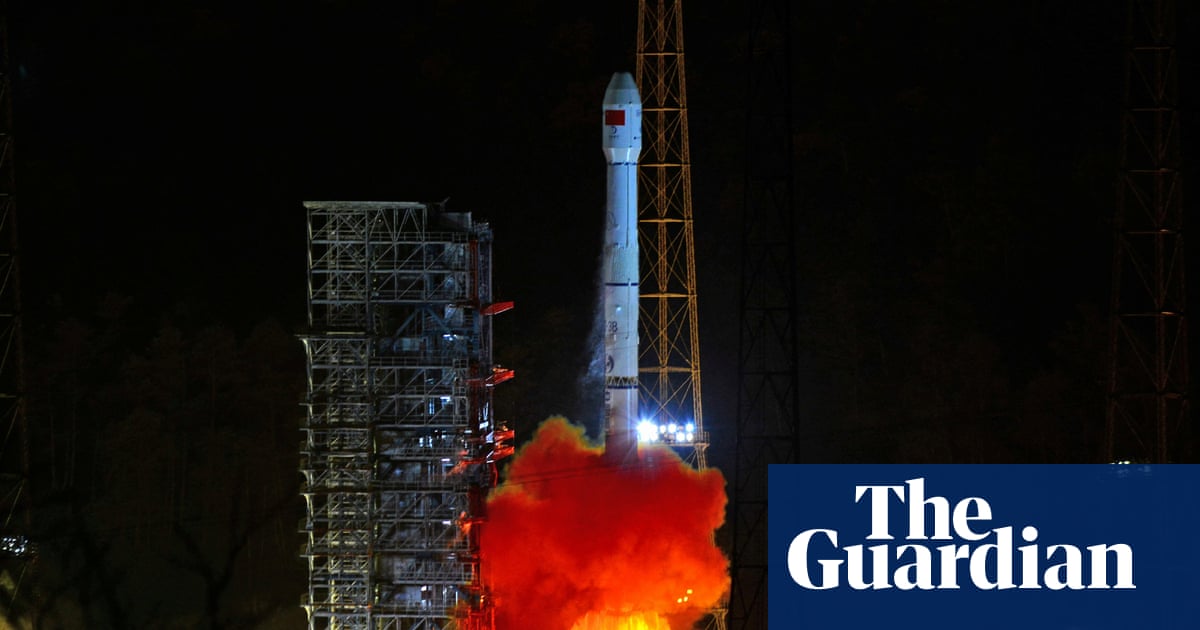
Good morning. This week Glasgow hosts one of the UK’s largest ever gatherings of the space industry at Space-Comm. With representatives of Nasa, the UK and Scottish governments and the UK space agency among 2,000 space leaders gathering there, it is a chance for people in the commercial supply chain of the space exploration industry to meet policy makers and space agencies.
It comes at a crucial moment in the exploration – and exploitation – of space. For almost three decades the International Space Station (ISS) has bound the US and Russia into cooperation and shared interests. That project is nearing its end, and we can expect to see a realignment of missions and goals – which may bring states and scientists into conflict.
For today’s newsletter, I spoke to Ian Sample, the Guardian’s science editor, to find out what the next few years of a resurgent and competitive space race might look like, why humans seem set on going back to the moon, and why all that is making some scientists angry. But first, the headlines.
Five big stories
Politics | Britain’s budget watchdog, the Office for Budget Responsibility, has said the early leak of its budget documents before Rachel Reeves made her speech last week, was the “worst failure” in its 15-year history, as its chair resigned and it emerged a similar leak had happened earlier this year.
Health | The World Health Organization has urged countries to make weight loss drugs more accessible and pharmaceutical companies to lower their prices, saying jabs including Mounjaro represent a “new chapter” in the fight against obesity.
Ukraine | The coming days may be “pivotal” for talks to end the war in Ukraine, the EU’s top diplomat said, as Volodymyr Zelenskyy met Emmanuel Macron in Paris on Monday and the US envoy Steve Witkoff flew out to meet Vladimir Putin in Moscow on Tuesday.
Donald Trump | Donald Trump said he “wouldn’t have wanted” a second strike that the US military reportedly conducted on a boat in the Caribbean that it believed to be ferrying drugs, killing survivors of an initial missile attack. The UN human rights chief, Volker Türk, has urged Washington to investigate, saying there was “strong evidence” of “extrajudicial” killings.
Asia-Pacific | Sri Lanka and Indonesia have deployed military personnel to help victims of the torrential floods that have killed 1,100 in four countries in Asia. Heavy cyclones and tropical monsoon rains have hit the region in recent days.
In depth: ‘We really are in new territory’A new post-ISS world is coming. Photograph: Martin Belam/The Guardian
When I was a child, as well as my space Lego – which I still have (pictured above) – I owned a battered paperback with transcripts of the Apollo 11 mission comms and a potted history of the space race. I pored over it again and again, admiring the bravery and derring-do of the likes of Yuri Gagarin, Valentina Tereshkova, Alan Shepard, Alexei Leonov and, of course, the poor dog Laika.
“I think this new post-ISS world is going to be really interesting,” Ian Sample told me. “We really are in new territory.”
The shift is fundamental. Decades of enforced cooperation – astronauts sharing cramped modules, jointly performing joint repairs and representing two superpowers dependent on one another’s rockets – are coming to an end as the ISS retires. What replaces it isn’t yet clear, but it will not be a single international project but a splintering into parallel alliances with competing goals.
The new space alliances shaping up
With the ISS programme drawing to a close in 2030 – and with diplomatic fault lines caused by the invasion of Ukraine among other topics – Russia is turning away from its cooperation with Nasa and towards working with the Chinese.
“Russia has got the rocket capability,” Ian explained, “while China has been doing some amazing stuff. They are super-competent.” The two countries are now presenting themselves as a single lunar power bloc, planning joint missions, joint infrastructure and even a shared lunar research station.
On the other side sit the US, Europe, Canada and Japan, who are developing their own orbiting platform and surface programmes under the Artemis umbrella. Donald Trump has been urging Nasa to return Americans to the moon as quickly as possible, and recently declared that the US space programme is about “building strength, expanding freedom, and ensuring that the American flag remains the ultimate symbol of leadership across the final frontier”. It is chiefly geopolitics, not science, behind the wheel.
The striking thing, Ian said, is that both coalitions are broadly attempting the same thing – a permanent human presence on and around the moon – but will do it separately, with separate stations, separate landing sites and separate rules of engagement.
Man’s return to the moon
Ian said both sides are working towards the same basic architecture: an orbiting lunar way station where crews can dock, swap in and out, and descend to the surface. “You fly to the moon, you dock there, put your new crew in,” he said. “They go down to the surface. You take the old crew back.”
It does all sound a little like the journeys to the moon in the future world portrayed in Arthur C Clarke and Stanley Kubrick’s 2001: A Space Odyssey – just several decades later.
On the surface itself, nations are weighing up everything from inflatable habitats to simple structures built by heating and compressing lunar soil. “You could pile up loads of lunar soil to make a sort of igloo,” Ian said, “or try to make bricks. Or you take inflatable structures and just pop them up when you get there.”
Much of this would be prepared in advance by robotic missions that deliver equipment and assemble infrastructure long before any astronauts arrive.
The ‘vague’ commercial incentive
The moon is far away and expensive to get to, and people will want to see a return on investment. So, at the risk of sounding foolish, I asked Ian what are the commercial opportunities people see with the moon. He said the economic case is still “vague”, but several ideas are driving interest. One is the extraction of minerals such as rare earth elements, which are essential for electronics and clean-energy technologies.
But the immediate commercial push, he said, is really regarding logistics. “Nasa is funding loads of companies to send stuff to the moon so there’s a private sector that can do lunar missions.” Lower launch costs could eventually make extraction or manufacturing viable – but “that’s the long game”.
Isn’t this all just a self-indulgent waste of carbon?
Katy Perry after her trip to the edge of space last April. Photograph: Blue Origin Handout/EPA
In an era of fossil-fuelled climate crisis, there are questions about whether space exploration is the right investment for the planet – especially when someone like pop singer Katy Perry (above) is being briefly hoisted to the edge of space by Jeff Bezos for publicity.
Ian said the counterargument from scientists and agencies is that investment in space technology has often produced breakthroughs with environmental benefits on Earth – from more efficient solar cells to satellite climate monitoring. Some even argue that the moon’s resources could eventually support cleaner energy systems at home.
One isotope, Helium-3, is rare on Earth but in abundance on the moon, and some scientists have theorised it could provide safer nuclear energy in a fusion reactor, since it is not radioactive. This is all still in the realms of theory though.
Another reason countries are willing to expend this carbon centres on the question of how do you divide up territory on the moon. It could end up similar to the governance of the Antarctic – which is collectively maintained by the Atlantic treaty, with nobody owning it outright, but nations having designated spheres of influence where they can carry out scientific work.
“Whatever rules will be drawn up on apportioning resources, who gets to work where, what permissions there are, how you carve up the moon, you’ve got to be there to be taken seriously in those debates,” Ian said. “That’s why China and Russia and the US are really keen to get there, so they can demonstrate they have a stake and set the agenda.”
Why is all this making some scientists uneasy?
“There’s some really interesting science to do on the moon, but those locations could get destroyed,” Ian said. He cited ancient and pristine bits of the moon where we might learn interesting things about the makeup and formation of our only natural satellite.
skip past newsletter promotion
Our morning email breaks down the key stories of the day, telling you what’s happening and why it matters
Privacy Notice: Newsletters may contain information about charities, online ads, and content funded by outside parties. If you do not have an account, we will create a guest account for you on theguardian.com to send you this newsletter. You can complete full registration at any time. For more information about how we use your data see our Privacy Policy. We use Google reCaptcha to protect our website and the Google Privacy Policy and Terms of Service apply.
after newsletter promotion
“Or what is probably more interesting is if they want to build instruments up there. If you build a radio telescope on the far side of the moon, you’re using the moon to shield all the radio wave noise from Earth. You can then point your telescope into space and it is in what they call a radio quiet environment. You’d be able to detect really sensitive stuff.”
“But obviously,” he said “it’s a real drag if someone then lands next to you and starts drilling or building a lunar theme park.”
When I was reading that battered paperback about the heady days of the 1950s and 1960s space race, that younger version of me firmly believed that we would be able to fly to the moon on commercial space liners by 2025. That possibility seems a long way off yet. But it does seem that, after an absence of more than 50 years, that child may still have grown up and lived to see people walking on the moon once more.
What else we’ve been readingCara Hunter in Portrush, Northern Ireland. Photograph: Polly Garnett/The Guardian
I can’t stop thinking about this conversation with Cara Hunter (pictured above), the Irish politician targeted by a malicious deepfake video in 2022. Hunter tells Anna Moore of the “horrific” emotional turmoil she suffered, and her decision to go public with her experience to campaign for legislation against deepfake intimate image abuse. Karen
For Vice, Caleb Catlin recalls one of the most prominent Black voices in the 90s gangsta rap moral panic, that of C Delores Tucker. Martin
Fossil fuel and mining firms are bringing a record number of cases challenging governments attempts to halt climate breakdown via secretive offshore courts, writes George Monbiot, citing a case against Britain, after the quashing of a Cumbrian coalmine proposal. Karen
One winter, I realised I could hate December every year for the rest of my life, or just throw myself into the Christmas spirit. If you are struggling with that, our writers have 25 tips for you. Martin
I loved Irvine Welsh’s tribute to the fashion designer Pam Hogg. The “groundbreaking” artist, who died last week, once took pity on her fellow Scot, by getting Welsh into Soho’s Wag Club in the 1980s, thus kickstarting a friendship forged through clubbing, touring and partying. Karen
SportKimi Antonelli in action during the Qatar Grand Prix, where he ran wide on the penultimate lap and was overtaken by championship leader Lando Norris. Photograph: DPPI/Shutterstock
Grand Prix | Mercedes driver Kimi Antonelli has received an apology from Red Bull after being subject to death threats amid a torrent of online abuse following suggestions from some members of the Red Bull team that the teenager moved over to allow Lando Norris through at the Qatar GP.
Football | Premier League clubs and sports bodies have expressed fears they will be forced to pay millions more in policing costs after being called in for consultations with the Home Office this week.
Cricket | Will Jacks is in surprise contention for the day-night second Ashes test against Australia.
The front pages
“OBR chair quits after inquiry into early release of budget document” – that’s the Guardian and it’s in the Times as well: “OBR boss quits as PM’s budget leak rebuke”. The i has “OBR chief forced out after contradicting chancellor over budget black hole”. The Mail’s slant is not hard to predict: “The fall guy for Reeves’ budget lies” while the Telegraph says “Reeves clings on as OBR chief silenced”.
The Financial Times has simply “OBR chief resigns after review blames budget leak on regulator’s leadership”. The Express runs with “Now PM admits seeking ‘closer’ links to EU”. “Justice for the lost victims” – a piece on the Post Office Horizon scandal is the lead in the Mirror. “Striker clashes with right winger” is the Metro’s take on what it straplines as “Lineker v Robinson”, the latter mentioned being the racial demagogue Stephen Yaxley-Lennon.
Today in FocusMP for Islington North Jeremy Corbyn Photograph: Adam Vaughan/EPA
Your Party: leaderless or just hopeless?
Geraldine McKelvie reports from the ground at the inaugural Your Party conference, while Peter Walker talks to insiders about the divisions that have beset the party.
Cartoon of the day | Ben Jennings Illustration: Ben Jennings/The GuardianThe Upside
A bit of good news to remind you that the world’s not all bad
‘There was always a subconscious yearning for new and exciting things’ … Tam Patachako. Photograph: Ali Smith/The Guardian
Two years ago, while at work, Tam Patachako received a notification that his pay had landed in his bank account. Within an hour he’d spent £90 on clothes, decorative items and a “completely useless” weighted blanket he never ended up using. It wasn’t unusual behaviour: whenever he felt stressed, or bored, he found himself scrolling through shopping apps. He justified every impulsive purchase as “only £5”, but soon these amounts soon increased.
In this reflective essay for the series The one change that worked, Patachako traces how years of compulsive spending – shaped partly by growing up poor – finally shifted when he adopted a simple rule: placing items in his virtual shopping basket and waiting 24 hours before deciding to buy. The pause forced him to reconsider a prospective purchase. While he admits to the occasional slip, the act of stopping before shopping feels, to him, liberating and radical.
Sign up here for a weekly roundup of The Upside, sent to you every Sunday
Bored at work?
And finally, the Guardian’s puzzles are here to keep you entertained throughout the day. Until tomorrow.