

Listen to this article
Estimated 5 minutes
The audio version of this article is generated by text-to-speech, a technology based on artificial intelligence.
The White House on Monday defended a U.S. admiral’s decision to conduct multiple strikes on an alleged Venezuelan drug-smuggling vessel in September, saying he had U.S. Defence Secretary Pete Hegseth’s authorization, even as critics questioned the legality of a strike on survivors.
The Washington Post had reported that a second strike was ordered to take out two survivors from the initial strike and to comply with an order by Hegseth that everyone be killed.
U.S. President Donald Trump said on Sunday that he would not have wanted a second strike on the boat and that Hegseth had denied giving such an order.
But White House spokesperson Karoline Leavitt said on Monday that Hegseth had authorized U.S. Admiral Frank Bradley to conduct the strikes on Sept. 2.
Bradley “worked well within his authority and the law,” she said.
Leavitt said the strike was conducted in self defence to protect U.S. interests, took place in international waters and was in line with the law of armed conflict.
“This administration has designated these narco-terrorists as foreign terrorist organizations.”
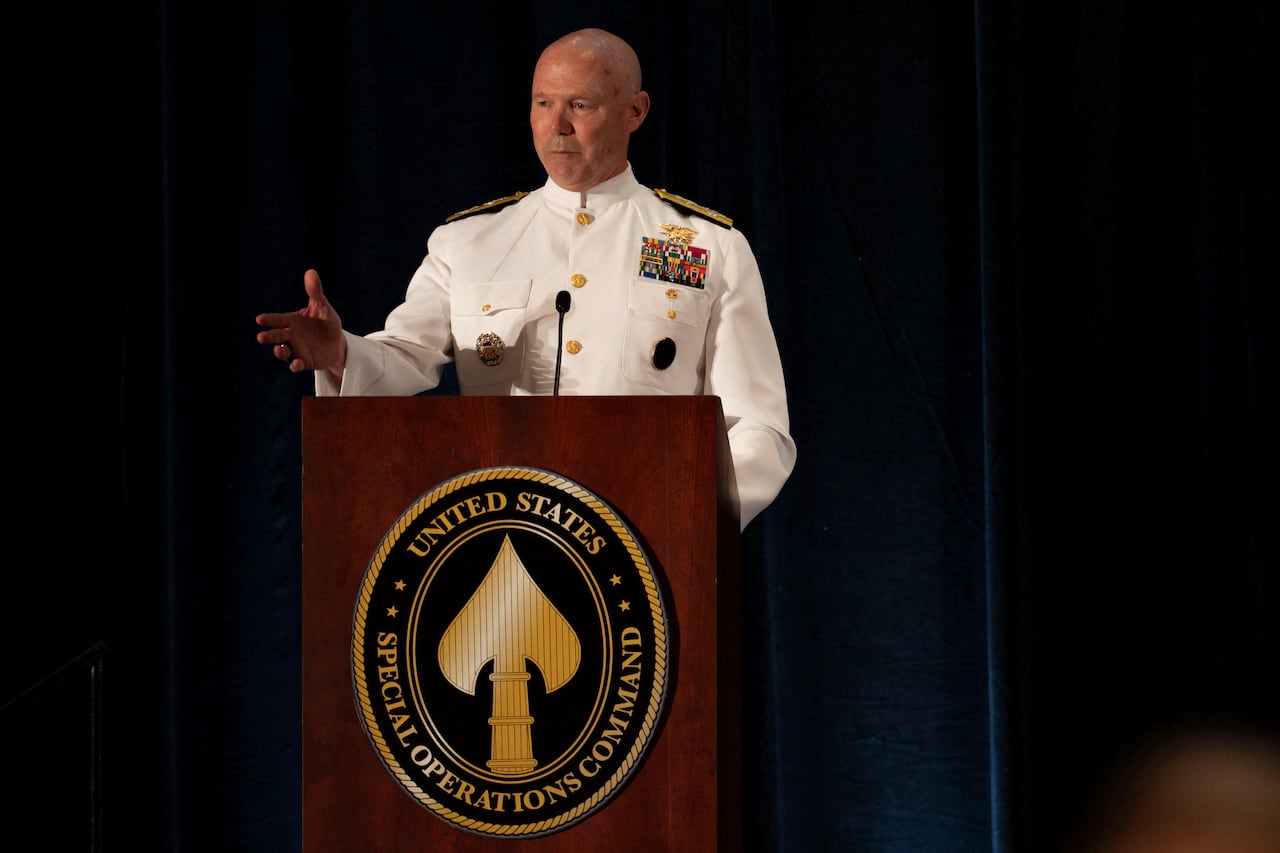 The White House said U.S. navy Admiral Frank ‘Mitch’ Bradley, seen here on Oct. 3, acted ‘within his authority’ when he carried out the order for a follow-up strike on a Venezuelan vessel. (Airman 1st Class Monique Stober/U.S. Special Operations Command/Handout/Reuters)
Starting in September, the U.S. military has carried out at least 19 strikes against alleged drug vessels in the Caribbean and off the Pacific coasts of Latin America, killing at least 76 people.
Critics have questioned the legality of the strikes, and both Republican and Democratic lawmakers have pledged to look into them.
WATCH | White House defends 2nd strike: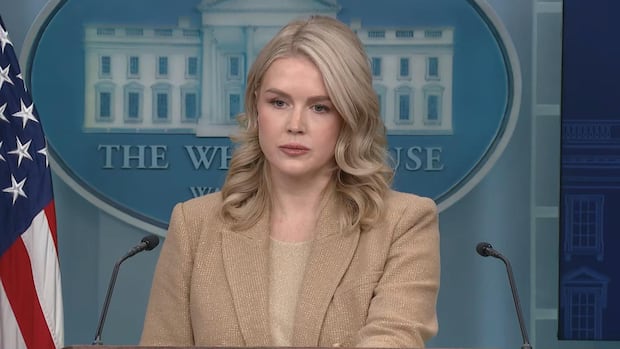
White House says admiral ordered 2nd strike on alleged drug boat
White House press secretary Karoline Leavitt said Monday that a U.S. navy admiral ordered a second strike on an alleged drug boat in the Caribbean Sea in September, while insisting the attack was lawful. The incident has come under bipartisan scrutiny amid a published report that Defence Secretary Pete Hegseth issued a verbal order for a second strike that killed survivors on the boat.Likely ‘a war crime’
International humanitarian law prohibits attacks on incapacitated combatants. The U.S. Defence Department’s Law of War Manual states that shipwrecked persons cannot be knowingly attacked and must receive medical care unless they act with hostility or attempt escape.
George Washington University law professor Laura Dickinson said most legal experts do not believe the boat strikes qualify as armed conflict, so lethal force would only be allowed as a last resort.
“It would be murder outside of armed conflict,” she said. Even in war, the killing of survivors “would likely be a war crime.”
A group of former military lawyers, the JAGs Working Group, called the order “patently illegal,” saying service members have a duty to disobey it and that anyone who complies should be prosecuted for war crimes.
On social media platform X, Hegseth defended Bradley, calling him “an American hero” and saying he has his “100% support.” Hegseth said he stands by Bradley’s combat decisions on that mission “and all others since.”
Trump discussed the pressure campaign against Venezuela with top advisers, among other topics, at a later Monday meeting, a senior U.S. official said.
Trump has flagged the possibility of U.S. military intervention in Venezuela. On Saturday, he said the airspace above and surrounding Venezuela should be considered “closed in its entirety,” but gave no further details, stirring anxiety and confusion in Caracas.
WATCH | What is Trump’s endgame in Venezuela?: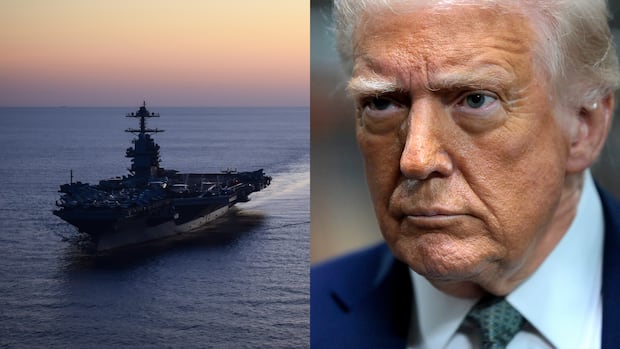
Trump’s Venezuela endgame: ‘This could be very ugly’
After a series of attacks on alleged ‘narco traffickers’ off Venezuela, the U.S. has deployed its largest aircraft carrier to the region. For The National, CBC’s Eli Glasner explains why President Trump’s show of force may go far beyond fighting drugs.
Trump confirmed on Sunday that he had spoken to Venezuelan President Nicolas Maduro, whom the U.S. considers an illegitimate leader. Trump declined to provide details of the conversation.
The Trump administration has been weighing options to combat what it has portrayed as Maduro’s role in supplying illegal drugs that have killed Americans. Maduro has denied having any links to the illegal drug trade.
Yet even as the Trump administration has used the alleged flow of drugs to the U.S. as the legal underpinning justifying the strikes on the vessels near Venezuela, Trump said Friday he would pardon former Honduran president Juan Orlando Hernández, who is one year into a 45-year sentence in a U.S. prison for helping drug traffickers move tonnes of cocaine to the United States.
Democratic Sen. Tim Kaine called Trump’s decision to pardon Hernández “shocking.”
“He was the leader of one of the largest criminal enterprises that has ever been subject to a conviction in U.S. courts, and less than one year into his sentence, President Trump is pardoning him, suggesting that President Trump cares nothing about narco-trafficking,” Kaine said on CBS’s Face the Nation.
Reuters has reported the options under U.S. consideration in Venezuela include an attempt to overthrow Maduro, and that the U.S. military is poised for a new phase of operations after a massive military buildup in the Caribbean and nearly three months of strikes on suspected drug boats off Venezuela’s coast.
Trump also has authorized covert CIA operations in the country.