

Listen to this article
Estimated 4 minutes
The audio version of this article is generated by text-to-speech, a technology based on artificial intelligence.
A final agreement that allows Canada into the European Union’s €150-billion ($244-billion Cdn) Security Action for Europe (SAFE) program has been concluded, but Defence Minister David McGuinty is unable to say how much it will cost the federal treasury.
The deal marks the first time a country outside of Europe will formally participate in the joint military procurement initiative, McGuinty said.
“This will allow Canada, for example, to participate by supplying capabilities such as ammunition, missiles, drones, artillery systems, infantry weapons and beyond,” the minister said.
“So the opportunities for Canada are enormous. It will catalyze massive private investment in Canada.”
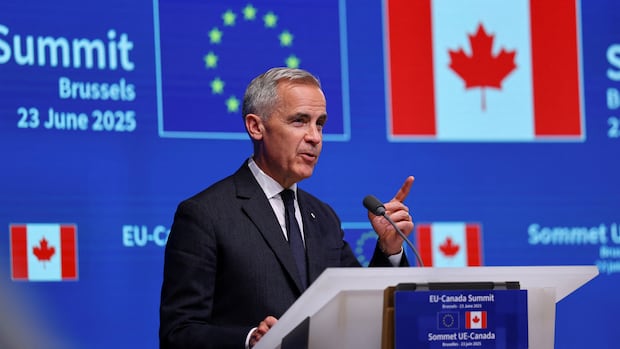
There have been months of detailed negotiations, which began after Prime Minister Mark Carney signed an overarching defence-security partnership with the EU last June.
The SAFE program allows partner countries to access low-interest loans for the joint procurement of military gear and weapons. It also allows Canadian companies to bid on those joint projects.
A European diplomat, speaking on background, said there is an entry fee to join the SAFE scheme, a payment which is based on, among other things, an estimation of how much business Canadian defence contractors are expected to do under the program.
The fee allows those companies access to a greater share of the loans, all of which are underwritten by the European Commission.
“If Canada wants to make sure that its equipment can be considered for those purchases, it will need to put money into those loan guarantees,” said Christian Leprecht, a professor at the Royal Military College of Canada who has followed the file.
“And that’s more complicated than they’re saying, well, we’re just going to put in money if you buy Canadian equipment.”
McGuinty said that while they have an agreement, some of the details, such as money, are still being worked out.
“We’ll have more to say about that in due course,” McGuinty told reporters on Parliament Hill Monday.
“We’ve been allowed to step inside a tent, the European Union tent. We’ve been allowed to participate like no other … non-European state has been allowed. We have negotiated our way into the tent to build this relationship and participate in very large opportunities for procurement. The details in terms of costs, percentages are being ironed out.”
An official in McGuinty’s office — following the minister’s remarks — insisted the fee will be in the millions, not billions, of dollars.
WATCH | Budget 2025 included major military spending: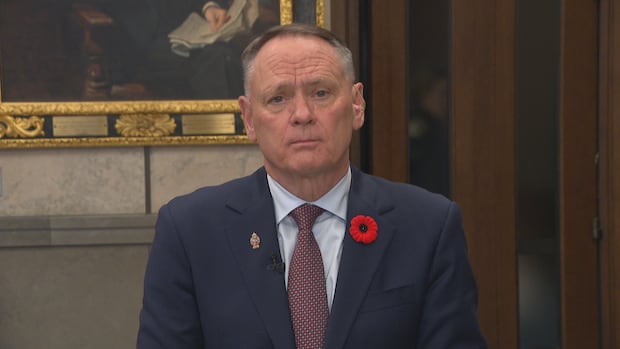
Feds set aside additional $81.8B over five years to build up Canadian military
The federal government is describing this budget as a ‘blueprint’ to defend Canada’s ‘sovereignty.’ Defence Minister David McGuinty says it’s ‘hard to predict’ whether Canada is on track for its NATO targets.
The fee is a crucial element.
The U.K. has been negotiating its way into the same program, but those talks broke down recently in a dispute over the fee.
Without an agreement on the ante, companies will be limited on the total value they’ll be able to contribute to projects.
EU countries had set Nov. 30 as the deadline for initial bids for the loans, which are expected to be issued next year.
It’s unclear how the passage of the deadline will affect Canadian companies that want in on the action — or whether they’ll now have to wait until 2027.
The SAFE program was announced by the EU in March and is part of a whole-of-Europe effort to rearm in the face of Russia’s ongoing war with Ukraine.
To this point, 19 out of 27 EU countries have applied for loans.
Poland has, thus far, been allocated the biggest portion — €43.7 billion ($71 billion Cdn). Romania is a distant second at €16.6 billion ($27 billion Cdn). Hungary and France have each been given €16.2 billion ($26.3 billion Cdn).
Leprecht said his understanding is that the initial €150 billion is already largely spoken for and that Canada has its eye on the wave of deals that will follow.
“The opportunities here — with the European Union Parliament — is negotiating the multi-year fiscal framework for the next five years,” he said. “This is the real opportunity. What are we going to collaborate on [in defence procurement] with the European Union over the next five-year, multi-year, fiscal framework cycle?”
Last spring, prior to signing the overall defence agreement, Carney pointed to the SAFE program as an important component of rebuilding not only the Canadian military but also the country’s industrial base.
That caused some angst in the European diplomatic community, which was concerned the program may have been politically oversold in this country.