

In the isolated Ogasawara Islands, about 1,000 kilometers south of Tokyo, scientists carried out a bold experiment. They removed 131 feral cats in an urgent attempt to save one of Japan’s rarest birds—the red-headed wood pigeon (Columba janthina nitens).
Within three years, the birds’ numbers surged. But that was only the start.
What happened next shook decades of assumptions in conservation biology. Instead of succumbing to inbreeding depression, the critically endangered pigeon—once reduced to fewer than 80 individuals—began a dramatic recovery. And its genome told a story few expected: centuries of isolation may have purged harmful mutations, giving this species an unexpected edge in the fight against extinction.
After the Cats Were Gone, the Birds Returned
The Ogasawara Islands, a UNESCO World Heritage Site, have long been plagued by invasive species. Among the most destructive: feral cats, introduced over decades of human activity. By the 2000s, the red-headed wood pigeon, which nests close to the ground and is endemic to this archipelago, was nearing extinction.
Between 2010 and 2013, conservation teams captured and removed 131 cats from Chichijima, one of the islands in the chain. The results were fast and clear. The number of adult pigeons soared from 111 to 966, and juveniles jumped from 9 to 189, as reported in Communications Biology.
 Distribution and population history of the critically endangered red-headed wood pigeon (Columba janthina nitens) and the widespread Japanese wood pigeon (C. j. janthina). Credit: Communications Biology
Unlike many endangered species, the pigeons didn’t collapse under the weight of genetic bottlenecks or loss of diversity. Instead, they appeared to thrive.
Genetic Purging May Have Changed the Rules
In most small populations, inbreeding leads to accumulation of harmful mutations, reducing survival and reproductive success. But the red-headed wood pigeon defied that rule. Genomic sequencing by a team from Kyoto University revealed that these birds carried fewer nonsense mutations—genetic defects that disrupt protein function—than their more genetically diverse mainland relatives, the Japanese wood pigeon.
More than 80% of the island pigeons’ genome was homozygous—an indicator of inbreeding usually associated with extinction risk. Yet, individuals with higher inbreeding levels in captivity often lived just as long—or longer—than others.
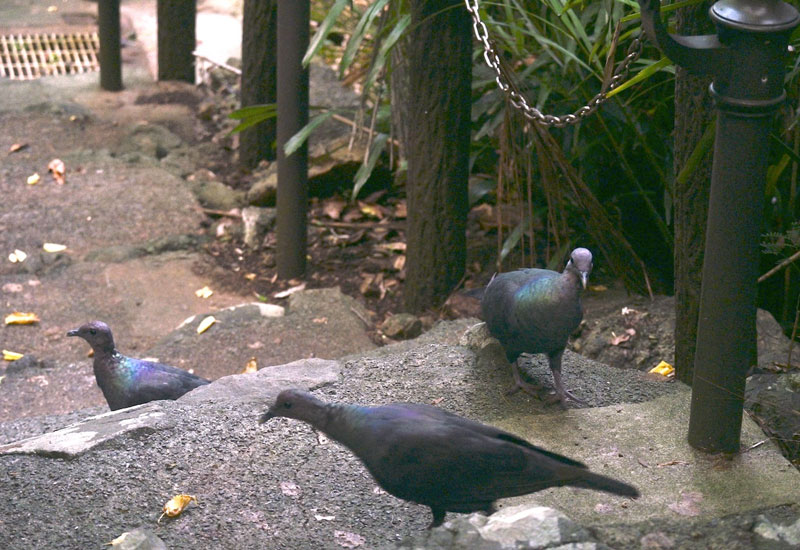 The red-headed wood pigeon, a critically endangered species endemic to the Ogasawara Islands, Japan. Credits: KyotoU / Daichi Tsujimoto
This suggests a phenomenon known as genetic purging. Over many generations, harmful mutations may have been systematically removed from the gene pool. The result: a population with low genetic diversity, but also a surprisingly low genetic load.
“Most conservation models assume small populations are always vulnerable due to genetic deterioration,” said Dr. Daichi Tsujimoto, lead author of the study. “But what we found suggests that, under certain long-term conditions, small populations can actually adapt to survive.”
Not Just a Fluke—Other Island Survivors Show the Same Pattern
The red-headed wood pigeon isn’t the only species that appears to have “purged” its genetic baggage. Similar patterns have been documented in other island-endemic animals. The island fox (Urocyon littoralis), native to California’s Channel Islands, rebounded from near extinction with minimal signs of inbreeding-related problems.
Likewise, the northern elephant seal (Mirounga angustirostris), once reduced to fewer than 100 individuals, managed to bounce back to over 200,000 today. Both species exhibit low genetic diversity—but also few severe genetic defects.
 Northern elephant seal population growth. Estimated population sizes are represented by the diamonds. Credit: Journal of Heredity
This growing body of evidence is forcing scientists to revisit long-held beliefs about what makes a population viable.
A Fragile Future Despite Success
Despite the pigeon’s impressive rebound, its future remains uncertain.
While purging may have helped clear its genome of the most damaging mutations, the lack of genetic variation still poses risks. The species could struggle to adapt to new diseases or climate stressors. Similar concerns have emerged for other species like the Seychelles paradise flycatcher, which also experienced purging but remains vulnerable to change.
 The Japanese Wood Pigeon. Credit: Kasia & Takashi Someya
“Purging isn’t a universal solution,” warned Dr. Cock van Oosterhout, a geneticist at the University of East Anglia. “It depends on the type of mutations, the history of the population, and how quickly environmental conditions shift.”
Even in captivity, where hand-rearing and controlled conditions support the birds, the long-term adaptive potential of such genetically uniform species remains an open question.
References: