
You probably did it at high school. Your kid probably did too. But why?
*BEEP*: Wait, what’s happening?
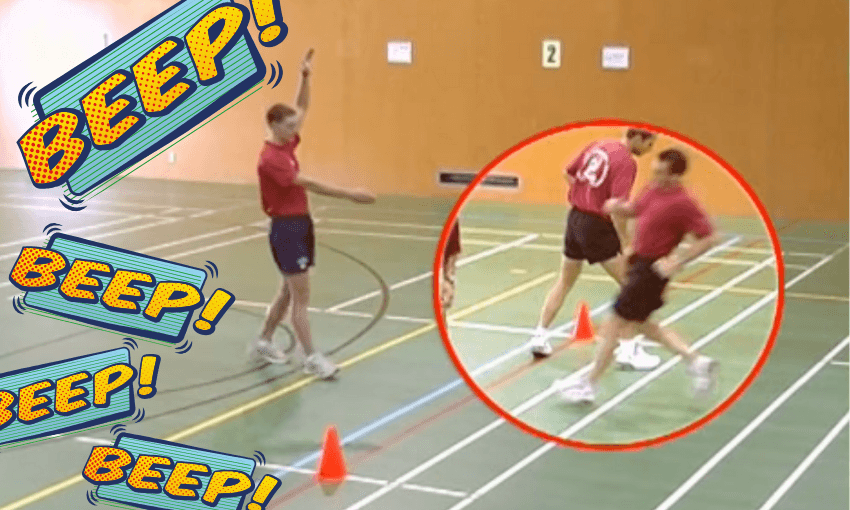
Get up, we’re doing increasingly fast shuttle runs. If you want to use the “proper” terminology, this is a multi-stage fitness test (MSFT), but everyone in New Zealand just calls it the beep test. Participants run back and forth across a 20-metre distance – like a gym or field – while keeping time with pre-recorded beeps. These increase with frequency for the duration of the test’s levels. If you can’t keep up, you’re eliminated. Scores are assigned depending on how long you last.
Sound familiar? You probably did it at high school. Its popularity is largely due to its ease of execution, explains Nicholas Gant, head of the department of exercise science at the University of Auckland. “It’s simple to administer, requires minimal equipment, and provides a reasonably accurate estimate of cardiorespiratory fitness without the need for scientific skills or lab equipment.”
*BEEP*: Oh my god, what’s the point?
It can be a “reliable indicator” of general fitness for prolonged physical activity, according to Gant. This is due to the fact that the beep test engages large muscle groups, requires whole-body movement, and its progressively increasing intensity demands more oxygen with each level. “The participant typically reaches exhaustion shortly after hitting their maximum oxygen uptake, known as VO₂max.” This reflects aerobic capacity, which in most people is determined by cardiac output. “It’s also useful for identifying athletic potential, as a high VO₂max is often a prerequisite for elite performance and is largely genetically influenced. Most people will also reach close to their maximal heart rate during the test.”
*BEEP*: Stop! Beeping!
Sorry, that’s kind of the point. “The version commonly used in New Zealand was originally published by the National Coaching Foundation in the UK,” Gant explains. The beeps were generated using a BBC Microcomputer programme. “The tones were recorded via the computer’s speaker and transferred to cassette tape. I’ve personally operated the original BBC programme at Loughborough University!” Those beeps can be heard around Aotearoa. “Since the test parameters were made publicly available and never commercialised, the tapes were widely copied and later converted to MP3 format, which is now the standard method of distribution without loss of fidelity.”
 In case you wagged every PE class in high school, this NZ Army video helpfully tells you how to do the beep test (Image: DefenceCareers YouTube)
*BEEP*: How long have we been doing this? It feels like ages.
You’ve only been running for a few minutes, but what you’re doing goes back far longer. “The original concept was developed in Canada in the late 1970s to early 1980s and later refined and validated by other researchers, leading to the widely used 20-metre multi-stage fitness test we know today,” explains Gant. Its spread here seems to follow a global pattern of schools and organisations adopting the beep test, and anyone born from the 1970s onwards probably slogged through it at least once.
*BEEP*: Am I supposed to enjoy this?
Not with that attitude. A ritual of youth in Aotearoa, doing competitive shuttle runs in front of your peers as a teenager is laden with the baggage of growing bodies, social hierarchy and being watched and judged. Even the most athletic at The Spinoff remember hating it, while one staffer described it as a way to “humiliate the unathletic children”. They’re not wrong. Alan Ovens, associate professor of health and physical education at the University of Auckland, says that framing physical activity around maximal aerobic fitness privileges students who are already fit, while marginalising less confident or competitive students. “It depends heavily on external pressure and compliance, which can undermine enjoyment, intrinsic motivation, and the development of a positive relationship with movement. Because results are often compared across students, it can reinforce ability hierarchies and negatively affect belonging and self-efficacy.”
*BEEP*: OMG we’re still going. Surely this is illegal.
Sorry, no. However, that doesn’t mean it’s a compulsory part of the nation’s school syllabus. “The beep test was never a mandated or officially required part of the New Zealand PE curriculum,” Ovens reveals. “The curriculum has always focused on broad learning goals rather than prescribing specific fitness tests. Its use in schools has therefore been a matter of local choice rather than national direction.”
*BEEP*: You’re telling me teachers chose to do this?
Yep. It was popular in the 1980s, when he began teaching. “Over time its use has tended to wax and wane as we found that it had little effect on young people’s physical activity, had limited use as a motivational tool, and little informative value in helping young people take responsibility for their own wellbeing needs.” In fact, the beep test is now actively discouraged. “Our priority is supporting teachers to create positive, meaningful experiences that encourage young people to lead healthy, active lives.”
*BEEP*: What’s the point of PE then, if not shuttle runs?
Things like movement, wellbeing, hauora, health, and the development of motor skills. The curriculum “does not require any specific fitness test or prescribe the measurement of aerobic capacity”, says Ovens. “Our aim is to encourage teachers to create supportive, meaningful experiences that help all young people develop confidence, identity and a lifelong commitment to being healthy and active.”
*BEEP*: If I leave school can we stop this?
Sure, as long as you don’t pursue a career in the military. The test is part of fitness requirements for serving in New Zealand’s army, air force and navy. The latter picked up their pace in 2019, introducing a “first class level of fitness requirement” for the beep test, aligning it with the standards of the other two divisions.
*BEEP*: OK, so jocks are into it, that makes sense. But surely everyone else repressed the beep test memories as soon as possible?
Not so fast. “Creatives” have ongoing feelings about it too. Beep Test* was made by Isobel MacKinnon and Simon Haren in 2013 and performed during the New Zealand Fringe Festival. MacKinnon describes it as a “deranged gladiatorial sweat-fest of audience participation, exploring competition, duress and failure” that they hoped would also improve their fitness. The premise consisted of increasingly time-pressured participatory demands; MacKinnon re-sat a failed fifth-form NCEA maths exam and the audience took part in a cumulative beep test.
“We made a lot of participatory work and had been thinking about participation in its broadest sense – how loathed it can be in the theatre and the connection with how adulthood seems to involve not doing things unless you’re good at them. During childhood, being good at something isn’t a necessary prerequisite for doing it. As children, participation is usually mandatory,” says MacKinnon. “That’s kind of the horror of childhood.” The test was “medieval torture for millennial teenagers” and MacKinnon thinks people’s response to the show reflected that; a surprising number of attendees willingly stripped off to take part. “It had a real feeling of a reckoning, like, ‘this time I will defeat the dragon’ type of feeling.”
It turns out high school beep tests were inspiring. (Image: National Library of New Zealand)
*BEEP*: I’m definitely feeling something.
Hannah Mettner did too. Her poem Beep Test, published in 2023’s Best New Zealand Poems, describes PE as a lesson in sunburn and body shame. “The beep test felt like peak PE,” she recalls. “It was always inside, and always seemed so intense: the competitiveness on full show.” At the time she didn’t realise it measured improvements in student fitness. “Rather, it felt like a sadistic act designed specifically to hurt and shame us (me).” Being a group test compounded the stress. “Failure in the beep test (and everybody fails sooner or later) is so public that it’s basically ritual humiliation, which can be so crushing as a young person.”
*BEEP*: Yeah, that tracks.
Yep. Beep Test was written while she was grappling with the repetitiveness of adult life and the systems we become trapped by. “The poem started up in my brain following a conversation in which someone said to me, ‘Life is just work, eat, sleep, repeat, amirite?’ For some reason, this triggered a memory of the dreaded beep test. The act of rushing back and forth between two arbitrary points with increasingly little time became a metaphor, I guess.”
*BEEP*: Sounds familiar.
I bet it does. It’s the poem Mettner’s most frequently asked about. She’s been sent screenshots from friends’ group chats and messages from strangers.“A group of people I vaguely know began referring to themselves as ‘the slow girls’ in response to one of the lines in the poem.”
*BEEP*: I’m shattered. Maybe they had the right idea.
When she was writing it, Mettner thought she was the only one who had these memories and feelings about the test. “I really didn’t think others would even remember doing it, so took care to describe the ‘rules’ in the first stanza of the poem. But, it turns out, everyone remembers.”
*BEEP*: OK, are we done?
Might as well stop now. No high school PE teachers responded to The Spinoff’s requests for comment.