
After two years of multi-front war, the OECD presents an unexpectedly optimistic outlook for the Israeli economy: a return to “normal” growth this year at 3.3%, followed by a sharp acceleration. According to the organization’s forecast, growth is projected to reach 4.9% in 2026, and in 2027 it is expected to exceed the long-term trend of 4.6%.
The OECD envisions an economy no longer reliant on bloated public spending and a soaring deficit, but one converging toward fiscal stability, with growth driven by the business and private sectors. This trajectory is supported by low inflation, expected to reach the midpoint of the price-stability target in 2027, and interest rates that will continue to fall gradually to 3.75% next year. This marks a shift from years in which security spending, compensation for displaced residents, and emergency outlays were the primary engines of growth.
1 View gallery

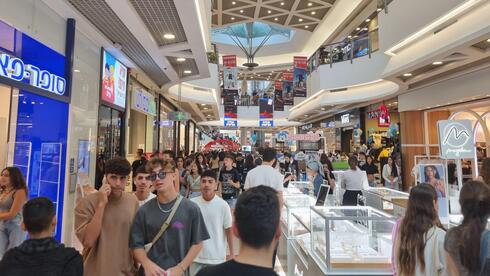
Azrieli mall shoppers
(Peter Klener)
The report also casts a revealing light on exports, a central driver of the economy. Israel’s exports of services to the United States, which account for the majority of its export sector, are projected to remain unaffected by Trump’s tariffs, including research and development services. In other words, the largest and most important share of Israeli exports to the U.S. – high-tech, software, and R&D – is expected to continue growing (5% in 2025 and 7.7% in 2026), even under the 2025-26 tariff regime.
Goods exports also receive a relatively positive assessment: the overall “effective” tariff Israel will face stands at 10.2%, significantly lower than the expected 15%, because the structure of Israeli exports lies outside the main areas of impact. The report’s third major point is that the “boom” in Israel’s defense and cyber industries is expected to benefit the economy.
However, risks remain. A renewed escalation of the conflict could derail the recovery, while irresponsible fiscal policy could undermine the OECD’s positive projections. The report highlights three main forces expected to shape the economy in 2026-27: business-sector-led growth; smart, not blind, fiscal restraint; and expansionary but cautious monetary policy. It notes that the ceasefire, falling risk premiums, rising consumer confidence, and a stronger shekel are helping exports recover, allowing private consumption and investment to lead economic momentum. As a result, the OECD predicts unemployment will fall from 3% this year to 2.8% in each of the next two years, historic lows.
Inflation is also projected to return to target. While inflation this year stands at 3.1%, it is expected to fall to 2.4% next year, within the 1%-3% range, and then stabilize at 2% in 2027. In other words, OECD economists express strong confidence in the Bank of Israel and its policy framework.
This process is expected to be supported by improved supply conditions (labor, aviation capacity, and more), a stronger shekel, and budget reductions that return the deficit and public debt to reasonable levels. The OECD expects interest rates to continue falling but remain relatively high, 3.75% in 2026, rather than returning to the near-zero levels of the pre-pandemic era, a shift the Governor has described as a “new regime.”
On fiscal policy, the OECD places particular emphasis. It forecasts a deficit of 5.4% of GDP in 2025, above 5% for the third consecutive year, and recommends a gradual reduction. The deficit is expected to decline to 4.1% of GDP in 2026. In other words, the OECD does not believe the finance minister will meet his self-imposed target of 3.2%; instead, the final figure is likely to be about one percentage point higher, roughly NIS 21 billion above the ceiling. It is important to recall that the Finance Ministry and the Central Bureau of Statistics calculate the deficit differently, but the OECD considers only the CBS definition.
The OECD also stresses that reducing the deficit depends on ongoing security stability and continued economic recovery. It forecasts that the public-debt ratio has peaked: 68.3% of GDP this year, declining to 67.9% next year and 66.3% in 2027. This is a highly optimistic assessment, given uncertainties surrounding the 2026 budget, especially the future of the defense budget and Finance Minister Smotrich’s tax-cut plans.
In this context, the OECD outlines several recommendations, many of which have already been disregarded. First, it advises avoiding broad, across-the-board cuts and instead focusing on targeted reductions, as broad cuts are often ineffective and can harm growth. Most notably, the OECD recommends cutting subsidies for yeshiva students, arguing that they discourage participation in the labor market.
Second, the OECD recommends increasing revenue from the least distortive taxes, including abolishing VAT exemptions. Smotrich has not only avoided eliminating these exemptions; he has expanded them for direct imports and doubled the exemption ceiling.
The OECD also recommends reinstating taxes on disposable cutlery and sugary drinks, policies that are unlikely to return due to ultra-Orthodox opposition and the finance minister’s political concessions. Additional recommendations include imposing congestion pricing in dense metropolitan areas (not included in the current Arrangements Law) and taxing unused land.
All of these measures contrast sharply with the government’s current approach. Instead of reallocating funds from low-productivity areas to high-return investments, such as education, infrastructure, transportation, innovation, and workforce integration, the government has so far avoided the “smart belt-tightening” the OECD emphasizes.