
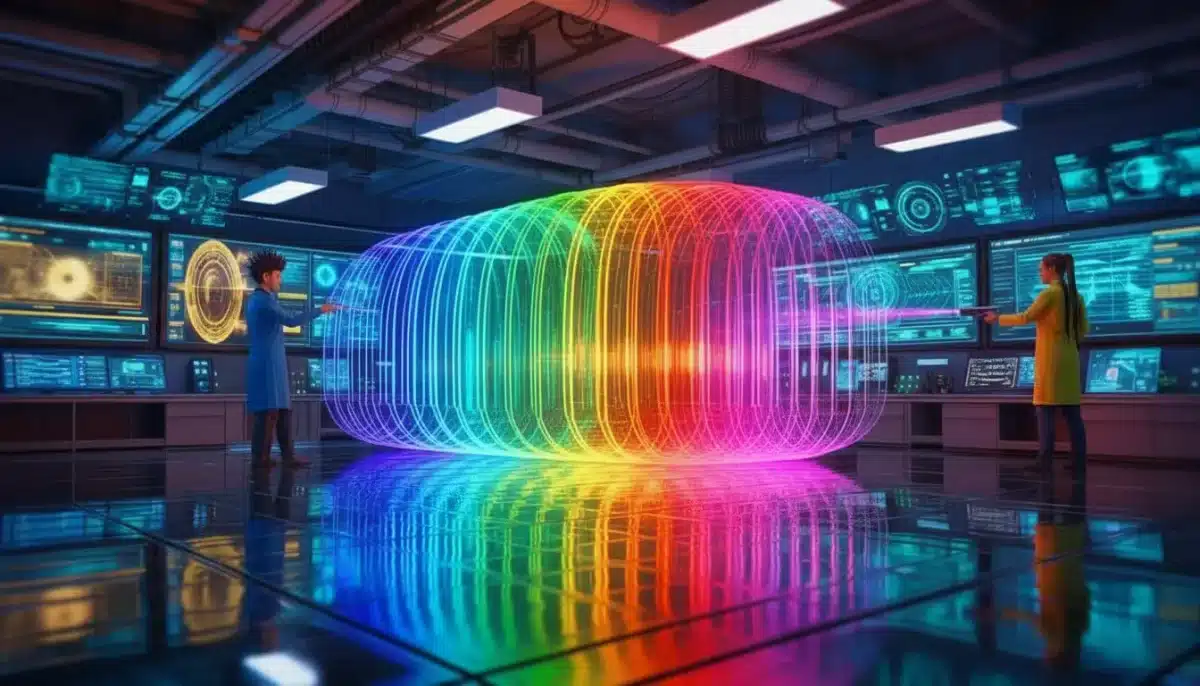
Buckle up—the rules of physics just got a wild rewrite. In an announcement that’s rattling the cages of science lovers everywhere, researchers at the CUNY Advanced Science Research Center have officially observed time reflection, a phenomenon so weird it was long thought to belong solely in sci-fi (or the overly-ambitious scribbles of theoretical physicists).
Understanding Time Reflection: Not Your Everyday Mirror
Let’s start with something a little more relatable: spatial reflection. You see it every day—a ball bounces off a wall, a shout echoes back at you, you make funny faces in the bathroom mirror. In all these cases, things bounce back in space, but time marches relentlessly forward. Light or sound waves hit a surface, bounce, and return to you. Simple, right? That’s spatial reflection, and it’s about as everyday as coffee spills on Monday morning.
But time reflection? That’s a whole different playground. Instead of bouncing in space, an electromagnetic wave’s journey through time is what gets flipped. Picture a wave zipping through a material—when suddenly, the material’s properties change everywhere at once, like someone flipping a switch in a magic show. This drastic shift actually makes the wave go backward in time! Think of what happens when you hit the rewind button on a video: motion reverses, sound twists, and everything plays out in reverse. That’s what scientists are now seeing with electromagnetic waves, and until now, it had never been caught in the act.
As if that wasn’t strange enough, this time-reversal also changes the frequency of the wave. Imagine red light morphing into blue, or a deep voice recording suddenly squeaking at the speed of a chipmunk. It’s like rewinding a cassette tape at double speed—except this is happening to the fundamental building blocks of nature.
From Theory to Reality: Overcoming Physics’ Ultimate Challenge
Time reflection has been a theoretical curiosity since the 1970s, but seeing it in the lab? That’s been a prescription for headaches and heartbreak, thanks to the tough technical demands. You’d need to change a material’s properties extremely quickly and uniformly—across the entire material—to interact with a zippy electromagnetic wave. We’re talking split-second synchronization and a lot of clever engineering.
The heroes at CUNY ASRC cracked it with a fresh take: they used a metallic strip rigged with ultra-fast electronic switches and capacitors that can dump or gulp energy almost instantly. With these synchronized in perfect harmony, they doubled the strip’s electrical impedance nearly in the blink of an eye, cooking up the exact conditions needed for time reflection.
In their experiments, a portion of the electromagnetic wave reflected not in space, but in time. For the first time ever, instruments picked up a reversed signal—a time-inverted copy of the original wave. After decades of theory and heaps of skepticism, this is the first experimental proof of time reflection.
Implications: Tech, Metamaterials, and the Edge of What’s Possible
This isn’t just exciting for folks who geek out over quantum mechanics. Time reflection could change technology as we know it. By skillfully manipulating electromagnetic waves, scientists foresee huge leaps in wireless communication, radar, and imaging. Picture signals flying faster and with greater efficiency, and security features so robust eavesdropping becomes nearly impossible.
Metamaterials—those engineered marvels that can twist and turn waves in ways nature never dreamed—also stand to benefit. With time reflection tech, we’re talking about the possibility of devices like cloaks of invisibility or sensors so sensitive they’d make your smartphone’s detectors look like ancient relics. The surface has barely been scratched, and the future looks dazzlingly bright (and possibly blue-shifted).
On a deeper level, this discovery throws open new doors for understanding our universe. It could reshape our grasp of the symmetry between time and space, and ripple across fields such as thermodynamics and quantum mechanics. With every discovery, scientists tiptoe further into the mysteries that govern reality itself.
The Road Ahead: Secure Communication and Scientific Frontiers
Just imagine:
Communication systems fortified by time-reversed signals, nearly impossible to snoop on.
Radar systems of the future boasting the kind of accuracy and range once reserved for superhero comics, able to spot objects clearly at distances that are currently unthinkable.
Metamaterials unlocking new frontiers in healthcare, defense, and telecommunications.
All this is no longer the stuff of fantasy. As researchers continue to master the art of time reflection, we might just find ourselves at the dawn of a scientific and technological revolution—one with more plot twists than your favorite streaming drama.
In the end, this journey is proof that the wildest ideas can lead to earth-shattering breakthroughs. Who knows? Maybe next time you hit “rewind” on your playlist, you’ll be reminded of the moment we learned time could do a little bouncing of its own.