
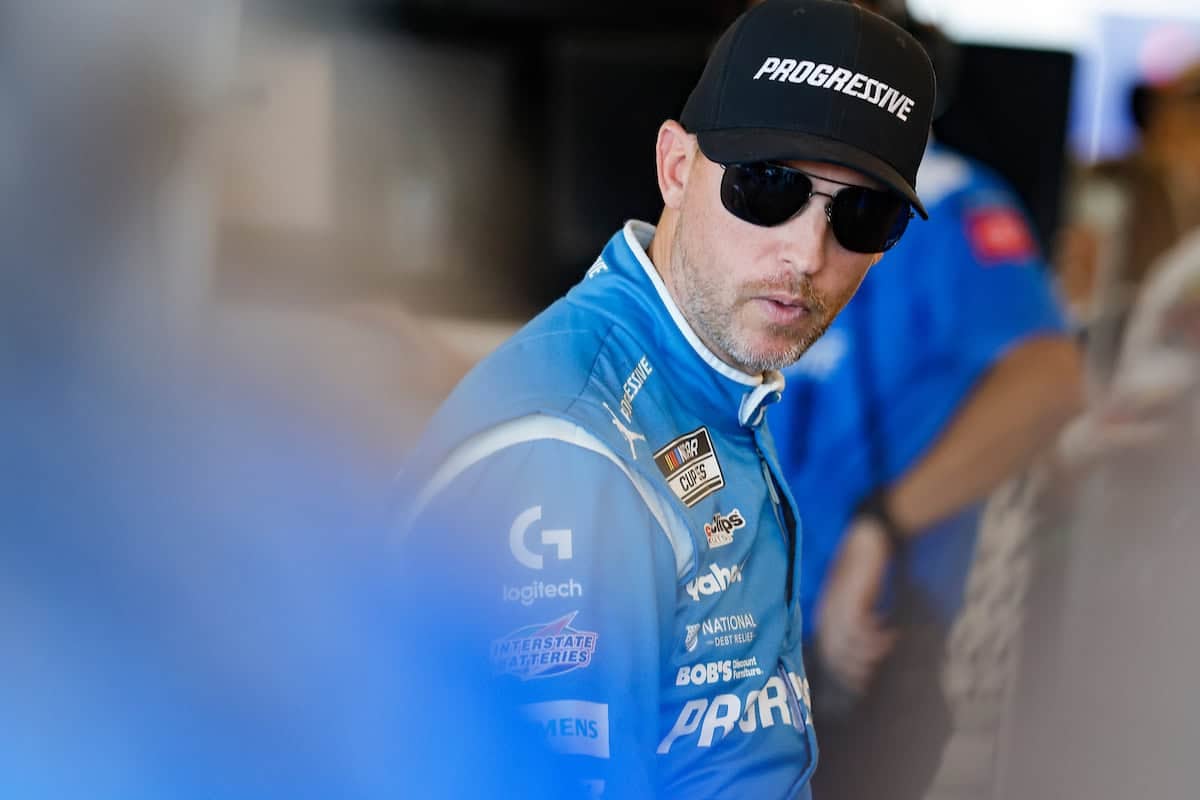
CHARLOTTE, N.C. — Denny Hamlin, plaintiff of the NASCAR vs. 23XI Racing/Front Row Motorsports trial, stepped down to join the rest of the courtroom in day two of the trial’s lunch break on Tuesday, Dec. 2.
The 23XI Racing co-owner had just finished a two-and-a-half-hour cross-examination session with NASCAR antitrust attorney Lawrence Buterman and was followed by NASCAR Chief Strategy Officer Scott Prime. They were the only two witnesses examined by the court on Tuesday.
In what felt like a longer edition of Hamlin’s podcast Actions Detrimental, the NASCAR racing veteran spoke at length and candidly on several occasions during the questioning. It was likely the highlight of the trial on its second day.
The trial, which began on Dec. 1, has become the focus of the stock-car racing world. Hamlin and fellow 23XI owner Michael Jordan were joined by FRM in filing a lawsuit against NASCAR in late 2024 after both teams did not sign the sanctioning body’s charter agreements that guarantee them a position in the NASCAR Cup Series field.
Since then, both sides have yet to reach a settlement and have met in the west district court of North Carolina.
In the morning, Hamlin was questioned by his own attorneys continuing where they left off the previous day, during which, Hamlin made claims against the current NASCAR business model, stating modern teams must receive help from outside sources to “make them whole.”
NASCAR Vs. 23XI/FRM Lawsuit Day 1 Recap
Afterward, the Virginian recalled meetings with Jim France and NASCAR leadership in which he made several attempts at pleading with leadership to assist in keeping Cup teams monetarily afloat.
When asked if why he refused to sign the charter agreement and decided to file the lawsuit against NASCAR by his attorney, he stated, “I think it was the only decision,” and “because it is time for a change.”
Shortly after in the late morning, NASCAR’s Buterman began his cross-examination of Hamlin. Buterman quickly cited a podcast appearance Hamlin made on Kenny Wallace‘s show in 2024 where he spoke positively about NASCAR’s Next Gen car. Buterman pointed out that his statements contradicted his voice of displeasure at the cost of the car.
Based on multiple reports here is the portion of @Kenny_Wallace‘s interview with @dennyhamlin that was brought up in cross examination at today’s trial.
It originally aired 7/10/2024.
For broader context they discuss the charter negotiations for 16 minutes here:… pic.twitter.com/gsZ5bun5KQ
— The Kenny Wallace Show (@KWallaceShow) December 2, 2025
However, Hamlin responded to this by saying, “Anytime I say anything negative, I get a phone call from NASCAR,” and spoke at length that he is constantly forced to say “talking points” by NASCAR. Buterman responded asking if Hamlin is saying that he can’t be trusted publicly.
Hamlin dismissed the question: “That’s nonsense.”
Later, Buterman read a statement from Hamlin that stated he had never entered the sport to make a profit and that 23XI could still reach its goals despite the “ridiculous” terms set by NASCAR CEO Jim France.
One of the NASCAR’s strongest arguments was the evidence presentation of emails between 23XI co-owner Curtis Polk and Jordan’s financial team, stating that Polk didn’t agree that Hamlin tended to spend too much money at times. Supporting this claim was the creation of Airspeed, 23XI’s $35 million headquarters constructed in 2024 and the multimillion-dollar purchase of a third Cup charter in the same year.
Hamlin’s rebuttal was that Polk and other leaders of the team are supposed to be critical of his spending habits.
Among the few topics Hamlin spoke long about was the new driver incentive program — put into place to promote drivers participating in more media promotion — NASCAR implemented in 2025. The cause of concern for Hamlin was that the incentive program took away the most valuable part of the race team regarding future promotion. In Hamlin’s argument to Buterman, he stated that drivers have no incentive to do promotion with race teams anymore since they are being paid by NASCAR. In return, teams no longer receive the revenue from those driver promotions, only NASCAR does.
No, Jeffrey Kessler, IndyCar Owners Didn’t Get a Better Deal
One of the more shocking revelations of the day was Hamlin’s mention that a number of teams did research into creating a new racing league. However, this effort failed as “there was no access to racetracks,” which would be further discussed by his lawyer Jeffrey Kessler during examination of Prime.
Before the lunch break, Buterman asked Hamlin several questions regarding the signing of the charter agreement and revealed that the draft of the agreement was sent days, not hours, before the signing deadline. The defendant also stated that NASCAR addressed seven of the eight concerns discussed by 23XI and other race teams. When asked why he still didn’t sign the agreement after the addressing, Hamlin said that addressing something is not the same as fixing it.
When the jury returned after lunch shortly after before 2 p.m., NASCAR Chief Strategy Officer Prime was sitting behind the stand. Kessler asked him several questions to end the day. For most of the afternoon, Prime answered the questions conservatively, not answering several questions and claiming ignorance on several others.
Bringing the Heat: Reacting to Day 2 of the NASCAR vs. 23XI/FRM Trial
The first key pieces of evidence introduced by Kessler were several emails from Prime to NASCAR leaders like Steve O’Donnell regarding several contingency plans that NASCAR had in place in the event that race teams broke away from NASCAR to start their own series.
One of these was the plan for NASCAR to partner with Speedway Motorsports Inc. tracks to agree they could only host NASCAR stock car races and no other stock car racing series. This agreement was later used when the SMI had intention of hosting Camping World SRX Series races at its facilities but were not able because of this agreement, which was called the “sanction provision.”
Another contingency plan was the preparation to sell the charters to somebody else if the teams didn’t accept the terms of the 2025 charter agreement. Kessler also asked Prime to confirm NASCAR’s ability to dissolve the charters entirely three times before the judge finally asked him to answer the question. Prime confirmed.
Further examination of these emails showed that NASCAR were speaking with team leaders from Hendrick Motorsports, Joe Gibbs Racing, RFK Racing and 23XI regarding the revenue sharing of other sports and motorsports such as Formula 1. They found that while F1 pays its 10 teams 50% of the revenue it receives, NASCAR pays its teams only 30%. Prime himself sympathized with the teams in his emails to O’Donnell by stating, “Between us, [the NASCAR teams] have a point on the industry revenue splits.”
Regarding SRX, communications between Prime and NASCAR leadership displayed concern of the potential competition against the new stock car series. Prime drafted risks with one of the most prominent being the potential of team owners and drivers following the new series in also making its own stock car racing body.
The mitigation drafted was that NASCAR was protected by the new charter agreement in what was called the “Good Will Provision,” stating that team owners were prevented from participating in a new stock car series. Shortly after, the court was dismissed for the day before 5 p.m. ET.
The trial will resume on Wednesday, Dec. 3. Prime is expected to return to the stand for questions from NASCAR’s defense team.

NASCAR At Track Coordinator at Frontstretch
Dalton Hopkins began writing for Frontstretch in April 2021. Currently, he is the lead writer for the weekly Thinkin’ Out Loud column, co-host of the Frontstretch Happy Hour podcast, and one of our lead reporters. Beforehand, he wrote for IMSA shortly after graduating from Embry-Riddle Aeronautical University in 2019. Simultaneously, he also serves as a Captain in the US Army.
Follow Dalton on Twitter @PitLaneCPT