
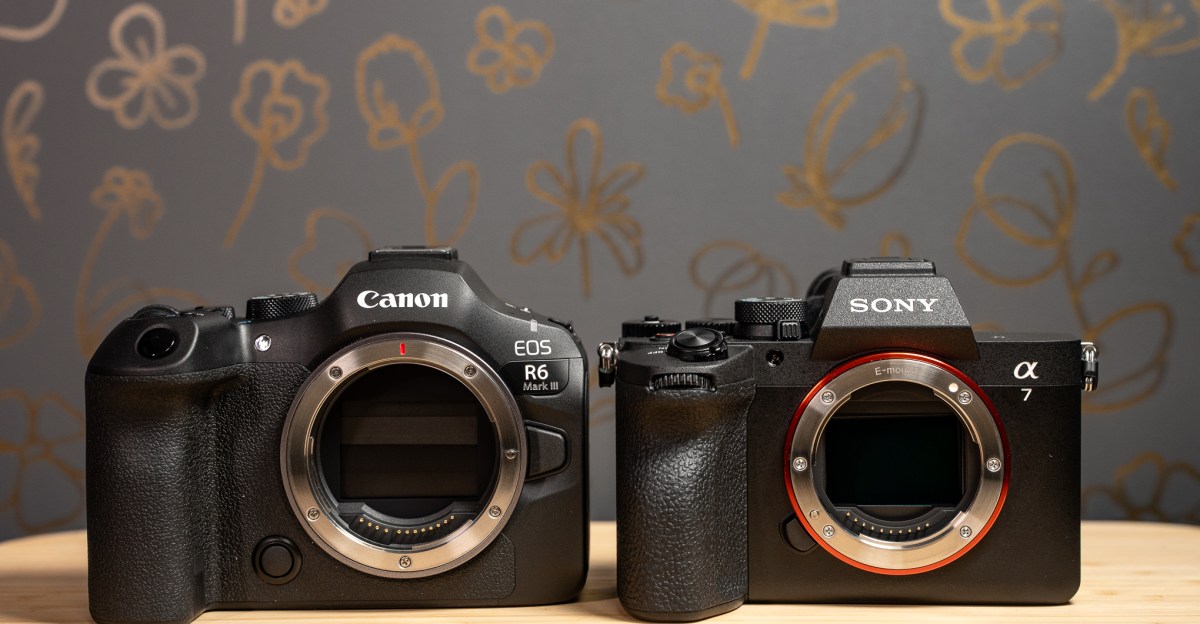
I was stoked to learn that the recently announced Sony A7 V had improved ergonomics. Just like I was happy to first hear that Sony’s flagship A9 III and A1 II cameras got new ergonomic grip designs before that. I actually bought an A9 III to replace my aging A9 II for my wedding photography. But Sony’s ergonomic improvements have disappointed me time and time again, both in my personal cameras and ones I’ve tested for The Verge.
The new designs seemed good at first, with the A9 III and A1 II featuring slightly taller grips with better rounded contours, but they just aren’t comfy enough for pro cameras designed to be used for hours on end. And the new A7 V, the camera designed to appeal to a wider audience, is the weakest of all the new ergonomic designs. Its grip isn’t as tall or contoured as Sony’s pro flagships, despite Sony being known for putting many of the same exact features and designs from its highest-end cameras into much more affordable models.
1/6Left: the original Sony A1 with the old grip design. Middle: The A9 III with revised and slightly better design. Right: The A7 V and its slightly revised but barely improved grip.
I’ve been railing against this niche nuisance for years now. And I give Sony credit for at least starting to pay attention to it in 2023 with the A9 III, but it just isn’t doing enough. My A9 III feels slightly better to use than my original A1 that I pair it with for weddings, but no matter which I use it’s almost a guarantee that after a 10-hour wedding the middle joint of my middle finger is going to hurt. As I’ve written about before, I nicknamed this the “Sony knuckle” with my fellow wedding photographers who also shoot with high-end Alphas and go home with at least a tiny bit of pain and discomfort after a long day (compounded further for anyone working a double, triple, or the dreaded quad over a weekend).
I know we choose to use heavier lenses like fast primes and constant-aperture zooms, and that not everyone is handling their cameras for marathon sessions. But what blows me away is picking up or testing cameras from other brands and feeling like I’m gripping a comfy pillow by comparison. Cameras like the Nikon Z8 and Canon R6 Mark III — which range from only slightly bigger to close in size to Sony’s Alpha models — afford even taller grips, softer contours, and better materials that feel less stressful on your hand.

That dark spot on my knuckle you see after I squeezed the A7 V? That’s the Sony knuckle.
I don’t have particularly large hands or anything, either — any love I hold for the original Xbox’s Duke controller is purely from rose-tinted nostalgia. So it’s not like I’m asking Sony to make a camera catered specifically to Ken Griffey Jr. in “Homer at the Bat.” I just want something that feels like it was designed for humans when I pick it up.
How you use a camera and how it feels are incredibly important and should not be overlooked. It’s easier to give passes to much more compact models like the Sony A7C II and A7C R or the Fujifilms and Leicas of the world. I can forgive my pinky finger hanging off the bottom of the grip in smaller, street-style everyday carry cameras. And the flat front of my Leica Q2 or the various Fujifilm X100 models out there allow them to be about as small as possible — with, of course, the easy addition of a grip if you choose. But once you get to a $2,900 A7 V or $7,000 A1 II, meant for all manner of pro work, you shouldn’t have to worry about an inevitable finger or hand cramp being built into the design.
I, and I think many others, still choose to use Sony Alpha cameras despite all this because we’re too obsessed with how good they are at continuous tracking autofocus (that, and we’re in too deep on lenses). Other brands have mostly caught up with great tracking autofocus of their own, but in my testing they’re just never quite as good or reliable. It’s changed the ways I use my cameras, and allows me to reliably nail shots I never would have dreamed of when I started assisting wedding photographers back in college.
1/4Pinkies be damned on an A7 V, or just about any other Sony Alpha.
Sony has made some strides here, and I appreciate the ergonomic changes it has made in recent cameras, to a degree. But the company and its designers are still being stubborn about the size of its cameras. When the original A7 and A7 R cameras came out in 2013, mirrorless was in its infancy and just about putting big sensors into very small interchangeable system cameras. The first-gen A7 duo were tiny compared to today’s models, and that also meant small batteries, making them a nonstarter in professional environments. Since then, mirrorless cameras have grown, literally, into something much bigger.
There’s still a place for more compact designs, but modern cameras are technical marvels that are pretty much excellent across the board. You hear “You can’t buy a bad camera these days” echoed all around the photography community. But the cameras should feel excellent to use too.
Photography by Antonio G. Di Benedetto
Follow topics and authors from this story to see more like this in your personalized homepage feed and to receive email updates.Antonio G. Di BenedettoAnalysisCloseAnalysis
Posts from this topic will be added to your daily email digest and your homepage feed.
FollowFollow
CamerasCloseCameras
Posts from this topic will be added to your daily email digest and your homepage feed.
FollowFollow
GadgetsCloseGadgets
Posts from this topic will be added to your daily email digest and your homepage feed.
FollowFollow
ReportCloseReport
Posts from this topic will be added to your daily email digest and your homepage feed.
FollowFollow
SonyCloseSony
Posts from this topic will be added to your daily email digest and your homepage feed.
FollowFollow
TechCloseTech
Posts from this topic will be added to your daily email digest and your homepage feed.
FollowFollow