
CHARLOTTE, N.C. — NASCAR strategy chief Scott Prime continued to try to fend off accusations of his company’s alleged illegal monopoly power abuses as testimony continued Wednesday in the antitrust lawsuit against NASCAR.
Prime, a NASCAR executive vice president, was on the stand for a second day as Jeffrey Kessler — the attorney representing 23XI Racing team owners Michael Jordan and Denny Hamlin and Front Row Motorsports owner Bob Jenkins — used Prime’s emails and corporate communications to paint a picture of what he said were NASCAR’s monopolistic abuses.
Prime originally worked for consulting firm McKinsey, during which he prepared a 2014 report expressing “concerns over the longevity of the sport” if NASCAR did not take steps to improve the health of its race teams.
One such step in his report included taxi-like “medallions,” which ultimately came to fruition in NASCAR’s “charter system” — franchise-like licenses with expiration dates that guarantee certain financial and other benefits. That system was most recently renegotiated in 2024, and the resulting deal — which 13 of NASCAR’s 15 charter-holding race teams signed, but 23XI and Front Row did not — is at the heart of the sides’ legal battle.
Kessler noted how despite the charter system’s existence, teams are hamstrung by a weak negotiating position and stuck in unfavorable terms when it comes to renewing charters because they have nowhere else to go.
Kessler cited a 2019 letter from one team that asked for a better business model with more sustainable revenues to aid in teams’ viability, which Prime acknowledged resulted in no changes to new charter agreements in 2020.
“We presented the offer and they accepted it,” Prime said.
“You’re a monopoly!” Kessler said. “There’s no place else to compete. There was no place else for them to go, correct?”
“NASCAR is the premier stock car racing series today, yes,” Prime said.
During the 2024 charter negotiations, one email from Prime to other executives relayed four demands from the race teams he found “quite disappointing” because the teams said they would be “forced to recommit our energy to exploring all our options” if NASCAR did not agree.
That heightened concerns of a breakaway stock car series formed by the race teams, to which Prime laid out various options of how NASCAR could respond — including reducing the number of charters and offering them on a “first come, first served” basis to create a panic among the teams, updating the charter language to NASCAR’s liking and then offering a take-it-or-leave-it deadline to sign, dissolving the charter system altogether, or taking all of the cars in house and eliminating the need for race teams.
“You accurately reflected our options,” then-NASCAR president Steve Phelps responded to Prime in an email. “They are playing with fire. Lots of options, but all have the same theme: Pick a date and they can sign or lose their charters. It is that simple.”
“Only a monopolist could say this,” Kessler claimed. “Only a monopolist has the power to say, ‘Take my offer and if you don’t take it, you will no longer be in this business, and someone else will take your place.’”
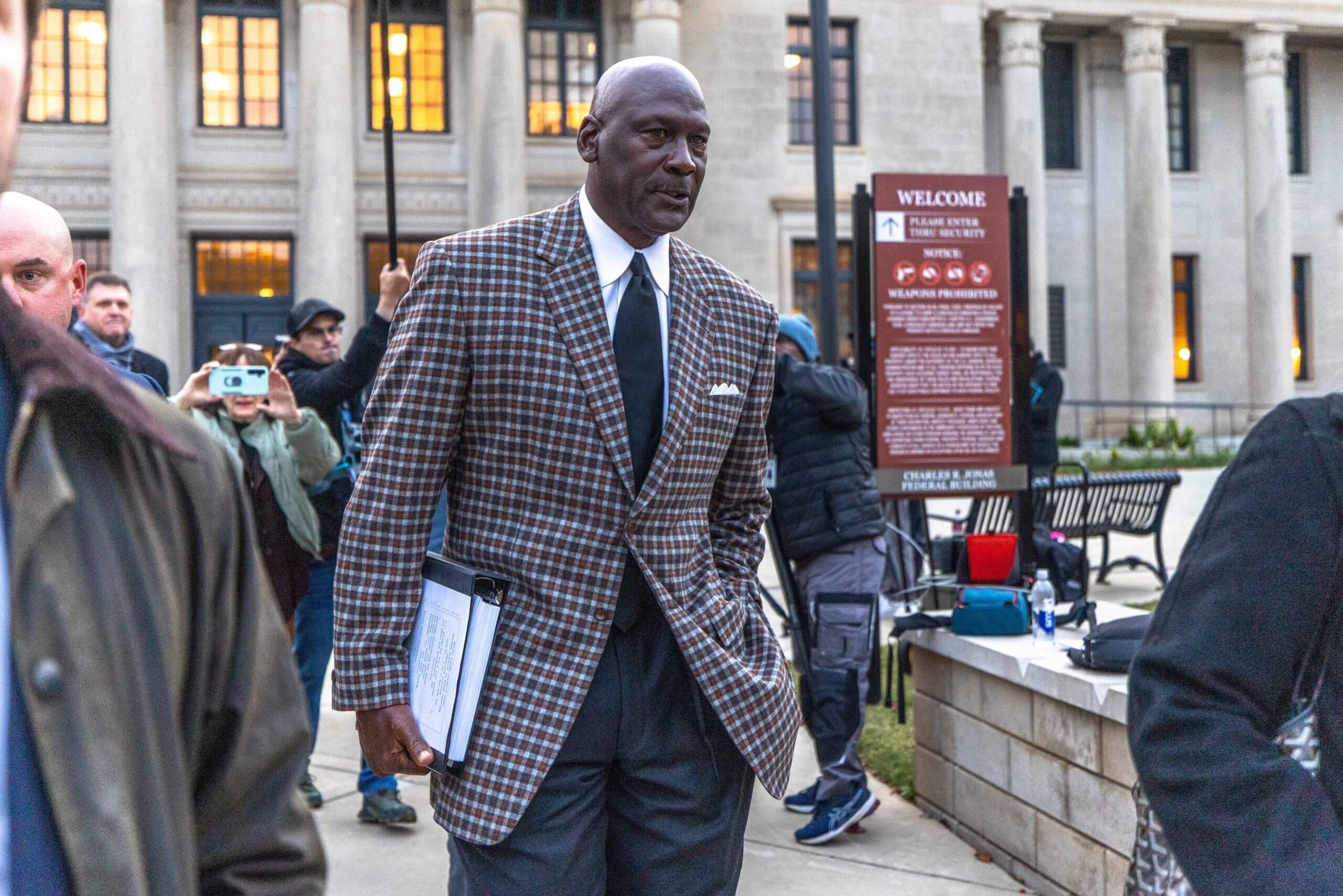
Michael Jordan, NBA legend and one of 23XI Racing’s co-owners, arriving at the courthouse on Monday. (Grant Baldwin / Getty Images)
Ultimately, NASCAR did present a take-it-or-leave-it offer to teams on Sept. 6, 2024 — an option Prime had described as “a gun to your head,” though he did not favor that.
“That’s what Jim wanted,” Kessler said, speaking of NASCAR chairman and CEO Jim France, also a defendant in the lawsuit.
“I don’t know what he wanted,” Prime replied.
Prime was portrayed as a moderate who was trying hard to strike a fair deal with teams. It was NASCAR’s board of directors, headed by France, who appeared to be pushing back.
“No bueno with Jim on charters,” Prime wrote via text after one meeting. “Can say (then-COO Steve O’Donnell) and I put our best foot forward, but it was a brick wall.”
“I’m sorry to hear this,” Phelps responded. “Super disappointing.”
Inside the courtroom, Hamlin leaned forward and looked across the aisle to gauge any reaction from the France family and their representatives, who sat expressionless.
Kessler also brought up NASCAR’s “goodwill provision” in its charter agreements, which says any owner of a race team — even a minority owner of only 10 percent — may not own a team nor invest in a competing stock car series.
Kessler called it a “non-compete” agreement and not a “goodwill” provision, which Prime disagreed with.
“It’s not goodwill, it’s anti-competitive will,” Kessler said. “Shouldn’t that be the name?”
NASCAR’s attorneys objected to that statement, and the judge sustained it.
But Kessler kept going, citing the goodwill provision’s clause that states even if a charter team leaves NASCAR or simply forfeits the charter, it still cannot join a competitor series for more than a year.
“And you think that’s goodwill?” Kessler said.
“I do,” Prime responded.
Kessler also cited Prime’s strategy document calling for intellectual property protections for NASCAR’s “Next Gen” model car after pondering a change from its former “Gen 6” car. Prime wrote that without IP protection, it “increases risk to NASCAR of the creation of a copycat series.”
As it turned out, NASCAR installed rulebook language that says teams cannot use their Next Gen car in any series but NASCAR. Prime said that was a standard IP practice, since NASCAR is the one that came up with the car and designed it.
“It was never an issue with the teams,” Prime said. “They understood the Next Gen car design and all the protections that went with it, yes.”
Later, under cross-examination, Prime said the teams’ demand of $20 million per car in revenue payouts would “put NASCAR bankrupt” and denied the earlier communications were a sign of ill intent on NASCAR’s part.
Prime said what he meant, during his earlier testimony Tuesday, by trying to “lock up” the tracks was simply signing them for the next season’s schedule, not excluding them from a competitor series, and said the idea of permanent charters did not make sense for anyone. Owning one of the 36 available charters allows a team entry into every Cup Series points race and a guaranteed floor of revenue.
“You can’t negotiate a deal and have the exact same deal forever,” Prime said. “You can’t write a contract today that’s going to last forever.”
Prime’s testimony was set to continue Wednesday afternoon, followed by Jenkins’.