
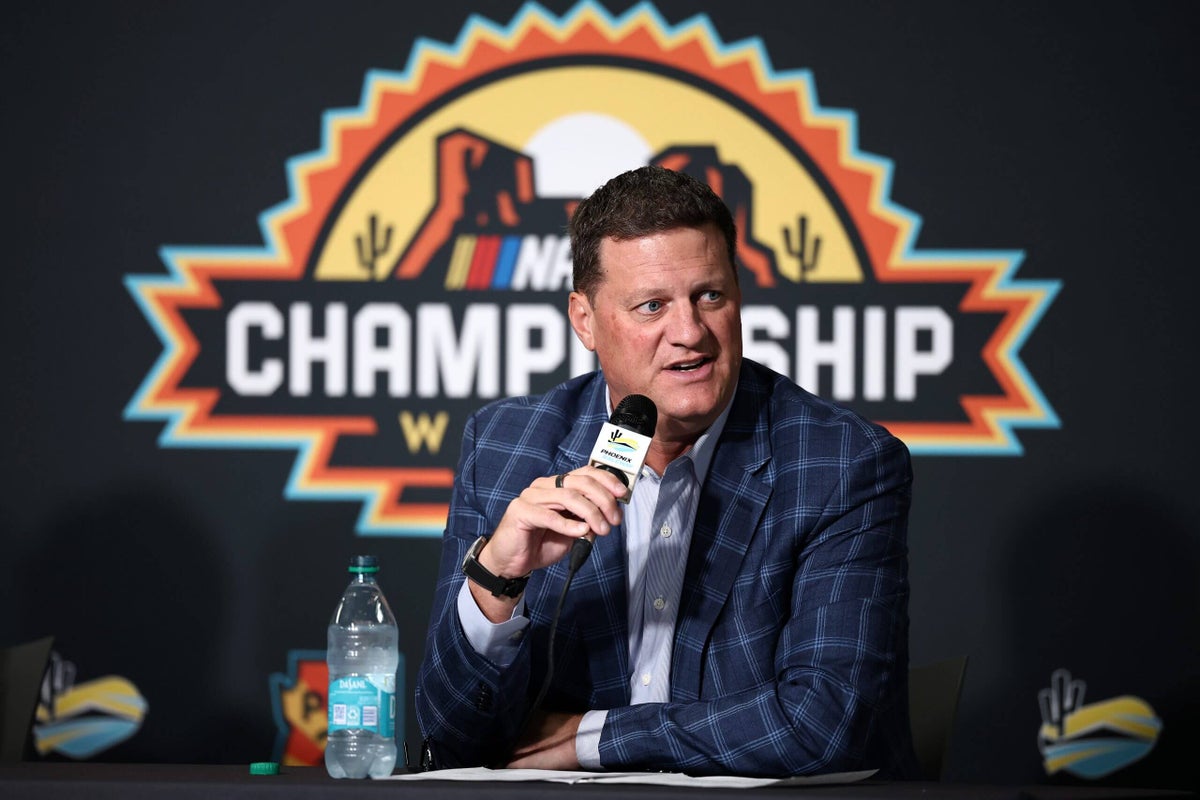
CHARLOTTE, N.C. — NASCAR president Steve O’Donnell took the stand Thursday as the antitrust lawsuit against the league, brought by Michael Jordan’s race team and one other, continued.
O’Donnell acknowledged he thought through a variety of options NASCAR’s car owners could pursue after a contentious meeting with teams, which came at the height of conversation around the first season of LIV Golf — the Saudi-funded circuit that signed several top players away from the PGA Tour — in 2022.
O’Donnell, NASCAR’s chief operating officer at the time, was worried teams could participate in a similar breakaway series of some kind, potentially building their own cars and partnering with rival track owner Speedway Motorsports, backed by a potential foreign investment.
In part to counter that move, O’Donnell presented various options to NASCAR’s board of directors — including chairman and CEO Jim France, a co-defendant in the lawsuit — about partnering with Speedway Motorsports on multiyear sanctioning agreements, which ultimately included exclusivity clauses preventing other stock car series from racing at those venues.
The exclusivity clauses also extended to independent tracks where NASCAR’s premier Cup Series races and, for the first time, also included the tracks for lower-tier national series (then known as the Xfinity Series and Truck Series).
O’Donnell did not disagree when Jeffrey Kessler, the attorney for the two race teams suing NASCAR, Jordan’s 23XI Racing and Front Row Motorsports, asked if NASCAR was a monopoly.
But O’Donnell said the teams could compete as “open,” non-charter teams if they did not like the proposed terms of NASCAR’s charter agreement — which grants each team licenses to compete in every race with guaranteed purse money and the latest terms of which are at the center of this dispute.
Kessler argued “open” teams make far less than charter teams, which made such a decision unsustainable financially.
The jury was shown O’Donnell’s notes from a March 2022 meeting with four team owner representatives, who told O’Donnell and other executives the business model was broken for race teams, which he agreed with.
O’Donnell also agreed that teams could go out of business if they lost a sponsor and said he understood there needed to be a model that was fair for everyone.
“We knew the industry was challenged,” he said.
Curtis Polk, 23XI’s co-owner, told O’Donnell of three goals in that meeting: Maximize television revenue from an upcoming media rights deal, create a more competitive landscape, and look at the cost model for teams, including a potential cost cap — a way of limiting spending to even the playing field. NASCAR agreed with those goals, O’Donnell indicated.
In that same meeting, Jeff Gordon — the four-time NASCAR champion who is now vice chairman of Hendrick Motorsports, one of the most powerful teams in the sport — asked NASCAR executive Ben Kennedy, who is a member of the France family: “Do you believe the family is open to a new model?”
“Yes,” Kennedy said.
Ultimately, the charter deal presented to teams in September 2024 did carve out more money from media deals, but the teams said France was unwilling to budge on other key points.
“As it turned out, Jim France was not open to a new model, right?” Kessler asked O’Donnell.
“No,” O’Donnell said.
O’Donnell is regarded as a NASCAR “lifer,” having started with the company in 1996, eventually ascending to president eight months ago.
Even before his most recent promotion, O’Donnell has been an instrumental figure within the company on both the business and competition sides. He was heavily involved in the most recent charter negotiations that sparked the antitrust lawsuit after 23XI and Front Row elected not to sign NASCAR’s take-it-or-leave-it offer to extend. NASCAR’s 13 other full-time teams signed the seven-year extension.
O’Donnell’s testimony is expected to be a key piece of a trial that carries the potential to reshape the sport, regardless of which party prevails. He was called to the witness stand by the suing teams as an “adverse witness.”
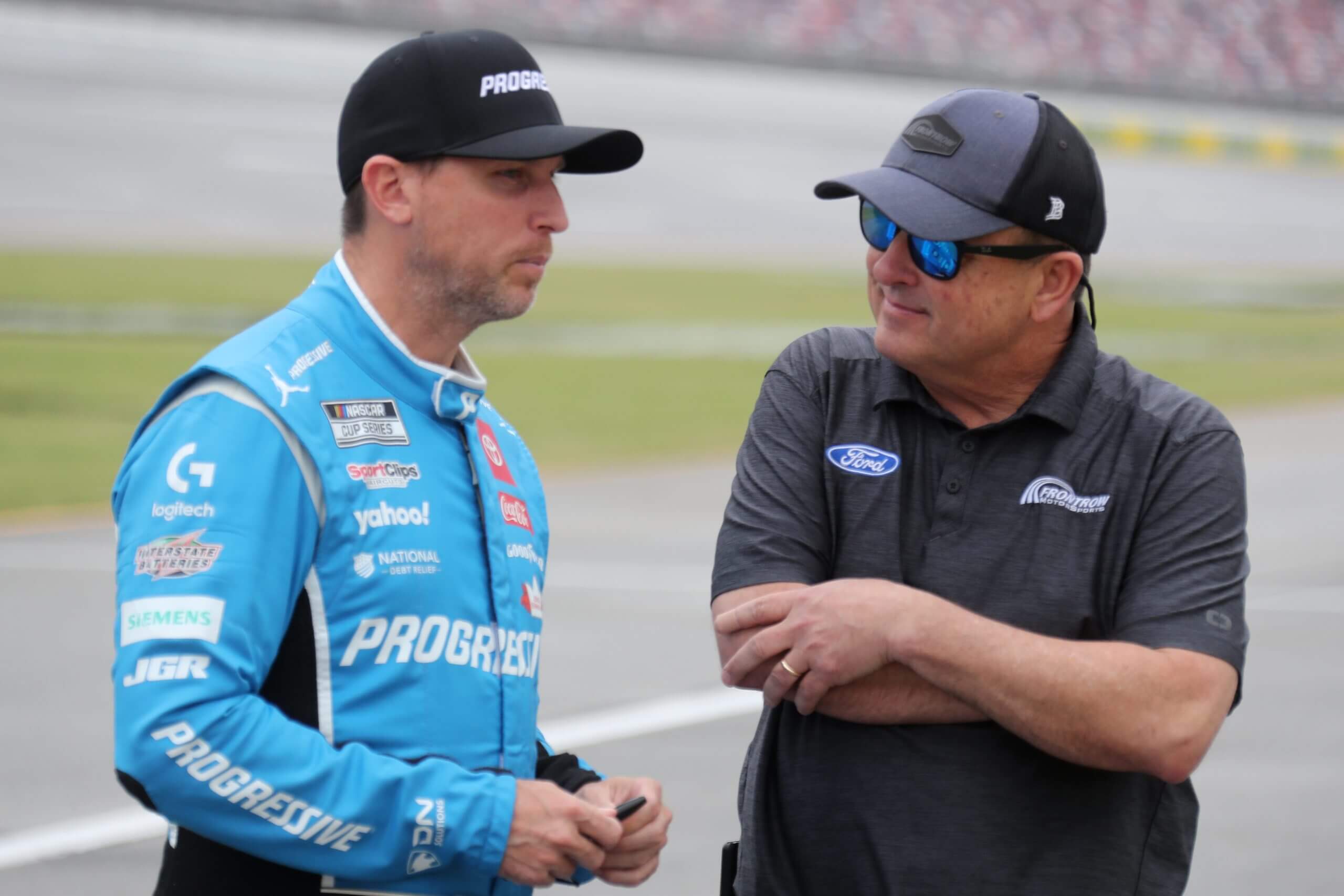
23XI Racing owner Denny Hamlin, left, with Front Row Motorsports owner Bob Jenkins, co-plaintiffs in the suit. (Jeff Robinson / Icon Sportswire via Getty Images)
Earlier Thursday, Front Row owner Bob Jenkins — a co-plaintiff in the case — wrapped up his testimony that began Wednesday.
NASCAR successfully got Jenkins to admit the $20 million cost per car figure used in this lawsuit — a figure that came from a survey of five NASCAR team owners representing a double-digit number of cars — did not apply to Front Row specifically.
Jenkins’ cost per car was closer to $14 million than $20 million in 2023, though Jenkins said his smaller team’s goal was to run as leanly as possible.
“The median cost is $20 million; the fact I can do it for less helps me reduce my costs,” Jenkins said.
NASCAR attorney Lawrence Buterman also showed how Jenkins had included some of his Truck Series team losses in the overall profit/loss chart shown to the jury, which he said was misleading for a trial about the Cup Series. Jenkins acknowledged it but said the Truck team’s impact on his bottom line was minimal.
Buterman also painted Jenkins’ complaints about NASCAR’s “take it or leave it” charter offer at 5 p.m. on a Friday night as hypocritical, noting Jenkins himself had used such a strategy with Denny Hamlin while the two pondered a possible merger between their teams in 2021.
“We can’t keep negotiating this forever,” Jenkins wrote in a text to Hamlin. “… That’s why we decided we had to have a deal by 5 p.m. (Friday).”
Jenkins said it was “another analogy that doesn’t work” because Hamlin had other options, unlike NASCAR pressuring teams into signing something as a monopolist, he said.
“The gun was not to his head,” Jenkins said.
Jenkins is the sole owner of Front Row, a three-car team that’s competed in the premier Cup Series since 2002. Front Row has held a minimum of two charters since NASCAR instituted the charter system beginning with the 2016 season.
Front Row has actively participated in the charter market, frequently buying, selling and leasing them. Jenkins testified Wednesday that Front Row has made $12.5 million in profit from charter transactions; most recently, Jenkins purchased a charter last year for $29.5 million from Stewart-Haas Racing.