
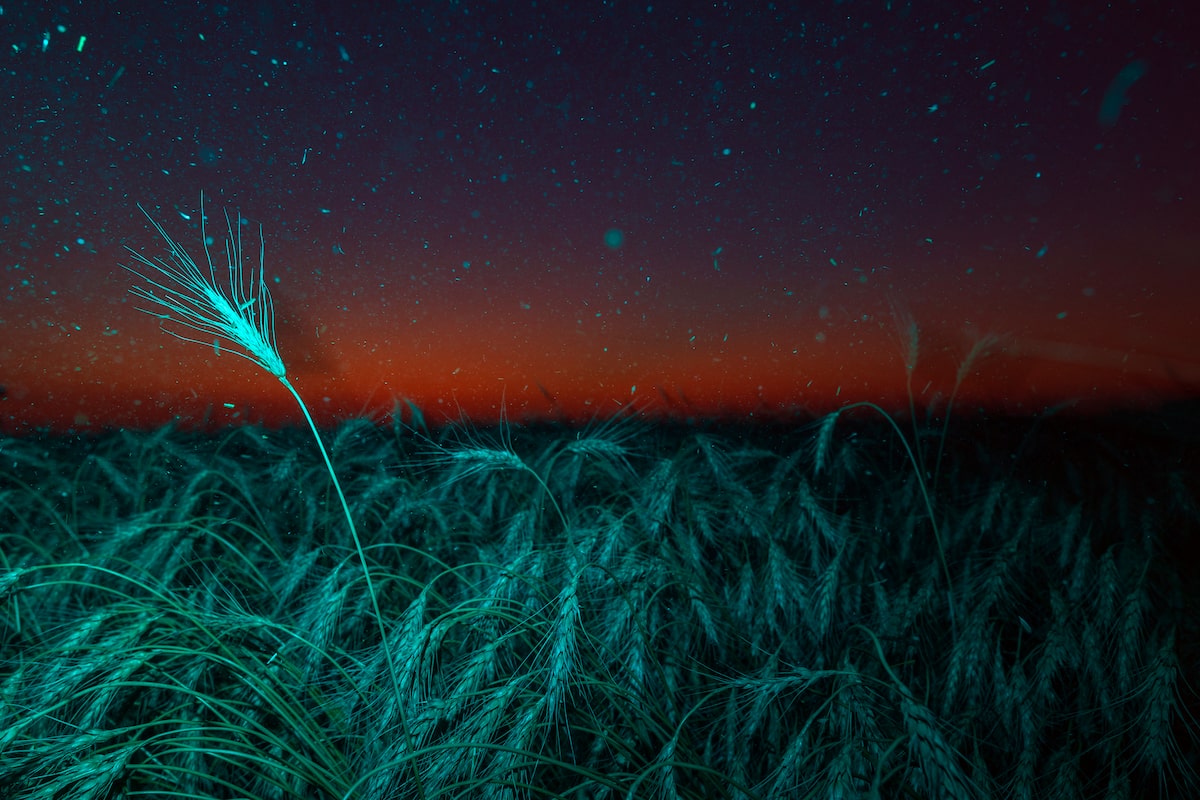
Underexposed is a year-long photojournalism project dedicated to shedding light on the unseen lives of Canadians in every province and territory. Learn more and share your thoughts with The Globe.
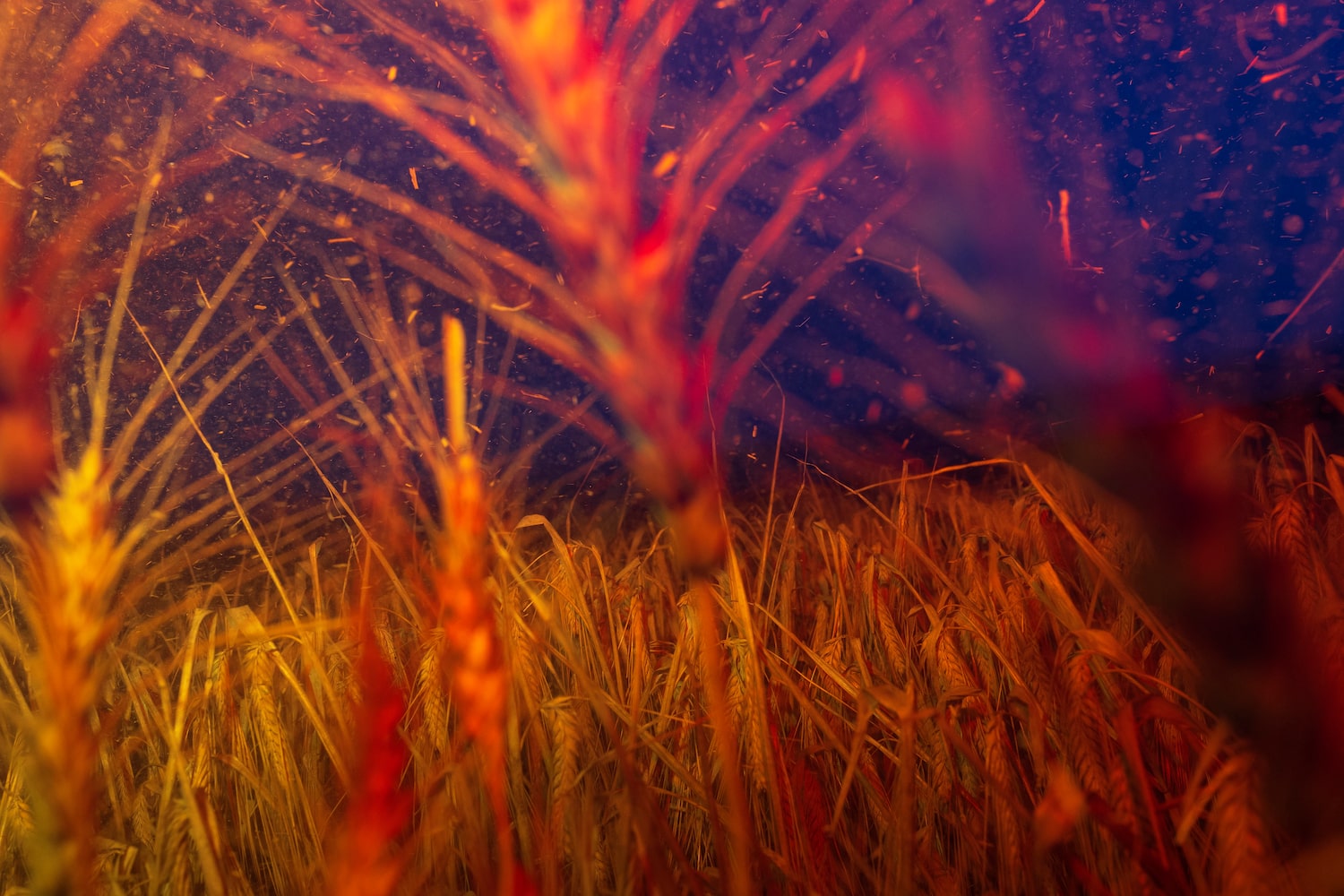
I’ve been photographing harvest for years, tripping over corn stalks in the twilight while following New Holland, John Deere, Fendt, Claas and other combines. Inviting myself to suppers in the field and being spoiled with late-night coffees and baked treats from the women of Deerboine Hutterite Colony.
As a rural photographer, I often see how farm life and the prairies are overlooked. Even though we rely heavily on farmers, it seems to me we misunderstand and even discard the fact of their physical and emotional labour.
Collectively, as a country, we are more removed from the ag sector than ever before. One hundred years ago the urban-rural divide was about 50-50. Agriculture counted for one in three jobs.
Now, it’s one in 61. About 75 per cent of Canadians live in urban centres.
I’m a wannabe rural kid. I grew up in the city, but I’ve spent close to two decades working to earn my street cred in the country. Grid-road cred, actually.
I’ve admired the beauty of rural life since reading the romanticized If You’re Not From The Prairie… by David Bouchard as a child and poring over Henry Ripplinger’s paintings.
Last year I was looking for a new way to tell the story of the harvest. For me, photography is about finding connection and I find that connection through getting as close as I can. Getting close, for this project, means being completely immersed in the chaff.
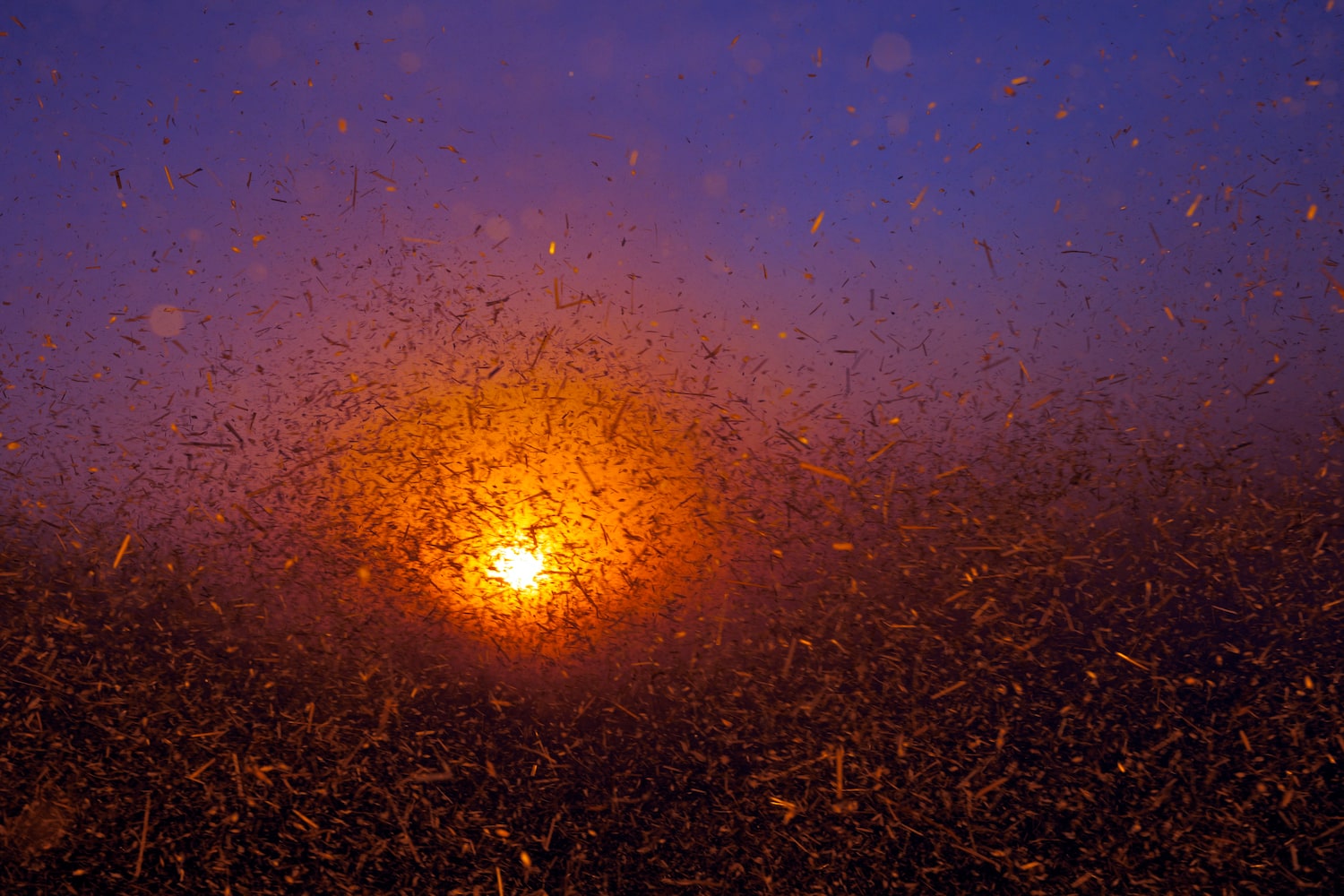
I’ve always found something beautiful about the mess of everything that comes out of the back of the combines.


Thankfully I know good farmers who are happy to turn a blind eye to my dumb ideas and equally eager to break the monotony of the harvest by laughing at me as I stumble and trip through their fields, trying my best not to die.
“If any guards or pieces of the header on the combine break off and go through the machine, they’ll go clean through you before you even feel it,” one farmer warned me.
At Deerboine Colony, though, it is all laughs as I sprint beside their New Hollands, trying to keep up in the dust storm. They move quickly at the colony. But they’ve got my back. “Be careful, there’s washed-out ditches in the field,” texts Arthur Wurtz from the cab of his combine. Sweat pours down my head, face, neck and back as I try to keep up with him. It washes some of the dust and chaff away but also causes more to stick to me.
When the combines cut low crops like beans, they pick up and spit out a lot of rocks. I’ve been hit by many, luckily nothing too big going too fast.
Harvest brings chaos for the small animals that find shelter in the tall crops. Coyotes sometimes follow combines to pick off mice and other prey scrambling through their newly exposed surroundings. Hawks hover over the stubble, dropping in for kills. The last sunlight of the day filters through the clouds of dust, creating beautiful backdrops.
My friends Cassandra and Stefanie Lepp, who farm in the Rivers/Rapid City area, drive a bit slower, allowing me to walk at a brisk pace in line with the back-end of their New Hollands. Cass and Stef’s dogs often ride shotgun in the cabs of the combines, their ears silhouetted by the sun as they warily watch me work. Sometimes they fall into deep sleep despite the incessant noise and bumpy jolts.
In September, the un-air-conditioned cabs are like saunas, forcing Stefanie to strip down one afternoon – an impressive feat, considering she has one broken arm in a brace.
This year the canola is kicking up so much dust that the machines become completely obscured in the fields. I disappear into the eye of the storm to make photos, vanishing save for the pop of a flash in the darkness that alerts Cass and Stef to my whereabouts.
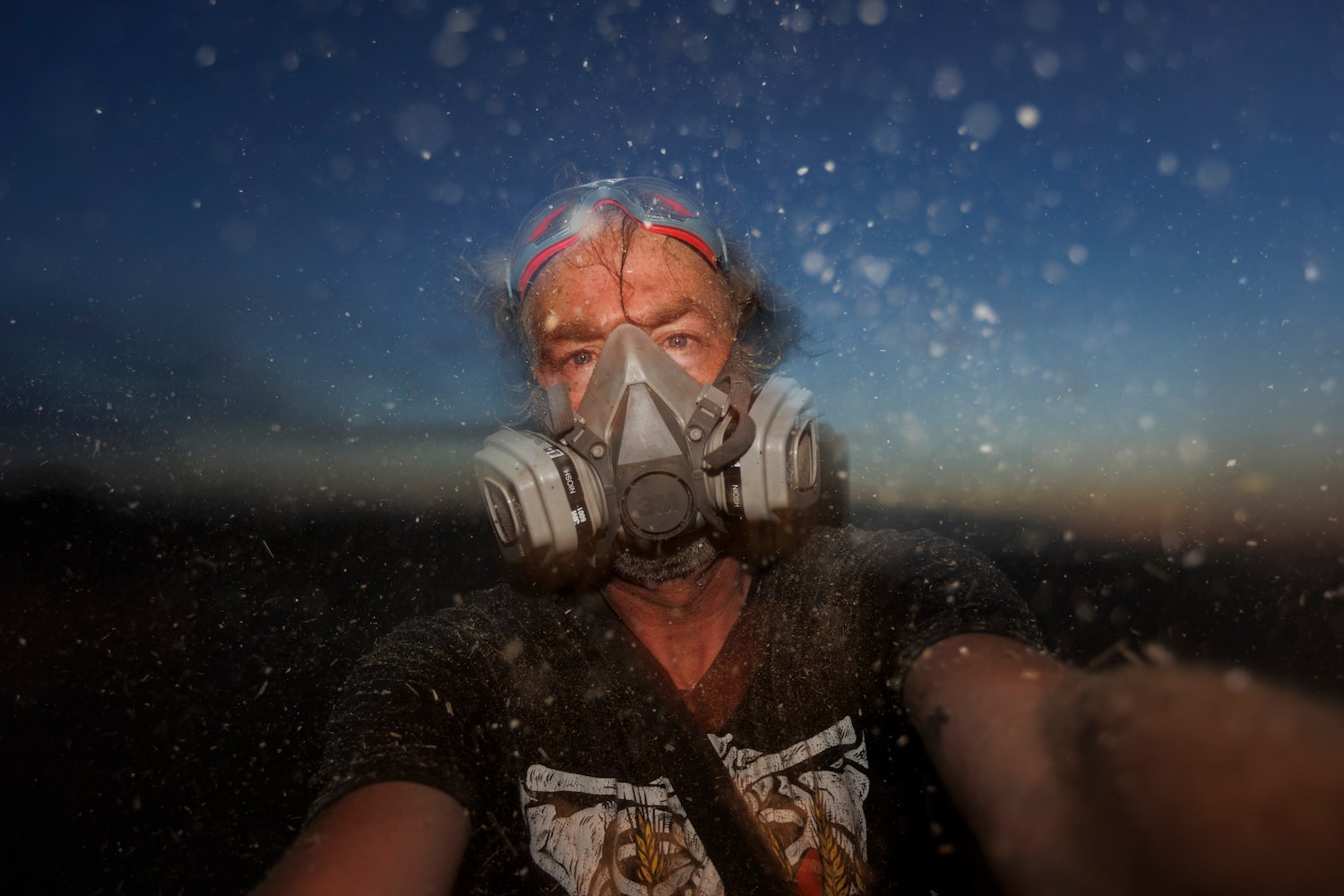
Every crop has its drawbacks. By far, canola is my least favourite. The chaff sticks like glue on my skin and gets in my lungs. It leaves me with a harvest hangover for days. My eyes remain red and irritated and I usually can’t focus for a day. Everything is a foggy blur.
Most farmers I know will tell you barley is the worst to deal with, because of how itchy it can be. I actually don’t mind it.
Corn causes mayhem as the cleaned cobs are flung out the back of the combine, pelting me continuously, even if I try to stay out of their trajectory.
Dust from pulverized fuzzy soybean pods fills my eyes, making it hard to see.
Wheat is probably the easiest to work with. It’s drier, so it doesn’t stick like glue, and the chaff contains none of the rocks and soil you might get with a crop lower to the ground.
I bring a four-litre jug of water and a complete change of clothes for when I’m done a session in the field. Right at the side of the road, or wherever I’ve parked, I start by pouring the contents of the jug over my head and washing away as much of the chaff as I can from my eyes and face. I just need the clarity to be able to drive home.
Then I strip and throw on a fresh shirt that isn’t soaked in sweat. When I get home, I go straight to the shower, trailing chaff all through my home.
About the photographer
Tim Smith, a Manitoba-based photographer, has spent 18 years documenting life on the Prairies. His work includes the most extensive visual record of Hutterite culture ever produced and has been published and exhibited throughout the world. Portions of his work from his Prairie and Hutterite projects are part of private and public collections, including the Province of Manitoba’s art collection and the city of Medicine Hat’s art collection.
Credits
Photography, video and story by Tim Smith
Video of Tim Smith by Silas Hofer
Editing by Lisan Jutras
Photo editing by Clare Vander Meersch
Video editing by Deborah Baic
Visuals editing by Solana Cain and Liz Sullivan
Interactive design and development by Christopher Manza