
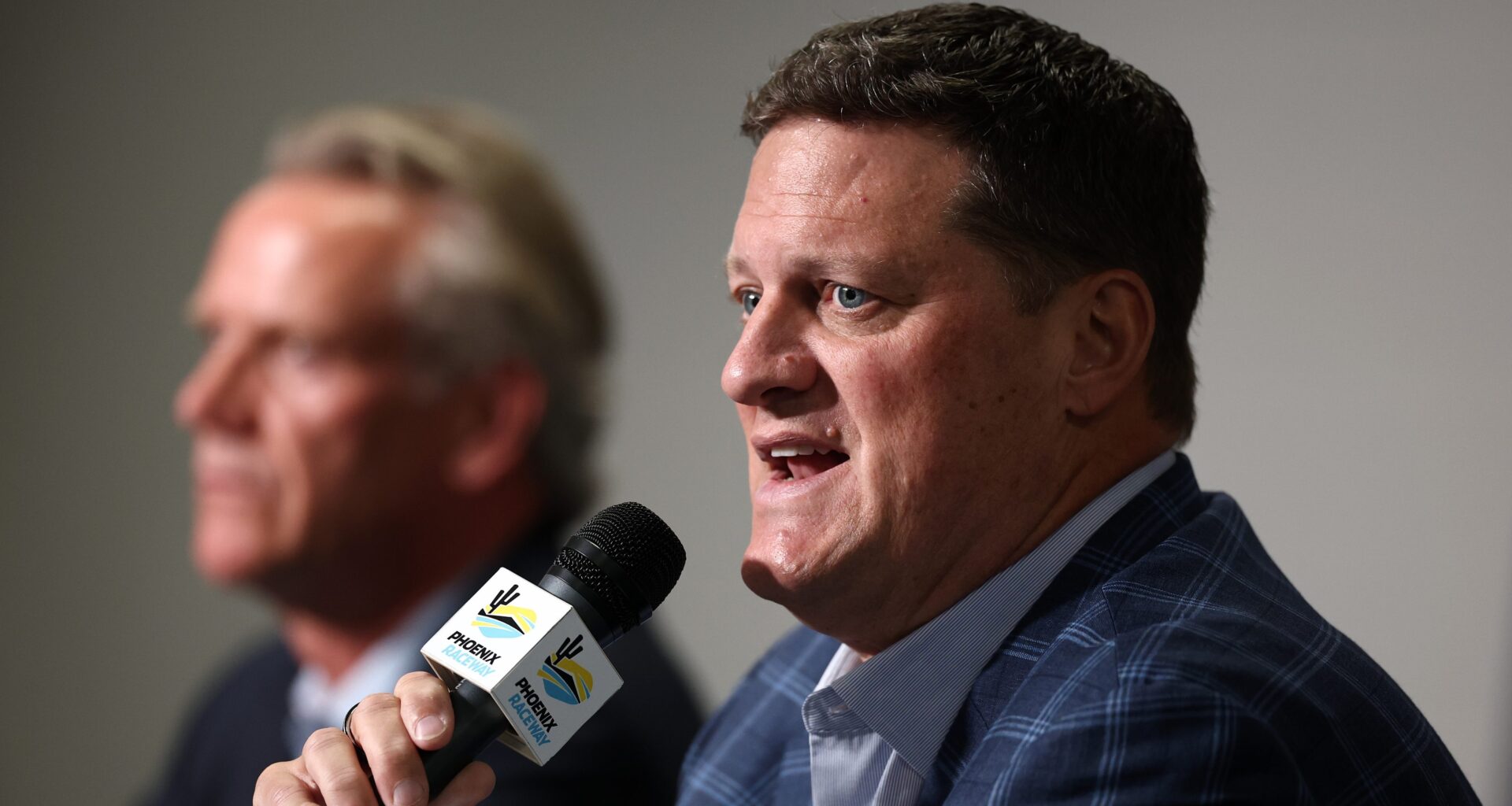
CHARLOTTE, N.C. — 23XI Racing and Front Row Motorsports continued presenting their case against NASCAR in an antitrust lawsuit trial on Thursday, primarily focusing on NASCAR President Steve O’Donnell.
The 30-year NASCAR veteran, who moved into the role of president in late March, spent approximately 4 hours and 45 minutes on the stand on Thursday. Plaintiffs’ legal team, represented by Jeffrey Kessler, took the bulk of this time. Defendants’ legal team, represented by Christopher Yates, accounted for just over 1 hour with more time scheduled on Friday morning.
Kessler focused on two key points that he used to attempt to show anti-competitive acts from NASCAR. This included track exclusivity agreements and concerns about the rise of Tony Stewart’s Superstar Racing Experience (SRX) series, which previously featured drivers in identical, purpose-built race cars competing at short tracks.
This series drew better ratings than the Truck and Xfinity Series at times as it aired first on CBS Sports and then ESPN, which created concern among NASCAR executives.
This session featured Kessler presenting several pieces of evidence regarding the SRX series, The first piece of evidence was a presentation from June 2022 where O’Donnell and other key NASCAR executives examined potential options for team owners and how NASCAR would respond. This included everything from boycotting the 2023 Daytona 500 to starting a new series. SRX served as the example.
“I recall we all became concerned with the look and the feel of the series, yes,” O’Donnell said when asked about NASCAR’s response to SRX and the series becoming being a potential competitor. He continued and said that drivers were permitted to race in SRX under the 2016 Charter Agreement.
However, O’Donnell said that the original pitch for SRX was nothing like what it became, which is why Stewart could own the series while also owning Cup Series charters. O’Donnell said this summer series was only meant for retired or non-active drivers. He said it was not built to compete with or look like NASCAR, nor was it to feature active drivers.
Active Cup drivers and team owners began making one-off starts in SRX. Examples included Denny Hamlin, Justin Marks, Ryan Blaney, Chase Elliott, and Brad Keselowski.
Evidence revealed that in 2023, Speedway Motorsports asked for an exception so that SRX could race at one of the company’s tracks. This became necessary due to exclusivity agreements prohibiting NASCAR-sanctioned tracks from hosting other motorsports series without approval.
NASCAR told Speedway Motorsports “No,” so SRX did not head to any of the company’s tracks.
The SRX-focused evidence continued with the jurors seeing previously unsealed text messages between Scott Prime, Steve Phelps, O’Donnell, and Ben Kennedy about the series. The first set displayed was from Feb. 1, 2023. The second set was from June 2022.
“This is NASCAR, plain and simple,” O’Donnell wrote after learning that Hamlin would compete in SRX in 2023. “Enough. We need legal to take a shot at this.”
This message prompted Phelps, now NASCAR commissioner, to say that they need to “put a knife in this trash series.“
Kessler pressed the NASCAR president about these texts multiple times asking if it were true that O’Donnell wanted legal to look at SRX so that they could shut it down. O’Donnell did not provide the answer Kessler sought after hearing the question multiple times.
“I was concerned with what was happening on the race track, so I asked legal to take a look at it,” he said.
O’Donnell didn’t provide further details about his reasoning for having legal look at SRX, but he addressed a different topic. He said this displayed evidence reminded him that they were in the middle of negotiations (both charter and broadcast) and they were “supposed to be standing hand-in-hand” with team owners.
O’Donnell also said that this text exchange reminded him that drivers and team owners “were out running in another series instead of promoting the Cup Series.”
Break in the middle of Steve O’Donnell’s direct examination by Jeffrey Kessler.
– says original track exclusivity agreements were five years to cover the initial charter lengths. (5 years before the 4 year option)
– Kessler said that tracks were able to renegotiate financials…
— John Newby (@JohnNewby_) December 4, 2025
Other details from NASCAR President Steve O’Donnell’s testimony
NASCAR pushed to remove the three strikes rule from the 2025 Charter Agreement, which it accomplished. This rule gave teams the ability to push back against decisions that would increase their costs three times. If NASCAR still made the move anyway after three “no” answers from owners, the Goodwill Provision (6.6) would go away. Teams could move to a competing stock car series without the one-year waiting period.
O’Donnell said NASCAR just removed the three strikes rule because teams were “using it” to prevent going to new tracks. “We would not have been in Mexico City,” he said.
O’Donnell said the track exclusivity rules in sanction agreements were in place because they hoped tracks would be loyal to NASCAR and would focus on promoting the Cup races instead of other events.
NASCAR still has an exclusivity agreement with Auto Club Speedway, which has not been active since 2023 when demolition on the property began.
The majority of Cup Series tracks signed five-year exclusivity deals in 2015. Dover signed in 2016. The reason for this timeline is that they wanted to confirm they could cover the payments for the first five years of the 2016 Charter Agreement, which included some fixed payments to teams.
The updated track sanction agreements began in 2022. For example, O’Donnell and NASCAR signed an agreement with Atlanta Motor Speedway on Aug. 30, 2022. This extends through Nov. 30, 2026, and includes language preventing other track activities.
The exceptions for these track exclusivity agreements include IndyCar, Indy NXT, IMSA, ARCA, and Modified races.
NASCAR put exclusivity restrictions in the Xfinity and Truck Series sanction agreements after concerns of competing series racing at some tracks exclusive to these lower-tier series. These prohibit anything having the “look and feel of Cup Series” races. The Xfinity agreements were signed on Sept. 21, 2021, for the 2022 season and beyond. The Truck Series version was signed on Aug. 25, 2022.