

The domestic economy expanded quickly in the first nine months of this year compared to the same period last year with growth of 4.1%.
New figures from the Central Statistics Office also show that Gross Domestic Product, which includes exports by multinationals, grew by a very significant 15.8%.
Consumer spending rose by 2.9% in the first nine months of 2025.
The multinational dominated sectors of the economy grew by 31.2% in the first nine months of 2025, mainly driven by strong exports particularly from the pharmaceutical sector.
Today’s figures show that while drug companies had increased exports before the Trump administration introduced tariffs, that elevated of activity has continued throughout 2025.
Investment, excluding aircraft leasing and intellectual property, rose 7.4%.
The CSO figures for the third quarter of the year, which are often more volatile, show a mixed picture.
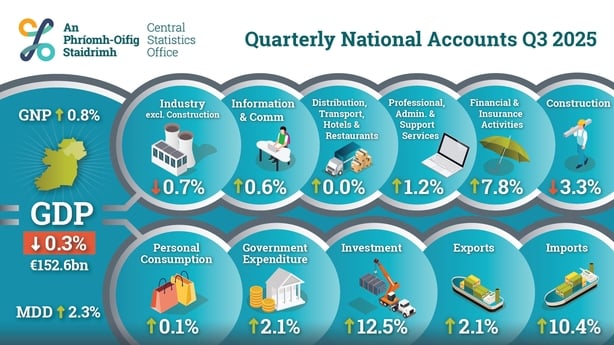
GDP in July, August and September fell by 0.3% while the domestic economy grew by 2.3%.
Tánaiste and Minister for Finance Simon Harris said today’s CSO figures confirm the continued resilience of the domestic economy.
“Modified Domestic Demand grew by 5 per cent in the third quarter on an annual basis. While this may overstate the underlying performance of the economy at present, I am encouraged by the strength of consumer spending which grew by 2.5% over the same period,” Mr Harris said.
“Alongside the robust exchequer figures released yesterday, today’s figures highlight the relatively healthy position of our domestic economy at present,” he added.
He also noted that GDP recorded double-digit growth in the first three quarters on an annual basis.
“Front-loading of pharmaceutical exports to the US in anticipation of tariffs played a key role in driving headline activity in the opening months of the year. The continued strength of GDP in recent quarters suggests that structural factors may also be at work, including significant underlying demand for a limited range of sub-categories of pharmaceutical exports,” he said.
“Looking ahead, the easing in the pace of jobs growth in recent quarters is a reminder that we cannot take the continued healthy position of the economy for granted,” he added.
Commenting on today’s CSO figures, AIB’s chief economist David McNamara said that GDP growth remains volatile but is reflective of the shifts in global trade patterns caused by the imposition of US tariffs in 2025, and the emergence of weight-loss drug production in Ireland.
He noted that a specific hormone derivative product related to weight loss drugs accounted for 56% of all Irish chemical and pharma exports to the US in the first half of this year compared to just 8% the same time in 2024, contributing to the surge in exports in the first half of this year.
“The rise in global demand for these drugs could underpin Irish pharma exports in the near term and may offset some of the negative effects of US tariffs in other sectors,” the economist said.
“On US tariffs, Ireland’s effective tariff remains close to zero, and among the lowest of the wealthy OECD countries, given pharma products have yet to be hit with tariffs. This remains a key downside risk for the economy in the year ahead if the US reignites its trade war with the EU and other key partners,” he said.
“This week’s Exchequer returns also signalled ongoing growth in the Irish economy, with tax receipts rising by over 8% in the year to the end of November,” he added.
David McNamara also said that domestic indicators point to a robust growth picture so far this year.
“Modified Domestic Demand (MDD), which strips out some of the volatility of the multinational sectors, rose 2.3% on the quarter. On an annual basis, MDD is 5% higher than the same period in 2024,” he said.
He said that AIB’s services and manufacturing PMIs both signalled an acceleration in activity in the domestic economy in the fourth quarter of 2025, so the latest evidence suggests the domestic economy is emerging from a softer growth period through the middle of 2025, as geopolitical uncertainty eases.