
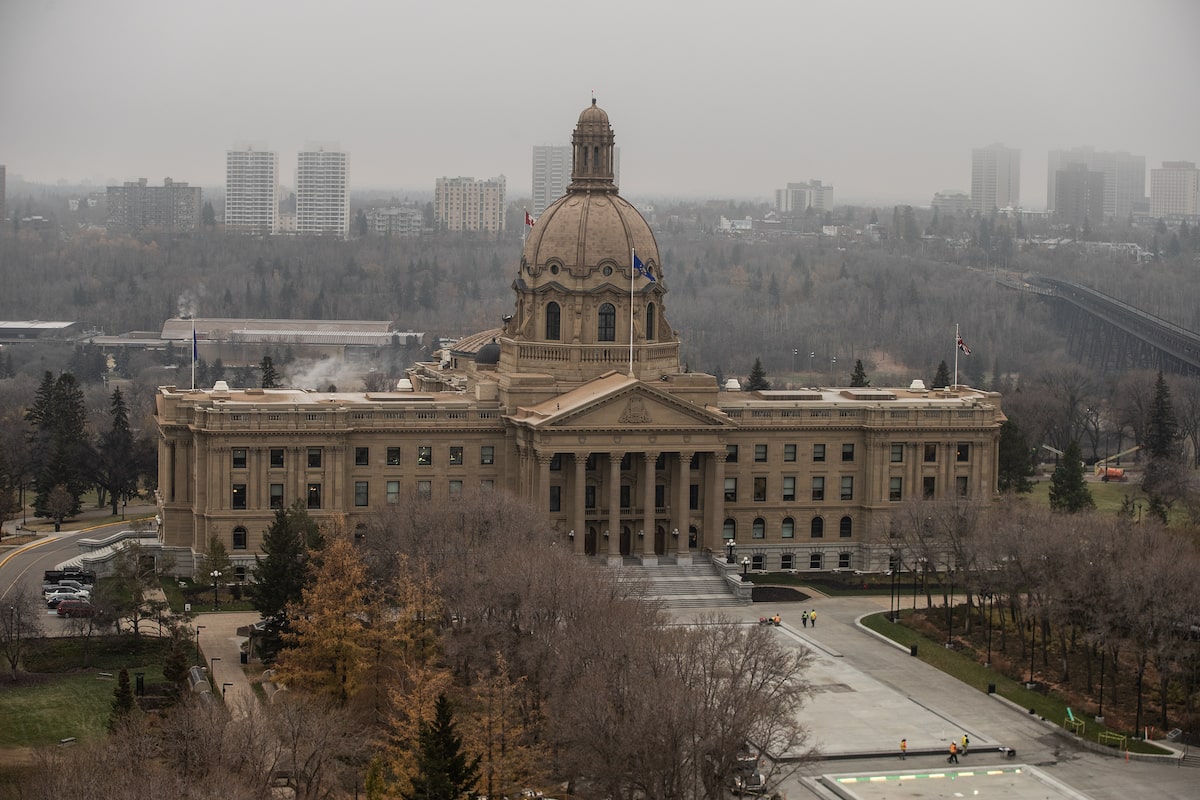
Alberta government officials say restricted words for new political parties include conservative, democratic, green, wildrose and republican.JASON FRANSON/The Canadian Press
The Alberta government is proposing sweeping changes that will limit what names can be used for new political parties, eliminate guardrails for citizen-initiated referendums, and strip the chief electoral officer of many of their powers.
The Justice Statutes Amendment Act, introduced Thursday, would help clear the way for a separation referendum question currently tied up in court and could prevent two former United Conservative Party MLAs from using the Progressive Conservative brand for a party they are hoping to create.
Amendments to Alberta’s recall legislation is notably absent from the bill despite Premier Danielle Smith foreshadowing that her government was considering changes amid efforts to unseat 14 UCP MLAs from the legislature. The government has argued that the law, introduced by the UCP in 2019, is being weaponized.
Justice Minister Mickey Amery, in a press conference, said the bill, which also has amendments that could hamper efforts to create excessively long ballots, said the goal is to “ensure that Albertans know which party they are voting for.”
Robyn Urback: With typical Alberta governing-party arrogance, Danielle Smith waves away a scandal
If passed, the bill would prevent political parties from using a word or phrase associated with another political party. Government officials said restricted words include conservative, democratic, green, wildrose and republican.
Mr. Amery said duplicate party names have always been an issue. However, the rules are bound to trigger a reaction from the competing parties – including the two former UCP MLAs currently attempting to co-opt the Progressive Conservative banner.
Peter Guthrie, who left the party earlier this year over the government’s handling of the Alberta Health Services controversy, and Scott Sinclair, who was removed from caucus after not voting for the budget, are being sued by the UCP, which alleges that the two have conspired to damage the party’s reputation by using the Progressive Conservative name.
“Some folks out there want to confuse people into voting for them based on the name ‘conservative,’ but this is not a partisan issue. Let me be clear about that,” Mr. Amery said.
The UCP was created after a merger between the Progressive Conservative and the Wildrose parties. Some existing parties in Alberta already share names, such as the Wildrose Loyalty Coalition and the Wildrose Independence Party of Alberta.
Alberta is also proposing major changes to the Citizen Initiative Act and Referendum Act that Mr. Amery said would create a “permissive environment” for people seeking province-wide referendums.
Specifically, the new legislation would allow a proposed referendum question to contravene the Canadian Constitution. However, it is also changing the rules so that the Alberta government would not be forced to implement the result of a referendum if acting on it would violate the Constitution.
The Justice Minister would also now have the power to determine whether a referendum application should go forward – a responsibility currently held by the Chief Electoral Officer.
Alberta’s Chief Electoral Officer, a role now held by Gordon McClure, will also be stripped of the ability to refer referendum questions to court and advise applicants on proposed constitutional questions. The minister would refer questions to the court and decide whether the application can proceed.
Gary Mason: Danielle Smith helped create a separatist monster that is now attacking her
The province is also using the bill to intervene in the justice system: All court proceedings brought forward by chief electoral officers under the Citizen Initiative Act would be discontinued.
A provincial judge recently heard final arguments from a pro-separation group over a question it submitted for a referendum petition. Mr. McClure earlier this year requested a judge to assess the constitutionality of the question, which asks whether Alberta should cease to be part of Canada.
Mr. Amery said on Thursday it shouldn’t be the electoral officer’s responsibility to refer questions “for endless litigation and months-long delays.” He encouraged Elections Alberta to drop its court reference earlier this year.
He also made an appeal to Alberta separatists.
“If those seeking independence believe that they have support for it, this is their chance to prove it. This is their chance to demonstrate it,” Mr. Amery said, adding that he’s clearing the way “for all Albertans.”
“It is the purest and simplest form of direct democracy, and it has nothing to do with the separatists.”
A similar question is being asked with a pro-Canadian tint by former deputy premier Thomas Lukaszuk, whose question – “Do you agree that Alberta should remain in Canada?” – was verified this week by Elections Alberta after collecting more than 404,000 verified signatures. Mr. Lukaszuk’s question is not constitutional, however, and he’s asking the province to send the question to a vote in the legislature instead of an Alberta-wide referendum.
The province is also seeking to drop rules that restrict similar topics from appearing together on the same referendum ballot.
Asked whether Mr. Lukaszuk’s and the pro-separation questions could appear together on a referendum, Mr. Amery said: “Simultaneously? Sure.”