

Listen to this article
Estimated 4 minutes
The audio version of this article is generated by text-to-speech, a technology based on artificial intelligence.
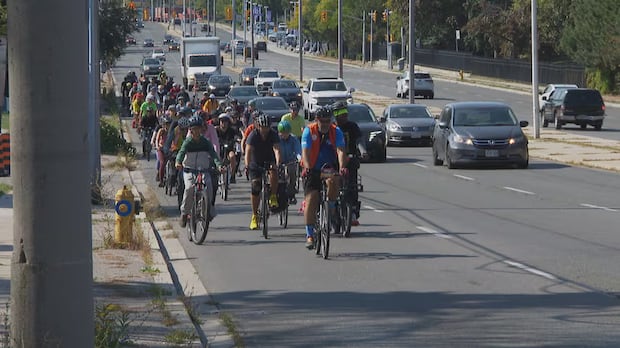
Toronto could see more than 20 kilometres of new bike lanes installed in a proposal that manages to get around the provincial government’s attempts to clamp down on them.
Car lanes won’t need to be sacrificed if the bikeways are approved. Instead, city staff propose to narrow them down.
Mayor Olivia Chow said the plan is “not a loophole” for provincial legislation at an unrelated news conference earlier this week.
“It’s just a better design,” she said. “From day one, I said there’s a win-win solution.”
Ontario’s Bill 212 — along with the recently-passed Bill 60 — both restrict municipalities from building bike lanes that impede traffic lanes for cars.
When asked if Toronto found a way to circumvent provincial rules at the same news conference as Chow, Ontario’s Transportation Minister Prabmeet Sarkaria was supportive of the city’s strategy.
“If there is a way in which you can have both a vehicle lane and a bike lane on the same street, then that is OK,” he said.
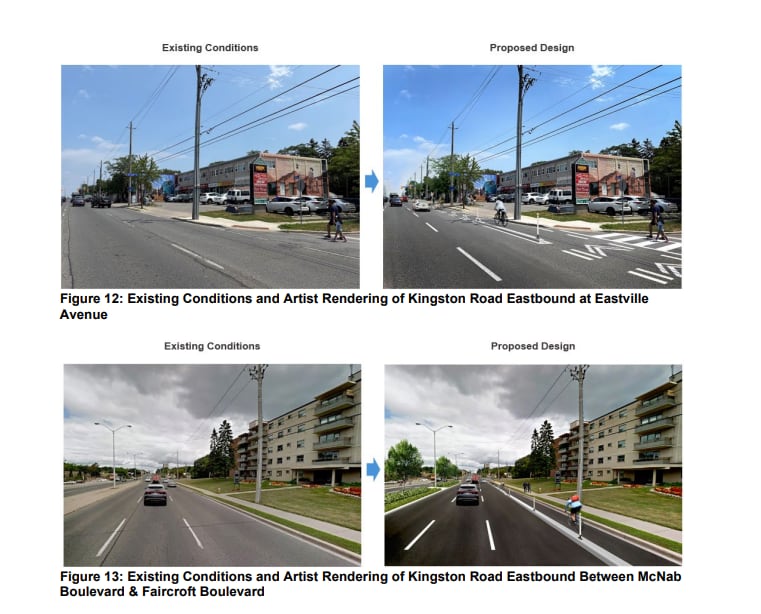 How the city is proposing to install a cycle track on Kingston Road without getting rid of car lanes. (City of Toronto)
With an estimated price tag of more than $30 million, the proposed lanes are designed to connect existing bike routes located mostly outside the downtown core. It marks the city’s most ambitious attempt to build new bike lanes since provincial restrictions kicked in.
In 2024, a total of 14.5 kilometres of bike lanes were approved, and in 2023, 17.9 kilometres were approved, according to the city.
The 20.5 kilometres of new bikeways is a significant amount for a single proposal, says Michael Longfield, executive director of advocacy group Cycle Toronto. It’s especially notable after the city’s previous cycling infrastructure update this summer proposed zero kilometres of new bike lanes, “which was fairly unprecedented,” he said.
Despite his enthusiasm, Longfield said, “you can’t take anything for granted. We’ve seen projects approved by city council that end up in limbo for years afterwards because of various factors.”
City staff are also proposing lower speed limits, new stop signs and traffic-control signals, and prohibiting right turns on red along the proposed bike routes.
The proposal also seeks to upgrade existing cycling infrastructure.
Lane proposed for Kingston Road
The largest proposed route is a six-kilometre lane on Kingston Road, stretching from Cliffside Drive to Scarborough Golf Club Road.
WATCH | What to know about Toronto’s bike lane rules:
Find Toronto’s bike lane rules confusing? You’re not the only one
Some Toronto city councillors are looking to make rules around bike lanes easier to understand. CBC’s Lane Harrison explains how.
But residents are concerned about losing parking spaces, the removal of right-hand turns and speed limits being reduced from 60 km/h to 50 km/h on Kingston Road, according to city councillor Parthi Kandavel, whose ward most of the lane would pass through.
“The reality is people are going at 60 km/h. So I’m going to be looking to maintain that,” he told CBC Toronto, adding he will propose amendments to the project.
A little over half — 51 per cent — of people surveyed in public consultations opposed the new bike lane, mostly citing concerns about increased congestion. The 43 per cent who supported it said the changes could make the road safer.
The area saw 1,910 collisions resulting in 22 serious injuries and six deaths between 2014 and 2024, according to a city report.
The Kingston project was initially more outspread. The original plan included a stretch of Danforth and Scarborough to create an uninterrupted bikeway connecting Scarborough and Etobicoke — but that would have required removing car lanes.
After the province passed Bill 212 in late 2024, the city revised the project area to focus solely on Kingston Road from Cliffside Drive to Scarborough Golf Club Road.
Kandavel says that even without the bill, he wouldn’t have supported a project that removed car lanes.
“The solution before us is a good balance,” he said.
If approved, the new lanes could be built by 2028. The proposal will go before the city’s infrastructure and environment committee Thursday, and if it passes, will head to city council for a vote in mid-December.