
The civil trial between 23XI Racing, Front Row Motorsports and NASCAR slogged on for a fourth day, and the courtroom has only heard from four witnesses as the trial approaches what is supposed to be its scheduled halfway point.
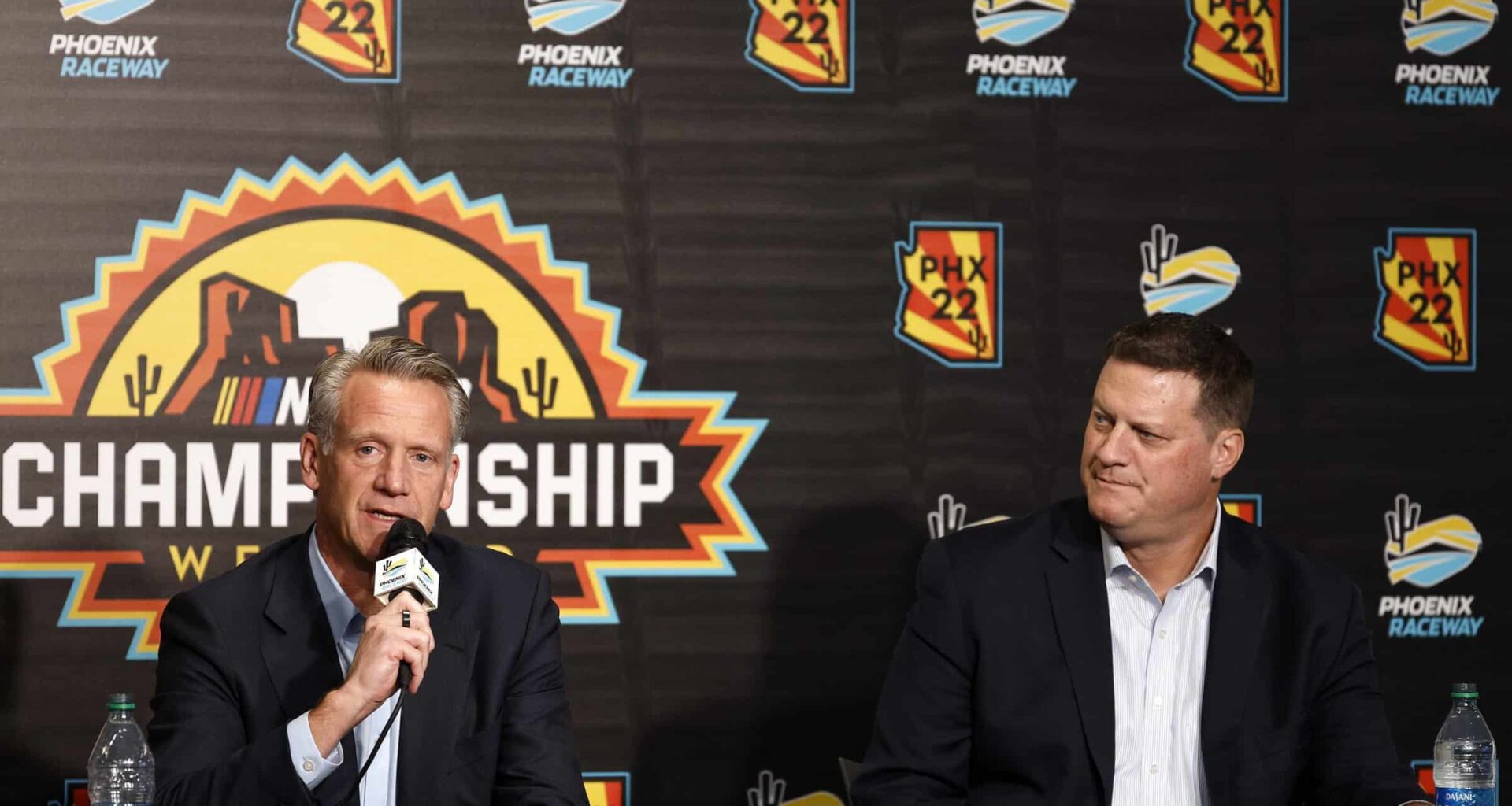
Thursday (Dec. 4) saw the conclusion of NASCAR’s cross examination of FRM owner Bob Jenkins, while the remainder of the day had NASCAR President Steve O’Donnell take the stand.
Thursday saw wins for both sides of the aisle, but the day ended with Judge Kenneth D. Bell ordering both sides to pick up what has been an incredibly slow pace. Bell specifically called out witnesses that would not immediately answer a question when asked and said that he would step in and ask them himself if necessary.
Day five of the trial might have a completely different look from the days before it, but for now, here’s some analysis on the important moments of day four.
NASCAR Vs. 23XI/FRM Lawsuit Day 4 Recap
Bob Jenkins isn’t quite spending $20 million to field a Next Gen car
Day three in court appeared to be advantageous for the plaintiffs, especially when Jenkins was at the stand. But momentum shifted back to NASCAR at the start of day four, as attorney Lawrence Buterman was able to uncover multiple discrepancies in Jenkins’ financials claims when he returned to the stand.
On Wednesday, Jenkins — who claimed to have never turned a profit in 22 years of NASCAR ownership — testified that it costs $20 million per year to field a Next Gen car, which is the same number that Denny Hamlin cited during his testimony on day one.
With Jenkins at the stand, Buterman uncovered evidence that showed FRM was spending far less than $20 million annually on fielding a Next Gen car. Altogether, since 2022, FRM had never spent more than $27 million per year to field two NASCAR Cup Series cars and a NASCAR Craftsman Truck Series team. Jenkins replied that he didn’t know the exact annual cost during testimony and was listing the average of the Cup teams, only for Buterman to remind him of his answer of $20 million under oath the day prior.
The plaintiffs have emphasized how expensive it is to run a team and how unfair the current model is for the Cup teams, only for Jenkins to be caught in a discrepancy of his previous claims. If the $20 million claim of annual spending for a Cup car is off the mark, are there other discrepancies to be found in the financial numbers the plaintiffs provided?
The France family refused to budge on charter negotiations with the teams last year
It had been suspected for quite some time — especially since the May 2024 texts between O’Donnell and NASCAR Commissioner Steve Phelps were first shown — that the France family was at an impasse in negotiations, and that was all but confirmed in O’Donnell’s testimony.
Evidence had showed Jeff Gordon asking O’Donnell if “the family” was open to a new model, to which O’Donnell testified that Jim France was not. O’Donnell had messaged Phelps that the teams and NASCAR needed to meet more in the middle and pleaded his case to the Frances, to no avail. Joe Gibbs Racing’s Heather Gibbs had sent an emotional letter asking for NASCAR to reconsider its stance on permanent charters, a letter to which Jim France was “swearing every other sentence” while reading it, according to a text from O’Donnell.
Interestingly, O’Donnell denied that France was swearing when questioned by 23XI/FRM attorney Jeffrey Kessler about the letter, but when asked what France was mad about, O’Donnell did not have a reply.
It’s no surprise then that the two sides reached an impasse where no one was willing to budge on negotiations, which ultimately led to NASCAR sending out the ultimatum for teams to sign the 2025-2031 charter agreement by midnight on Sept. 6, 2024, or risk losing them.
But if NASCAR has exclusivity control over the majority of tracks (more on that later) and has a financial model where it’s practically impossible for a full-time non-chartered team to survive, what choice did the teams have other than to sign or take it to court?
NASCAR paid SMI tracks for exclusivity and saw SRX as a growing threat
NASCAR has already been established as a monopoly by Judge Bell. It’s all about whether it broke antitrust law by using its power unfairly, and that came to the forefront as Kessler questioned O’Donnell about racetrack exclusivity and the threat that NASCAR saw in the upstart Camping World SRX Series.
And from the moment when Phelps’ “need to put a knife in this trash series” texts were revealed, everyone and their mother knew that the now-defunct SRX would play a pivotal role in this case.
Remember when Denny Hamlin revealed during his day-two testimony that some team owners explored the idea of forming a new series, only to realize that there “was no access to racetracks” to compete on? That’s where all of this comes into play.
It’s known that NASCAR has an agreement where it pays Speedway Motorsports, Inc. to have an exclusivity clause that prevents other stock-car series outside of NASCAR from competing on their tracks. The zMAX CARS Tour is an exception to that clause, but SRX is not, and when SMI asked if it could be granted an exception to host a SRX event at one of its venues, O’Donnell said in court that NASCAR “asked them not to.”
Reacting to Day 4 of the NASCAR vs. 23XI/FRM Trial
So in other words, if a new series were to be formed tomorrow, it would effectively be shut out of nearly every oval longer than 1 mile in the United States.
As for SRX, when did NASCAR start growing weary of it? According to O’Donnell’s testimony, it was when Cup drivers made numerous appearances during its final two seasons in 2022 and 2023, and O’Donnell added that he was frustrated that a NASCAR-like series was propping itself up right when NASCAR was in the midst of shopping for a new media-rights contract.
Kessler hammered home the point that the exclusivity clauses that NASCAR put in place with SMI and other independent tracks serve to lock out existing stock-car series from the largest tracks and prevent the formation of new ones to preserve NASCAR’s premier status. And with the real-life examples of SRX getting denied access to a SMI track and the race teams abandoning the idea of a new series because of the track exclusivity, it’s a tough point for NASCAR to refute in the trial.
Now we know how and why NASCAR made Chicago and Mexico City a reality
NASCAR, to its credit, has been unafraid to explore new ideas and visit new markets, with at least one new track on the Cup schedule every year since 2021.
Two of the biggest experiments were a street race through downtown Chicago and a trip south of the border to Autodromo Hermanos Rodriguez in Mexico City. Neither locale will be on the 2026 schedule, but they took NASCAR to new audiences and new heights in more ways than one.
Except in their pocketbook. O’Donnell testified that NASCAR lost $6 million in its visit to Mexico City in June and that it lost a whopping $55 million (an average of $18.3 million per year) during its three-year tenure in Chicago. NASCAR also lost $13 million in the three years of the Busch Light Clash at the Los Angeles Memorial Coliseum.
Yikes.
But in the case of Chicago, was it $55 million well spent? O’Donnell would be inclined to say yes, as he testified that NASCAR’s time in Chicago was the catalyst that helped it inked a five-race deal with Amazon Prime Video in the 2025-2031 media rights deal.
The trips to Mexico City and Chicago, in turn, revealed a new provision of the 2025 charter agreement, one that removed the “three strikes rule” present in the agreements from 2016 to 2024.
Simplified, the three strikes provided teams a level of veto power to prevent NASCAR from making more than three non-safety decisions that increased costs for the race teams.
The abandonment of the three strikes rule was yet another loss for the teams in the new charter agreement, and in retrospect, it’s another reason why the negotiations were as contentious as they were last year.
So why was that provision removed? According to O’Donnell, it was because NASCAR wanted to grow the sport and that the three strikes could’ve (and likely would’ve) prevented it from making the trek to Mexico City.
The removal of the three strikes and NASCAR’s subsequent ability to travel far and wide with no restriction is an intriguing discovery, because depending on what ruling is made in eight days’ time, it’s possible that the 2026 Cup schedule might not be as set in stone as we think it is.

NASCAR Content Director at Frontstretch
Stephen Stumpf is the NASCAR Content Director for Frontstretch and is a three-year veteran of the site. His weekly column is “Stat Sheet,” and he formerly wrote “4 Burning Questions” for three years. He also writes commentaries, contributes to podcasts, edits articles and is frequently at the track for on-site coverage.
Find Stephen on Twitter @stephen_stumpf