
1950 Italian GP, Monza – Farina takes decisive home victory
Championship situation before the title decider
1. Juan Manuel Fangio, Alfa Romeo, 26pts
2. Luigi Fagioli, Alfa Romeo, 24pts
3. Giuseppe Farina, Alfa Romeo, 22pts
Final standings
1. Giuseppe Farina, Alfa Romeo, 30pts
2. Juan Manuel Fangio, Alfa Romeo, 27pts
3. Luigi Fagioli, Alfa Romeo, 24pts
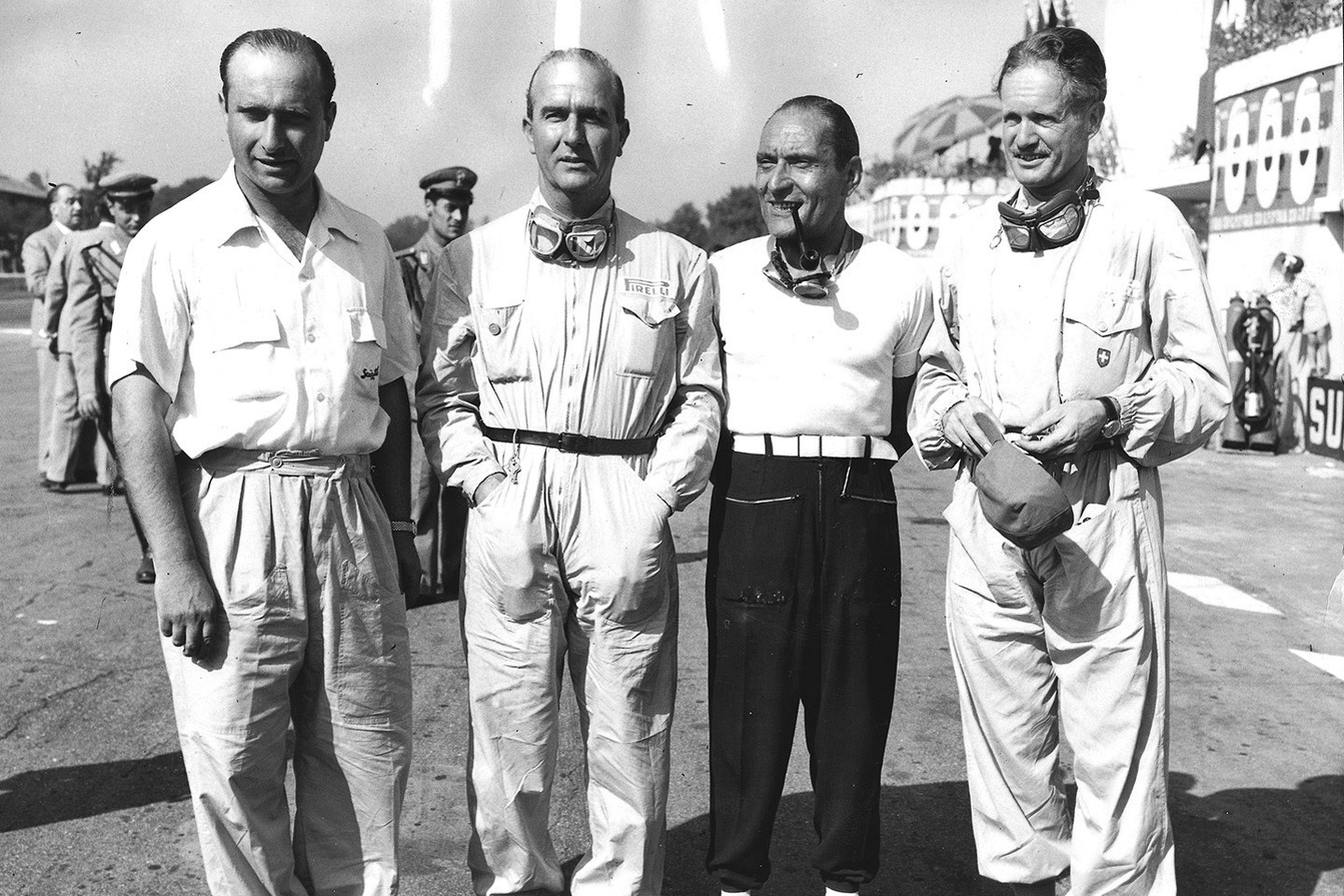
Alfa Romeo team: Juan Manuel Fangio, Giuseppe Farina, Felice Bonetto and Emmanuel de Graffenried
Photo by: Motorsport Images
The inaugural season of the world championship was all about the unrivalled Alfetta, which won all races (but the Indianapolis 500) and gave Alfa Romeo a 1-2-3 in the first world championship grand prix at Silverstone.
Nobody else collected more than 10 points before the title decider, so it was all to play for between Alfa’s drivers, with an important caveat: only the best four results from the seven-round season would be taken into account.
While Farina and Fangio had shared the victories so far with three points-scoring results each, Fagioli had finished second on four occasions and therefore needed to win with the fastest lap to have the slightest chance of surpassing Fangio.
Fangio got pole position with Farina third and Fagioli fifth, but Farina took the lead on the first lap and was only challenged by Ferrari’s Alberto Ascari, whose engine overheated, leading to his retirement.
A podium finish would have sufficed for Fangio to prevail in the championship, and he was running in second when he retired due to gearbox issues, awarding the title to Farina. Fagioli, meanwhile, finished third and scored no points owing to the aforementioned rule.
1951 Spanish GP, Pedralbes – Fangio sees off Ferrari threat
Championship situation before the title decider
1. Juan Manuel Fangio, Alfa Romeo, 27pts
2. Alberto Ascari, Ferrari, 25pts
3. Jose-Froilan Gonzalez, Ferrari, 21pts
Final standings
1. Juan Manuel Fangio, Alfa Romeo, 31pts
2. Alberto Ascari, Ferrari, 25pts
3. Jose-Froilan Gonzalez, Ferrari, 24pts
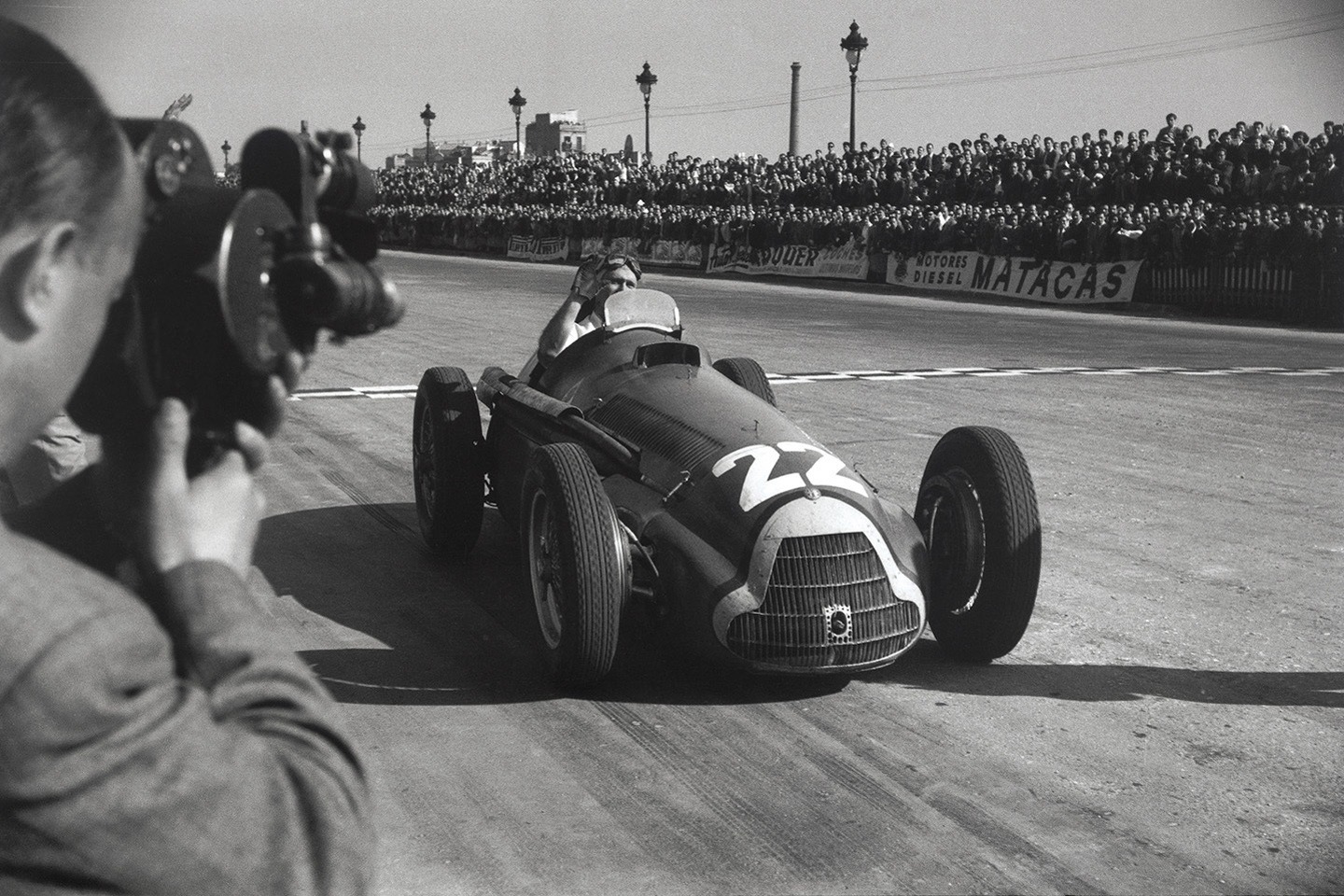
Juan Manuel Fangio, Alfa Romeo 159
Photo by: Motorsport Images
Ferrari became a real challenger to the Alfettas in 1951 with Alberto Ascari and Jose Froilan Gonzalez, while Alfa’s Giuseppe Farina was taken out of the running by technical failures at Silverstone and the Nurburgring.
The ‘best four results’ rule was still in use, meaning Gonzalez needed victory, the fastest lap and a Fangio non-score to win the championship, while Ascari’s title bid required him to finish at least second.
But Fangio already had the best results of anyone so far, so he needed second place to improve his tally by one point or a victory to put himself out of reach.
That’s exactly what he did on the very straightforward Pedralbes track, located in Barcelona, which was 6.3km long and featured six corners. Fangio was beaten to pole by Ascari by 1.68s, but Ferrari ran into tyre issues and Alfa’s Argentine passed him on lap four, leading all the way to the chequered flag for his first world title.
1959 United States GP, Sebring – Brabham prevails after running out of fuel
Championship situation before the title decider
1. Jack Brabham, Cooper, 31pts
2. Stirling Moss, Cooper/BRM, 25.5pts
3. Tony Brooks, Vanwall, 23pts
Final standings
1. Jack Brabham, Cooper, 31pts
2. Tony Brooks, Vanwall, 27pts
3. Stirling Moss, Cooper/BRM, 25.5pts
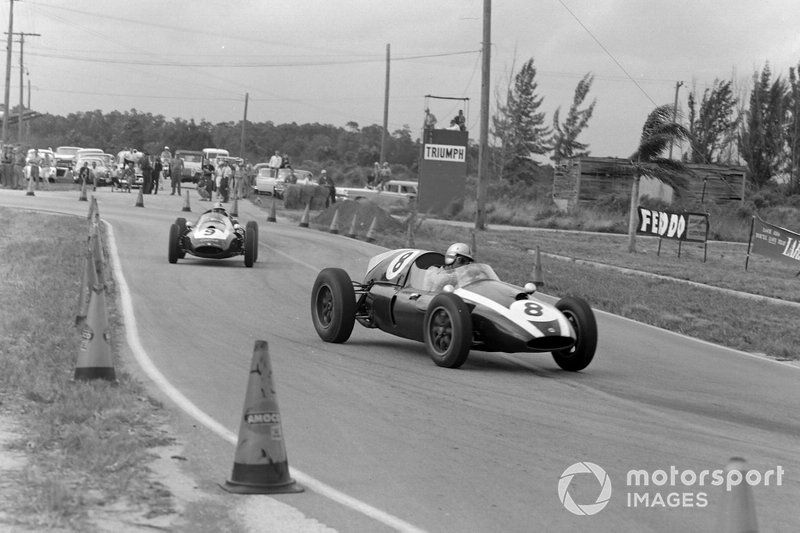
Jack Brabham, Cooper T51 Climax, leads Bruce McLaren, Cooper T51 Climax
Photo by: Motorsport Images
There were no world champions on the grid in 1959 after Juan Manuel Fangio and Mike Hawthorn retired. Jack Brabham’s season started ideally with four podiums, including two victories, which meant that halfway through the nine-round campaign (including the Indy 500) the Cooper driver was on 27 points, with Vanwall’s Tony Brooks on 14 and everyone else on nine or fewer.
A clutch issue took Brabham out of the German GP at AVUS, then he crashed out of the Monsanto race in Portugal, blowing the championship race open.
Every driver’s best five results counted towards the standings, which meant Stirling Moss would lose one point if he scored, while anything worse than a podium finish would be useless to Brabham. Moss needed at least second place for a title chance, while Brooks required a win.
Moss took pole at Sebring, three seconds faster than runner-up Brabham on the 8.4km Floridian track, with Harry Schell making it a Cooper 1-2-3 ahead of Brooks.
Moss led Brabham by 10 seconds after five laps, but gearbox trouble took him out of the race and title contention.
Brabham went on to dominate the race but ran out of fuel on the last lap. This wasn’t enough to jeopardise his championship, as Bruce McLaren and Maurice Trintignant were three minutes ahead of Brooks, who needed to win; Brabham pushed his car to fourth, and triumphed.
1964 Mexican GP, Mexico – Clark’s last-gasp retirement hands title to Surtees
Championship situation before the title decider
1. Graham Hill, BRM, 39pts
2. John Surtees, Ferrari, 34pts
3. Jim Clark, Lotus, 30pts
Final standings
1. John Surtees, Ferrari, 40pts
2. Graham Hill, BRM, 39pts
3. Jim Clark, Lotus, 32pts
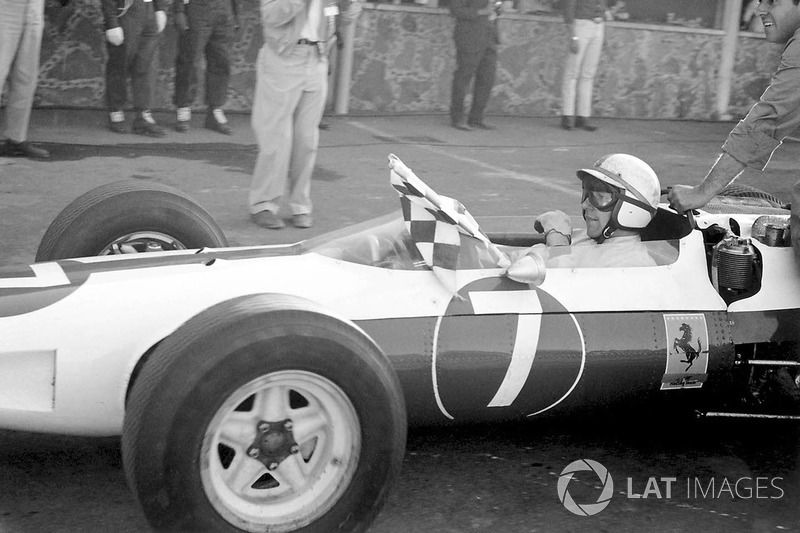
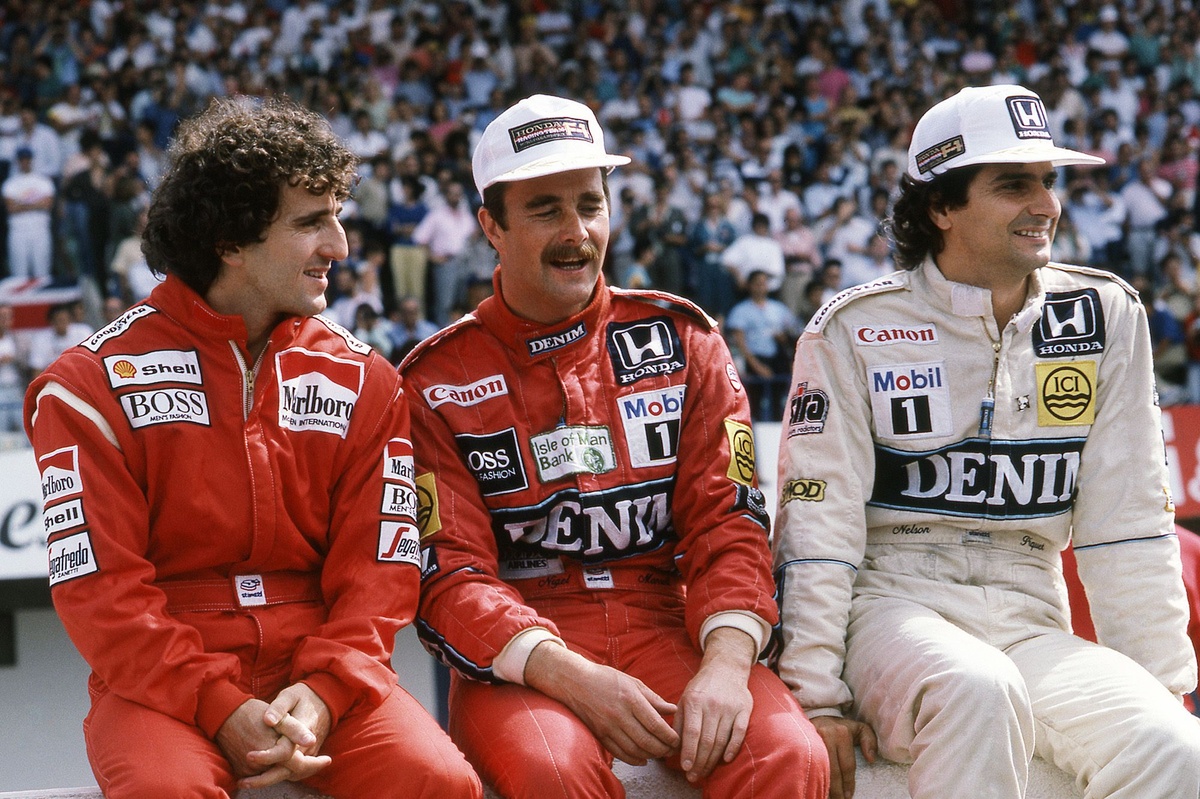
Champion John Surtees, Ferrari
Photo by: Motorsport Images
If you thought the 2008 Brazilian Grand Prix was unique in the title changing hands at the very end of the finale, please reconsider.
Graham Hill had been the most consistent driver over the 1964 season, but only the best six results counted, so he wasn’t going to improve his points tally unless he finished on the podium again in Mexico.
Ferrari’s John Surtees was his closest challenger, requiring at least second place to surpass the Briton, while Jim Clark needed to win and for Surtees not to do better than third.
Clark had been the strongest driver that season, taking four out of nine pole positions thus far and winning every race that he didn’t retire from – only three, as his Lotus’ fragility cost him dear in every other round.
Clark was fastest again, by nearly one second, at Autodromo Hermanos Rodriguez, where he led Dan Gurney and Surtees’ team-mate Lorenzo Bandini on the grid, with Surtees and Hill down in fourth and sixth respectively. Both of them lost even further ground at the start, as the BRM driver was readjusting his goggles when the flag dropped.
The situation was ideal for Clark. He led, with Hill 10th and Surtees 13th. The Englishmen fought their way up to third and fifth respectively by lap 18 – such a result would have given the title to Hill by one point. But on lap 31, he and Bandini collided at the hairpin, which damaged the BRM’s exhaust pipes. Hill dropped outside of the top 10 positions and never recovered.
The title just seemed to belong to Clark. But with some eight laps remaining, the Lotus suffered an oil leak. Clark lost the lead to Gurney on the penultimate lap, which handed the title back to Hill, then retired on the last tour.
But it wasn’t over. Having inherited second place, Bandini waved team-mate Surtees through, gifting him and Ferrari the world title.
1974 US GP, Watkins Glen – Fittipaldi comes out on top
Championship situation before the title decider
1. Emerson Fittipaldi, McLaren, 52pts
2. Clay Regazzoni, Ferrari, 52pts
3. Jody Scheckter, Tyrrell, 45pts
Final standings
1. Emerson Fittipaldi, McLaren, 55pts
2. Clay Regazzoni, Ferrari, 52pts
3. Jody Scheckter, Tyrrell, 45pts
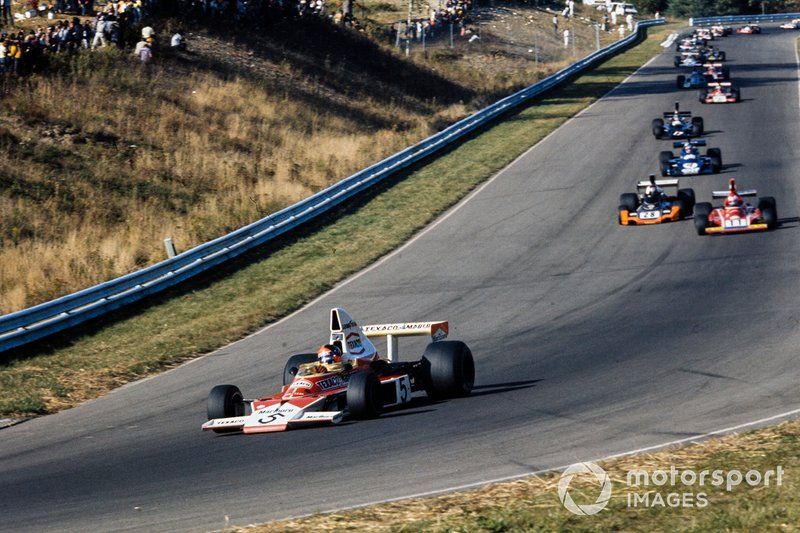
Emerson Fittipaldi, McLaren, Clay Regazzoni, Ferrari, John Watson, Brabham
Photo by: Motorsport Images
1974 was a topsy-turvy season with four drivers in contention for the title – including Ferrari’s Niki Lauda, who led after round 10 of 15 but retired from the last five races.
Therefore it was a likely duel between Emerson Fittipaldi and Clay Regazzoni, who were level on points – unless they both finished outside the top five and Jody Scheckter, completing his first full F1 campaign, won.
All of them ended up outside the top five on the grid at Watkins Glen, with Scheckter, Fittipaldi and Regazzoni sixth, eighth and ninth respectively. Brabham’s Carlos Reutemann got pole by 0.017s over Hesketh’s James Hunt, set for his first front-row start.
Reutemann led the race from start to finish, ruling Scheckter out of title contention – the South African retired from fourth anyway due to a mechanical issue.
Therefore it became all about who finished in front between Fittipaldi and Regazzoni, but the Swiss dropped down the order as he complained about his Ferrari’s handling, finishing a lowly 11th. Fittipaldi took fourth position and his second crown.
1981, Caesars Palace GP – Piquet crowned by just two seconds
Championship situation before the title decider
1. Carlos Reutemann, Williams, 49pts
2. Nelson Piquet, Brabham, 48pts
3. Jacques Laffite, Ligier, 43pts
Final standings
1. Nelson Piquet, Brabham, 50pts
2. Carlos Reutemann, Williams, 49pts
3. Alan Jones, Williams, 46pts
4. Jacques Laffite, Ligier, 44pts
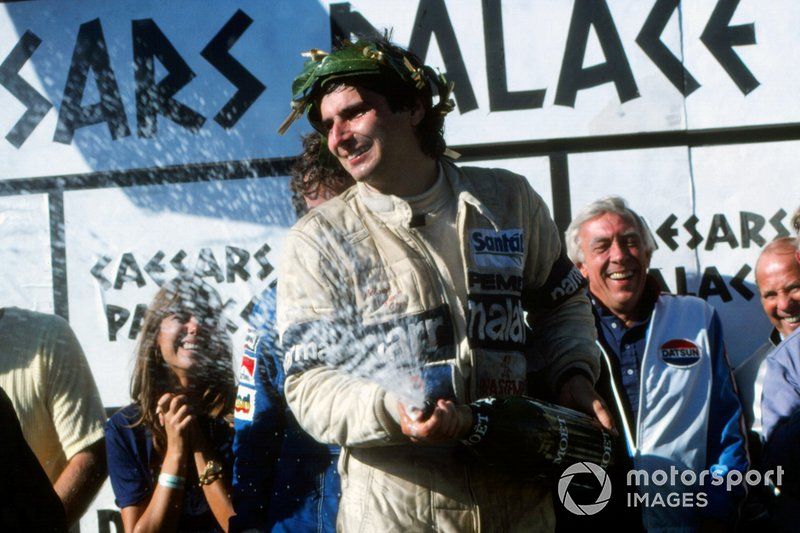
Nelson Piquet, Brabham
Photo by: Sutton Images
1981 was another hotly contested season, with five drivers within 12 points ahead of the title decider – but only three had a mathematical chance to win the title.
The season finale took place on the unloved Caesars Palace track in Las Vegas. Carlos Reutemann took pole position despite spectacularly colliding with title rival Nelson Piquet in qualifying, with the Brazilian taking fourth on the grid notwithstanding neck pain on the anti-clockwise track. Jacques Laffite complained of engine gremlins and found himself down in 12th.
Laffite needed at least second place to have the slightest chance of surpassing Reutemann, and he remarkably fought his way to that very position by lap 32 when Alain Prost pitted for new tyres, but the Ligier driver’s Michelin rubber ended up suffering from the sweltering conditions too and he dropped down the order.
More importantly, Reutemann tumbled down to fifth on the opening lap, then lost two further positions to find himself seventh, just ahead of Piquet.
The Williams driver was suffering from gearbox issues and was overtaken by Piquet on lap 17, with the Brazilian executing a clean, crucial manoeuvre for the title.
Retirements for Gilles Villeneuve and Mario Andretti helped the title-contending duo climb back up the order, but Reutemann was struggling too much after losing fourth gear. An exhausted Piquet ended up fifth, just two seconds ahead of Laffite and John Watson. That made the difference in the title fight.
1983 South African GP, Kyalami – Piquet prevails as unreliability strikes rivals
Championship situation before the title decider
1. Alain Prost, Renault, 57pts
2. Nelson Piquet, Brabham, 55pts
3. Rene Arnoux, Ferrari, 49pts
Final standings
1. Nelson Piquet, Brabham, 59pts
2. Alain Prost, Renault, 57pts
3. Rene Arnoux, Ferrari, 49pts
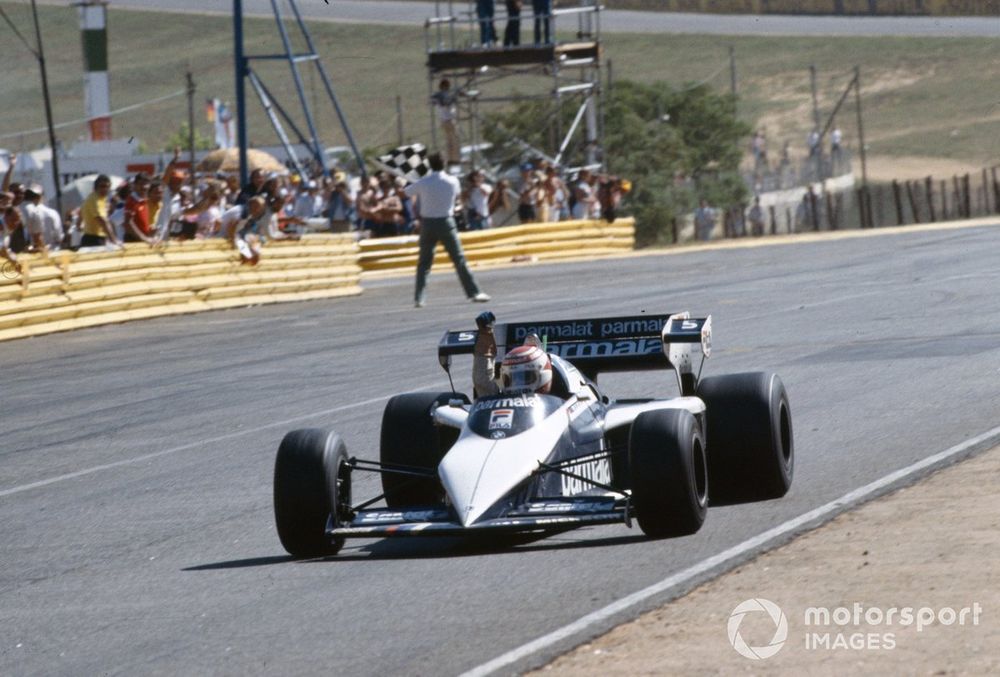
Nelson Piquet, Brabham BT52B BMW, punches the air at the finish
Photo by: Motorsport Images
Ferrari had the best one-lap pace in 1983 as Rene Arnoux and Patrick Tambay got four poles each, but struggled to get consistent enough results – even though the Scuderia won the constructors’ title and Arnoux recovered from a poor first half of the season to become a dark horse for the title, with three wins and two second places in six grands prix.
Arnoux still needed another victory in Kyalami, with fellow countryman Alain Prost leading the standings for Renault by two points ahead of Brabham’s Nelson Piquet.
Despite Ferrari letting him go for 1984, Tambay gave his all and took pole ahead of the two Brabhams, with Piquet leading Riccardo Patrese. Arnoux and Prost started from fourth and fifth on the grid, which gave Piquet the advantage for the title.
All the more so as the Brazilian snatched the lead at the start and immediately pulled away. Arnoux retired from eighth as early as lap 10, as his engine overheated. By lap 28, Piquet led team-mate Patrese by 28 seconds, with McLaren’s Lauda shadowing the Italian. Prost was down in fourth, six seconds further in arrears.
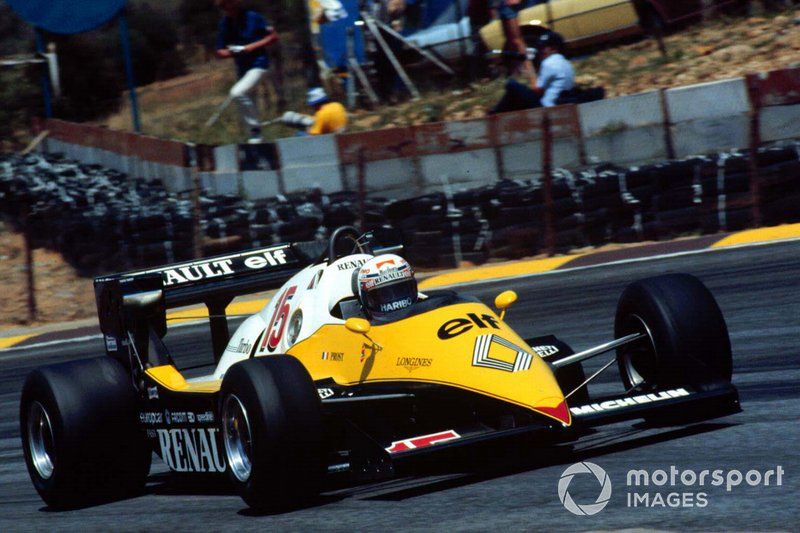
Alain Prost, Renault RE40 V6
Photo by: Motorsport Images
Piquet’s advantage was such that he could afford pitting for new tyres and rejoining in the lead. In the end, it mattered little. Prost retired on lap 36 with turbo issues, meaning all Piquet had to do was finish fourth and score three points. He cruised to the finish and duly stood on the third spot of the podium.
1986 Australian GP, Adelaide – Mansell’s blown tyre benefits Prost
Championship situation before the title decider
1. Nigel Mansell, Williams, 70pts
2. Alain Prost, McLaren, 64pts
3. Nelson Piquet, Williams, 63pts
Final standings
1. Alain Prost, McLaren, 72pts
2. Nigel Mansell, Williams, 70pts
3. Nelson Piquet, Williams, 69pts
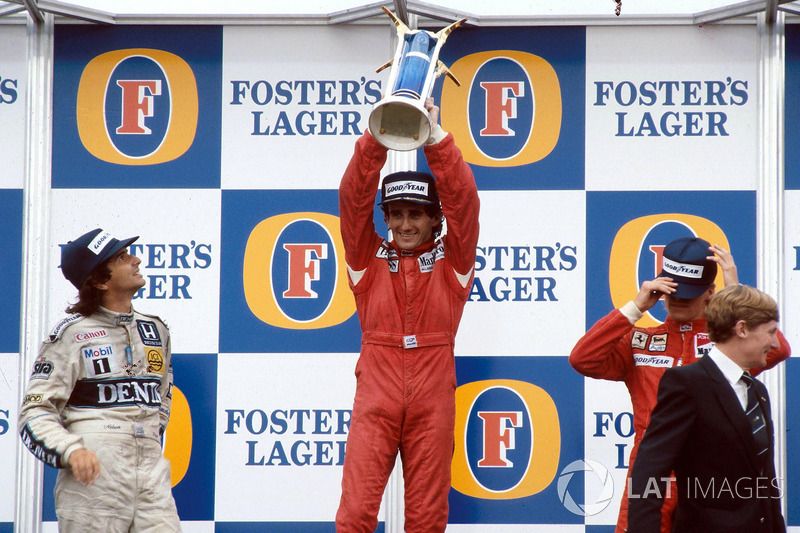
Podium: race winner and World Champion Alain Prost, second place Nelson Piquet, third place Stefan Johansson
Photo by: Sutton Images
For the first time since the 1950s, two team-mates tackled the season finale with title chances. Team-mates, but rivals above all, with increasing acrimony between Nigel Mansell and Nelson Piquet.
Erstwhile championship leader Ayrton Senna had dropped out of contention due to his Lotus’ unreliability, and Mansell was in a prime position to win the title. But only a competitor’s best 11 results counted towards the championship; both Alain Prost and Piquet could reach 72 points with a victory, in which case Mansell needed to finish second to see them off, owing to countback rules.
Mansell and Piquet took a 1-2 in qualifying, with Senna and Prost on the second row on the grid, but the Frenchman’s team-mate, Keke Rosberg, unexpectedly surged into the lead. The Finn disappeared into the distance, with his lead surpassing 30 seconds halfway through the race.
Meanwhile, Prost overtook both Williams cars as Mansell attempted to manage his machinery and Piquet spun. This meant Prost was in a position to win the title; as it stood, if Rosberg let his team-mate through, McLaren’s lead driver would end the season on 72 points – as many as Mansell, but winning on countback as he had more second places.
However, Prost clipped Berger’s Benetton when lapping the Austrian and pitted for new tyres on lap 32. Goodyear had previously recommended a one-stop strategy, but after inspecting the McLaren’s rubber, advised all runners that the whole race could be run on the same set of tyres.
Going into lap 63 of 82, Rosberg led his rivals by 22 seconds, with Prost putting pressure on Mansell for third place. That was when the Finn’s right-rear tyre delaminated. But Williams didn’t have time to warn its drivers, and Mansell’s tyre exploded on the next tour. He retired and risked losing the title if Piquet or Prost won.
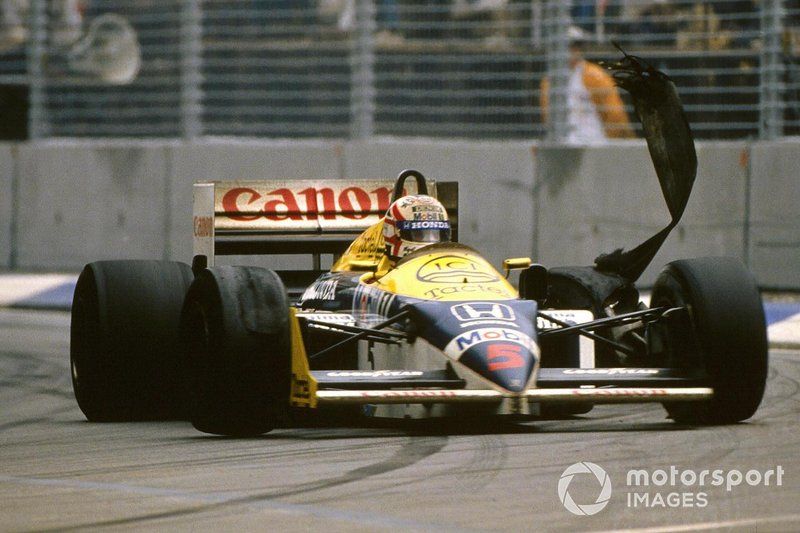
Nigel Mansell, Williams FW11
Photo by: Sutton Images
Williams played it safe and called Piquet in for new tyres; the Brazilian couldn’t make up the lost time despite his pace, meaning Prost won the race and the world championship.
2007 Brazilian GP, Interlagos – Raikkonen surges from behind
Championship situation before the title decider
1. Lewis Hamilton, McLaren, 107pts
2. Fernando Alonso, McLaren, 103pts
3. Kimi Raikkonen, Ferrari, 100pts
Final standings
1. Kimi Raikkonen, Ferrari, 110pts
2. Lewis Hamilton, McLaren, 109pts
3. Fernando Alonso, McLaren, 109pts
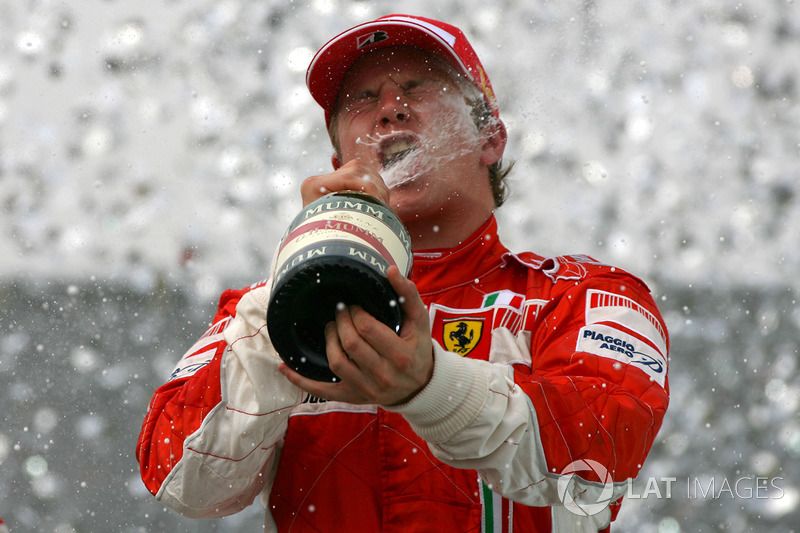
Kimi Raikkonen, Ferrari celebrates on the podium
Photo by: Sutton Images
2007 marked another intra-team rivalry as rookie Lewis Hamilton and two-time world champion Fernando Alonso went head-to-head for the title.
Hamilton’s maiden season had been nothing short of exceptional, and the 22-year-old Briton was the overwhelming favourite to win the title after winning a wet Japanese GP while Alonso crashed out. He then led his team-mate by 12 points and Ferrari’s Kimi Raikkonen by 17.
McLaren however failed to pit Hamilton early enough on a drying track in Shanghai, and he got beached in the gravel trap at pitlane entry after his tyres got worn down to the canvas, setting up a fascinating title decider.
Second Ferrari driver Felipe Massa took pole at his home track, leading Hamilton, Raikkonen and Alonso on the grid.
Hamilton was passed by both his rivals on the opening lap, locking up as he attempted to fight back against Alonso and dropping down to eighth. A few laps later, the English youngster encountered a gearbox issue and found himself down in 18th.
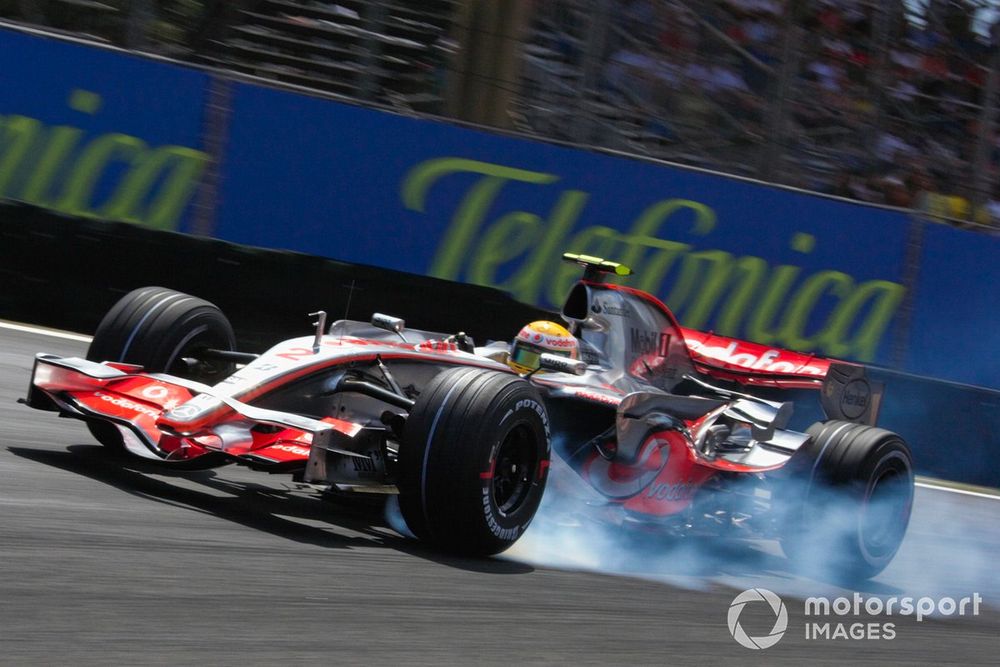
Lewis Hamilton, McLaren MP4-22 Mercedes with a lock up
Photo by: Rainer W. Schlegelmilch / Motorsport Images
As it stood, Alonso was on 109 points, Raikkonen on 108 and Hamilton on 107.
Hamilton recovered to seventh position, enough to get back ahead of Alonso on countback in the standings, but Raikkonen overcut Massa in the second round of pitstops, giving him the extra two points he needed to win the title.
Post-race, the Williams and BMW cars were investigated over fuel temperature, as fuel was not allowed to be more than 10C colder than ambient temperature. Had they been disqualified, Hamilton would have scored three more points, with the title switching back to him.
Stewards cleared those cars of wrongdoing as they deemed they lacked the necessary data to prove the fuel’s actual temperature. McLaren unsuccessfully appealed the decision.
2010 Abu Dhabi GP, Yas Marina – Vettel triumphs as Alonso, Webber fall into trap
Championship situation before the title decider
1. Fernando Alonso, Ferrari, 246pts
2. Mark Webber, Red Bull, 238pts
3. Sebastian Vettel, Red Bull, 231pts
4. Lewis Hamilton, McLaren, 222pts
Final standings
1. Sebastian Vettel, Red Bull, 256pts
2. Fernando Alonso, Ferrari, 252pts
3. Mark Webber, Red Bull, 242pts
4. Lewis Hamilton, McLaren, 240pts
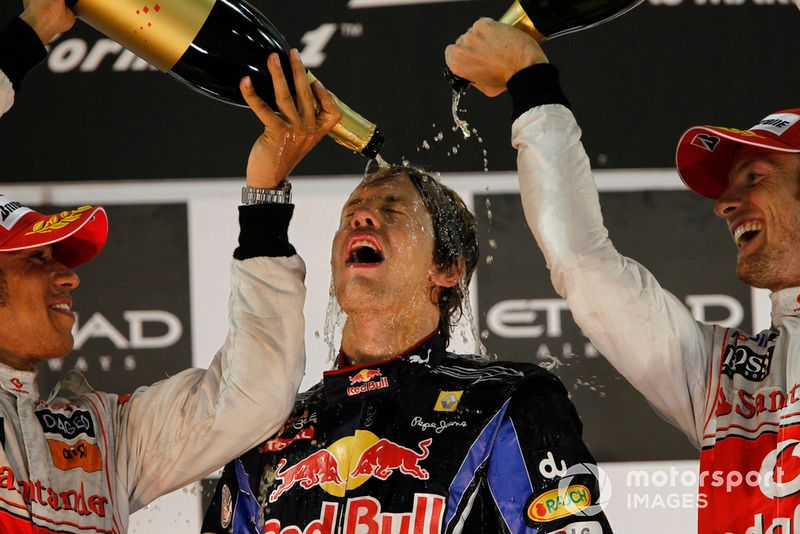
Sebastian Vettel, Red Bull Racing RB6
Photo by: Andrew Ferraro / Motorsport Images
For the only time in F1 history, four drivers were in contention for the title going into the season finale, as they shared all victories from round five onwards.
Lewis Hamilton needed to win, Sebastian Vettel required at least second place, and Mark Webber necessitated a top-five finish to have a chance to surpass Fernando Alonso.
Vettel took a decisive pole position, outpacing Hamilton by 0.031s with Alonso third and Webber down in fifth.
As it stood, Alonso was primed to win the title with 261 points, leading Vettel (256), Webber (248) and Hamilton (240). Alonso was passed by Button on the opening lap, but still had enough to be crowned, as he was virtually on 258 points.
The key moment of the race was Webber pitting as early as lap 11 as he struggled on the supersoft tyre compound. He was Alonso’s main threat for the title, so Ferrari decided to cover him and called Alonso in. The Spaniard rejoined in 12th ahead of Webber, but behind Renault’s Vitaly Petrov, who had done his mandatory pitstop under safety car conditions on the first lap.
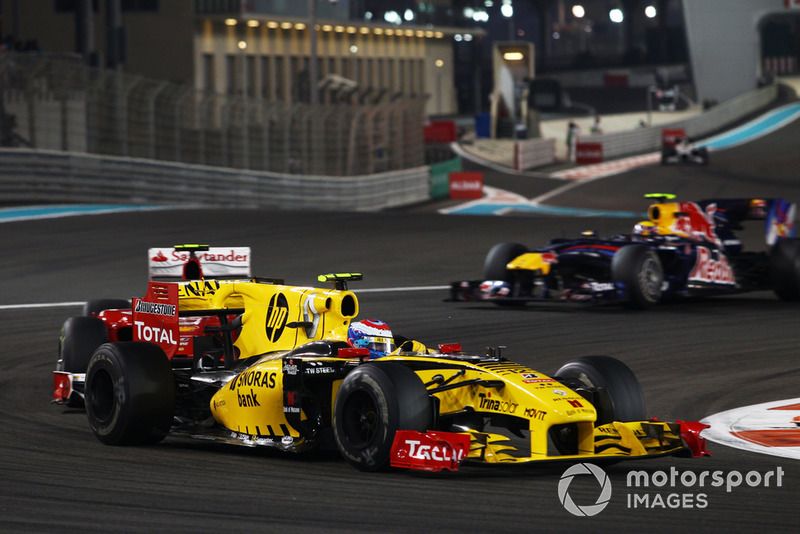
Vitaly Petrov, Renault R30
Photo by: Motorsport Images
In the last pre-DRS race, a dejected Alonso never managed to overtake the Russian rookie. He finished seventh, right ahead of Webber, while Vettel snatched the lead of the championship for the very first time of his career – at the very best time.
2025 Abu Dhabi GP, Yas Marina – All to play for between Norris, Verstappen and Piastri
Championship situation before the title decider
1. Lando Norris, McLaren, 408pts
2. Max Verstappen, Red Bull, 396pts
3. Oscar Piastri, McLaren, 392pts
Max Verstappen has been mounting a sensational challenge against McLaren after being more than 100 points down on the championship lead at the end of August.
Lando Norris has the edge going into the Abu Dhabi Grand Prix, but Verstappen and Oscar Piastri’s chances are not unreasonable. Find all title permutations below.
Read Also:
We want to hear from you!
Let us know what you would like to see from us in the future.
– The Autosport.com Team