
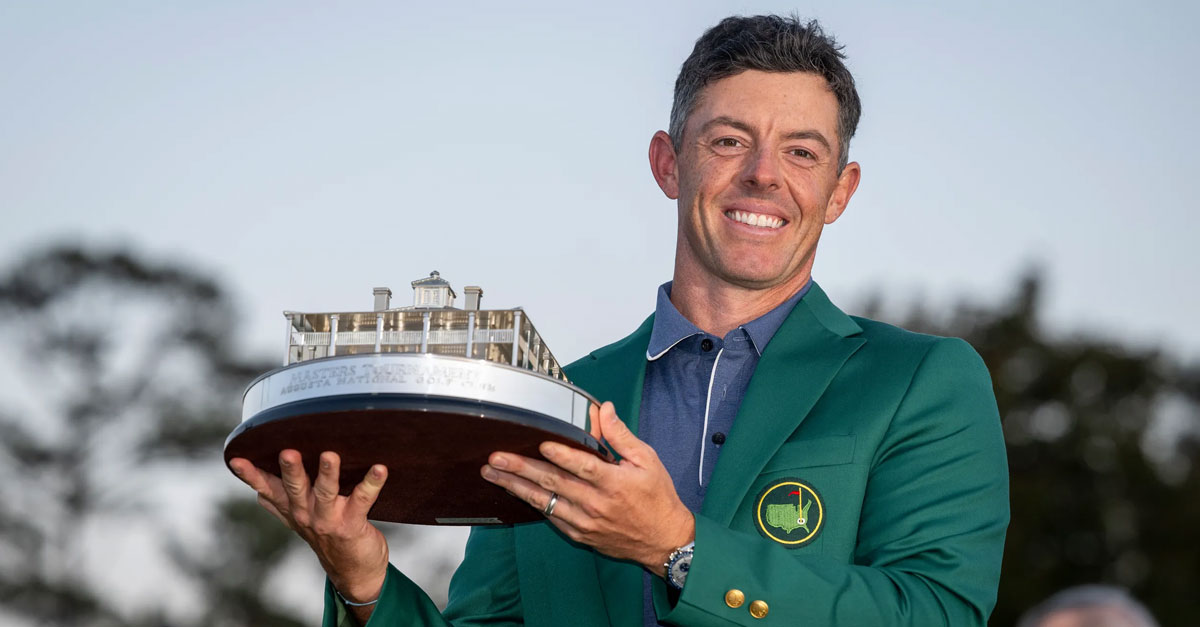
This week, Fried Egg Golf is looking back on the Year of Rory, and recapping the most interesting moments in the most interesting year of his career. Today, Kevin Van Valkenburg writes about the 2025 Masters, and why we’ll never experience anything like it again in our lifetimes.
The first time I ever had an extended conversation with Rory McIlroy, we ended up talking about Phil Mickelson.
It was a few years ago, and some of the details are fuzzy, but I’m confident I was the one who brought up Phil, because Phil had been my favorite player for much of my life. The conversation was largely complimentary, although each of our feelings about Mickelson had evolved over time. I brought up how fascinating it was to mull how many different philosophies Mickelson had brought to the Masters during his career. Some years, he overprepared, playing as many practice rounds as possible. Other years, he didn’t bother with a scouting trip, knowing his game was good enough to win if he just leaned into his experience as a strength. One year, he showed up with two drivers. Another year, he played without a driver. At some point, he brought five wedges to Augusta National. For a few years, he was obsessed with stats. A couple of attempts, he was only interested in vibes.
From my perspective, Mickelson tinkered because he was so talented, he needed to stay one step ahead of boredom. But boring golf was often consistent golf. I wondered if he could have won more green jackets if he didn’t have a penchant for overthinking.
“Overthinking things the week of the Masters?” McIlroy said. “You’re hitting a little close to home right now, Kev.”
We both laughed. It was hard not to appreciate the self-awareness, the acknowledgement that the Masters had turned McIlroy into a bit of a headcase, so much so that the headcase was willing to acknowledge it. But it only solidified something I felt deep in my gut and I just didn’t want to admit. Not yet.
He was never going to get a green jacket.
{{inline-article}}
Most people seemed to feel the opposite, at least outwardly — Mickelson and Tiger Woods and Jack Nicklaus and Gary Player among them. It was only a matter of time, they said, before Rory conquered Augusta. He was too talented, too destined, too deserving.
Every year, the greats of the game would saunter into the interview room and declare as much. “No question, he’ll do it at some point,” said Tiger. “Rory’s too talented, too good. He’s going to be playing this event for a very long time. He’ll get it done. It’s just a matter of when.”
Every time those Masters’ winners said something about fate with so much certainty, I suspected it was having the opposite effect on Rory. It was only making the burden feel heavier. Augusta is a wonderful, magical place — but only if the gods are on your side. It had tormented so many others, ripped a hole in some of them they could never fill. It was easy to say Rory wouldn’t suffer the same fate Greg Norman did, or Ernie Els did, or Tom Weiskopf did. It was harder — and more depressing — to mull a timeline where he was forever haunted by the place.
 Rory McIlroy alongside caddie Harry Diamond at the Masters (Fried Egg Golf)
For years, I told myself I had to be there when he broke his drought and finally won another major. I wanted to bear witness because I wanted to write something worthy of the moment, to carry the baton of golf scribes who came before me. I had grown up reading dispatches from Dan Jenkins, Rick Reilly, John Garrity, and Alan Shipnuck. They had documented Hogan and Tiger and Ernie and Phil. But Rory was my generational player. I wasn’t a good golfer, but I was a decent observer, a capable writer. I wanted to be a worthy link in the chain of people who scribble down drafts of golf’s history. When McIlroy was tied for the lead going into the final round of the Open Championship at St. Andrews, I was convinced I had missed my chance. I wasn’t there, and I had to accept that I’d missed it. Then Cam Smith and fate intervened. I took a job covering golf full-time and was grateful for my second chance. But all I got to witness over the next few years was more pain. Augusta National. Southern Hills. Brookline. LACC. Pinehurst. I began to suspect it was my cosmic fate to document his miseries, not his triumphs.
Along the way, we talked about raising daughters, about LIV Golf, about our own stubborn fathers, about work and colleagues and artists we admired. It wasn’t friendship exactly — you can’t truly be friends with a famous person, certainly not one you cover — but it became easier to understand his human side, and how it at times affected his golf. He had been ruthless back in 2014, admittedly a little selfish, and now he wanted to prove to himself he could be great with a different approach. I admired him for it, but I wondered too if he’d lost that edge that allowed him to be great in the first place.
***
In a press conference after the U.S. Open at LACC slipped from his grasp, the moderator called on me to ask him the final question. My mind went blank. Someone had already asked what I wanted to know, right before it was my turn. Somehow, I vomited up a question, wondering if it was exhausting to have to keep pretending these losses were building character, that he would grow from them, and eventually be rewarded. McIlroy smiled wearily, then produced what I came to think of as one of the best quotes of his career. “When I do finally win this next major, it’s gonna be really, really sweet,” he said. “I would go through a hundred Sundays like this to get my hands on another major championship.”
“A hundred Sundays like this”
It felt like such a poetic phrase, like it could have been — maybe even should have been — the title of a golf book John Feinstein had written a quarter century ago, before podcasting and Twitter overwhelmed golf media. When Rory kicked away the U.S. Open the following year at Pinehurst, missing two short putts on the back nine and peeling out of the parking lot without saying a word, it seemed like a tremendous test of that mantra.
“I’d like to get Bryson back for what he did to me at the U.S. Open,” Rory joked as the two men prepared to play an exhibition match, months later.
“To be fair,” Bryson teased, “you kind of did it to yourself.”
McIlroy winced. Even in jest, I could tell that the truth stung a bit.
“A hundred Sundays like this”
I kept turning it over in my head at the Masters this year, as I watched Rory walk a knife’s edge for five hours, wondering if this was going to be the most crushing loss of his career, or if it was the final boss he had to defeat if he was going to exorcise a decade of mental demons. When he dumped a wedge into the creek on 13, I thought I knew the answer. The cynic in me grabbed the reins.
When he hit his second shot into 15 on Sunday, I was standing outside the ropes, maybe 50 feet from him, packed into a crowd of foolish dreamers, but I couldn’t see the green. The trees blocked my view entirely. As he launched the ball toward the green, I craned my neck for a few seconds, then gave up and closed my eyes. Better to cede the floor to my other senses than stare into the back of someone’s golf polo, or the bark of a tree. A groan would let me know if the ball found the water.
When I tweeted about that moment hours later, someone called it the corniest shit they’d ever heard. They weren’t wrong. I am who I am. It’s still the best roar I’ve ever heard, and the best shot I’ve ever been present for, even if I didn’t get to see it.
Here is a cool thing I’ll remember forever: I was standing left of 15 today, not far from Rory when he hit his 2nd shot . It was packed, and hard to see the green. Impossible to see the flight of the ball. When he let it fly, I closed my eyes.
I let the roar tell me the outcome.
— Kevin Van Valkenburg (@KVanValkenburg) April 14, 2025
I never got to write the piece I’d dreamed of writing. Maybe I dropped the baton. (Apologies to the craft, Mr. Jenkins, Mr. Reilly, Mr. Herbert Warren Wind.) I was working on a podcast instead that week. Times change and dreams evolve, I’ve learned.
As it came together, I tried to convince myself I had no rooting interest in the outcome, that a story of him falling apart would be just as interesting as a story of his triumph. I was, after all, as seasoned as anyone in writing about his heartache. Perhaps that was my role to play, to chronicle the golf genius too human, too much of a headcase, to win a green jacket.
What an unexpected pleasure it was, in the end, to be proven wrong.
 Year of Rory Content
Australian Sandbelt in the Spotlight: Joseph LaManga examines Rory’s decision to play in the Australian Open, and how it offers hope for the future of golf Down Under.
‘This Is It’: Adam Woodard revisits Rory McIlroy’s career-defining shots on Saturday and Sunday at the 2025 Masters.
Favorite Moments from 2025: From Augusta National to Royal Portrush to comments made to reporters, McIlroy had a highlight-filled year.
Greater Importance of Rory’s Least-Impactful Win: Brendan Porath explains how McIlroy’s second Irish Open victory was a testament to his longevity and stature in the game.