
One cousin improved. Another cousin evolved. And a thief is loose north of the border.
Let’s open up the notebook to run through three NBA trends that have caught my eye over the past week:
Cheat codes
Three-time MVP Nikola Jokić is in the midst of his best-ever season.
A young superstar, Luka Dončić, is leading a 16-5 squad and is on pace to become the first Los Angeles Lakers player to average 35 points per game since Kobe Bryant. Oh, and he’s doing it while nearly averaging a triple-double.
Two-time MVP Giannis Antetokounmpo was better than ever until he hurt his calf earlier this week, an injury that could keep him sidelined for long enough to make him ineligible for postseason awards.
Either way, with all the NBA’s best players churning out career seasons, there should be no way that the reigning MVP repeats.
Or maybe not — because Shai Gilgeous-Alexander won a scoring title, an MVP, a championship and an NBA Finals MVP in 2025, then decided that wasn’t enough. The new version of Gilgeous-Alexander is making the guy who posted one of the most efficient, high-scoring seasons ever last season look like a scrub.
The Oklahoma City Thunder star has stopped missing shots.
He’s shooting 58.9 percent on 2s as a guard. Think about it like this: Shaquille O’Neal, the most physically dominant offensive force of most of our lifetimes, made 58 percent of his 2s.
The 3 ball, which was often his weak point, is at another level. Add one more item to the list of anxieties for any team facing the 21-1 Thunder: Gilgeous-Alexander’s stepback 3, which has never been so dangerous.
Last season, if Gilgeous-Alexander went right, he was more prone to pass or continue to the hoop. If he went left, he would get to his stepback. However, chucking so many stepback 3s and splashing in such a high percentage is giving defenses fits.
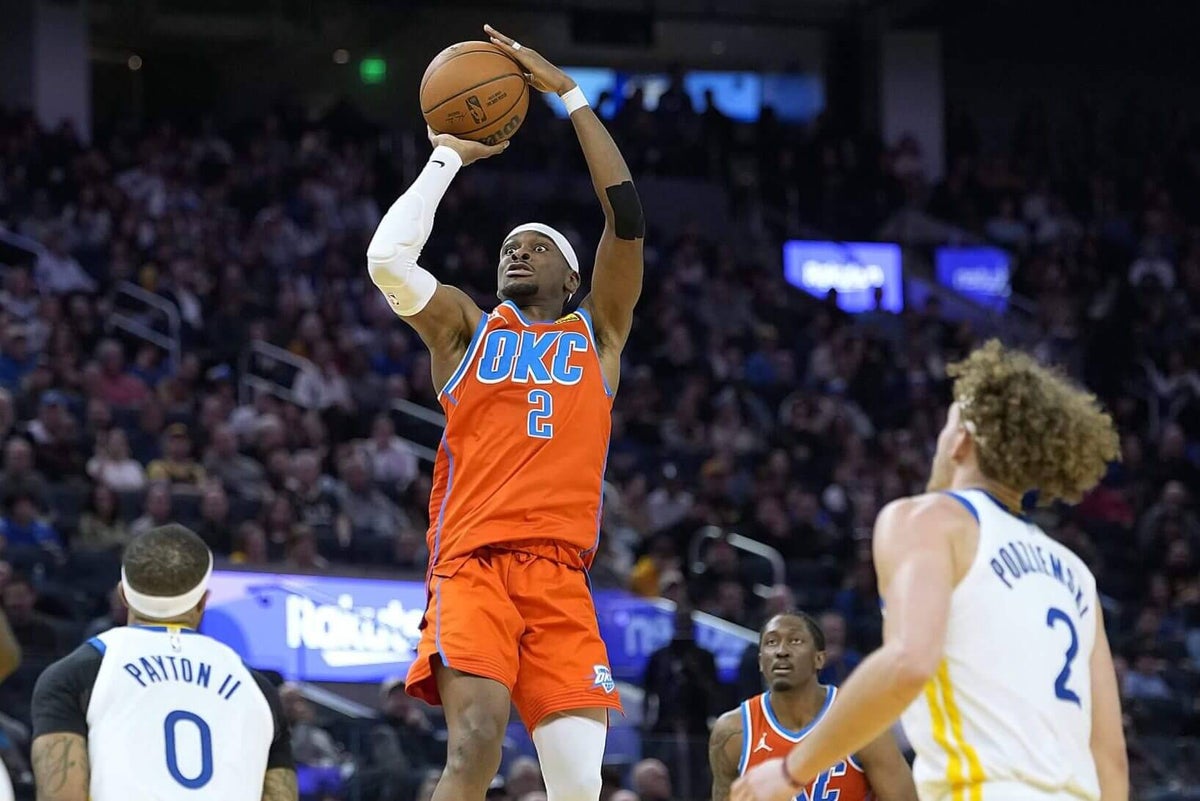
What is Golden State Warriors wing Brandin Podziemski supposed to do here? Gilgeous-Alexander looks like prime James Harden on this play:
But here’s where Gilgeous-Alexander is making defenses go haywire. The stepback can arrive at any point now.
A move that occurred only a couple of minutes after the above 3-pointer was horrifying. In the play below, Gilgeous-Alexander went right, planted, crossed over and stepped back for a top-of-the-key jumper.
Splash.
No one changes speeds with more precision than Gilgeous-Alexander does, but his skill set has never been this lethal so far away from the basket.
He has taken the fourth-most stepback 3-pointers in the NBA this season … and he’s shooting 52 percent on them. For reference, the three players who have taken more (Dončić, Harden and Tyrese Maxey) have made 34, 36 and 30 percent of their stepbacks, respectively.
The MVP from last season is scoring more, assisting more, getting to the line more, hitting way more 2s, nailing way more 3s and defending as well as ever for a team that’s even more dominant than the one that garnered a title.
Nickeil and diming
Two men in particular are thriving inside the Atlanta Hawks’ lightning-quick offense. Jalen Johnson, now a surefire All-Star, is filling up box scores. And he’s found a partner, a fellow who could double his career scoring average, as he’s done this season, and still not be the best player in his own family: the reigning MVP’s cousin, Nickeil-Alexander Walker.
With Trae Young hurt, the Hawks revved up what was already a speedy attack. They aren’t just trying to burst into transition anymore. They want to scramble whoever they face. One cut begets another. Johnson has absorbed the most facilitating duties, but he’s rarely pounding the basketball in search of a bucket or assist.
The Hawks, who have lost two straight but are still 11-7 since Young went down, are thriving on movement and quick decisions, which will make this team especially interesting once the ball-commanding Young returns.
However, for now, let’s look at how two of their breakouts fit together.
Alexander-Walker is destroying teams from deep. His season-long scoring average has now surpassed 20 a game, more than twice his career-long figure of 9.2. He’s especially scorched over the past 10 games — averaging 24.0 points and nailing 43 percent of his 8.8 long balls a night.
This is not the defensive-slanted pest the Hawks signed over the summer. It’s someone far more explosive. And Johnson is sparking the fire.
It’s not like Alexander-Walker has changed roles drastically since leaving the Minnesota Timberwolves. He might be a point guard in stature, but he’s not a lead initiator of the offense. He’s not firing off-the-dribble prayers from range. He’s reading defense while maneuvering away from the ball, relocating to open spots on the floor, and the offense is finding him from there.
The Hawks have started using him as a screener more often, especially when Johnson brings up the ball. During a narrow loss to the Detroit Pistons earlier this week, Alexander-Walker and Johnson ran inverted pick-and-pops aplenty — the smaller guy setting the screen and the bigger forward handling the rock. It’s an uncomfortable venture for Alexander-Walker’s defender, usually a guard who isn’t as experienced operating on the back end of a screen.
Look at how Cade Cunningham hesitates on this closeout of Alexander-Walker, which allows just enough room for the Hawks guard to drain a game-tying 3-pointer.
That play was part of a fourth quarter in which Alexander-Walker set constant screens for Johnson, enough so that the Pistons, owners of an imposing defense, began to slant to the two of them before they even came together.
Look at this possession from six minutes later, after Atlanta had spammed Detroit with pick-and-pops between these two guys. Still in a close game, Keaton Wallace hurries the ball up the court, a Hawks staple and heads to Johnson. But watch how the Pistons react.
Alexander-Walker is streaking alongside Johnson. It looks like the two of them will head into another pick-and-roll, given their positioning. However, Alexander-Walker, who opens himself up here if only because he is in a full sprint in a moment when the defense thinks going 90 percent will yield no harm, never sets the screen. He keeps running, slicing from the right wing across the paint to the opposite corner, which is not a standard cut.
The Pistons short-circuit. And Johnson flings a dime to his guy.
Johnson assisted Alexander-Walker on four 3-pointers just during that fourth quarter. Both are excelling inside an offense that’s in never-ending motion.
Locked in the Shead
Here is a helpful piece of life advice: If Toronto Raptors guard Jamal Shead is near you, do not dribble.
Shead is a stocky badgerer, the kleptomaniac who comes in with the reserves and makes a mess of everything. The Raptors love it.
Even the Hawks might not move as quickly as the Raptors. Toronto turns a higher percentage of its possessions into transition opportunities than any other team in the league. When it gets steals, it races the other way.
Enter: Shead, the second-year agent of chaos.
He will switch onto larger players and not care. Earlier this week, he got stuck on Portland Trail Blazers center Donovan Clingan, who is a foot taller than him. The Blazers noticed the mismatch and tried to wedge the ball to their big man down low. Shead bumped him away from the spot, leaped in front of Clingan and ripped the ball away, like a cornerback successfully wrestling for an interception.
Naturally, the Raptors were on the run after that.
Shead is pulling off all types of steals.
He’s outmuscling guys who tower over him. He’s eliminating passing lanes. Sometimes, he outdoes someone with pristine hands.
Look how quickly he reaches in to poke the ball away from Deni Avdija during that same Blazers game:
Shead had five steals that night. Over his past three games, he has 11 — and he’s done that in only 61 total minutes. He’s become one of the league’s best defenders of his size (6 foot 1).
Do not dribble anywhere near him.