
A little under two years ago now, I wrote about the misguided nature of the old platitude that ‘sport and politics don’t mix’.
The essence of its meaning, one would think, is that the two should not mix, rather than that there exists no overlap at all. However, the implication here is that keeping these two opposing worlds apart is a feasible option. Clearly, this is a fallacy.
Indeed, the inescapable influence that sport and politics continue to impose over one another is more evident today than at arguably any previous point in modern history.
Russia’s invasion of Ukraine in February 2022, to take the most salient example, has cast profound and far-reaching consequences across almost every sporting industry, as well as the deeper scars it still inflicts on global society in general.
Russian and Belarusian national teams across a multitude of different sports have been banned from international competition for nearly four years now, while the status quo of most individual athletes from these countries is a requisite to play under a neutral flag and, in some circumstances, to denounce the actions of their native governments.
Since the reversal of Wimbledon’s ban on the participation of Russian and Belarusian players in spring 2023, this has been the existing condition in tennis.
Namely, these two nations remain barred from the international team competitions that are the United Cup, the Billie Jean King Cup, and the Davis Cup, while neutrality is mandated across the rest of the calendar.
Inevitable tensions between players, embodied by the now customary lack of handshake between Ukrainians and Russian/Belarusian opponents, and the virtually impossible balancing act between accountability and individual safety, have opened up painful new avenues of debate in a sport that already has its hands full to the brim with other complex governing issues.
Exodus of Russian Tennis Players Continues to Grow
But one topic that has sat quietly in a dark corner away from the glare of the media spotlight has been the steadily growing number of Russian players switching allegiances from their native homeland.
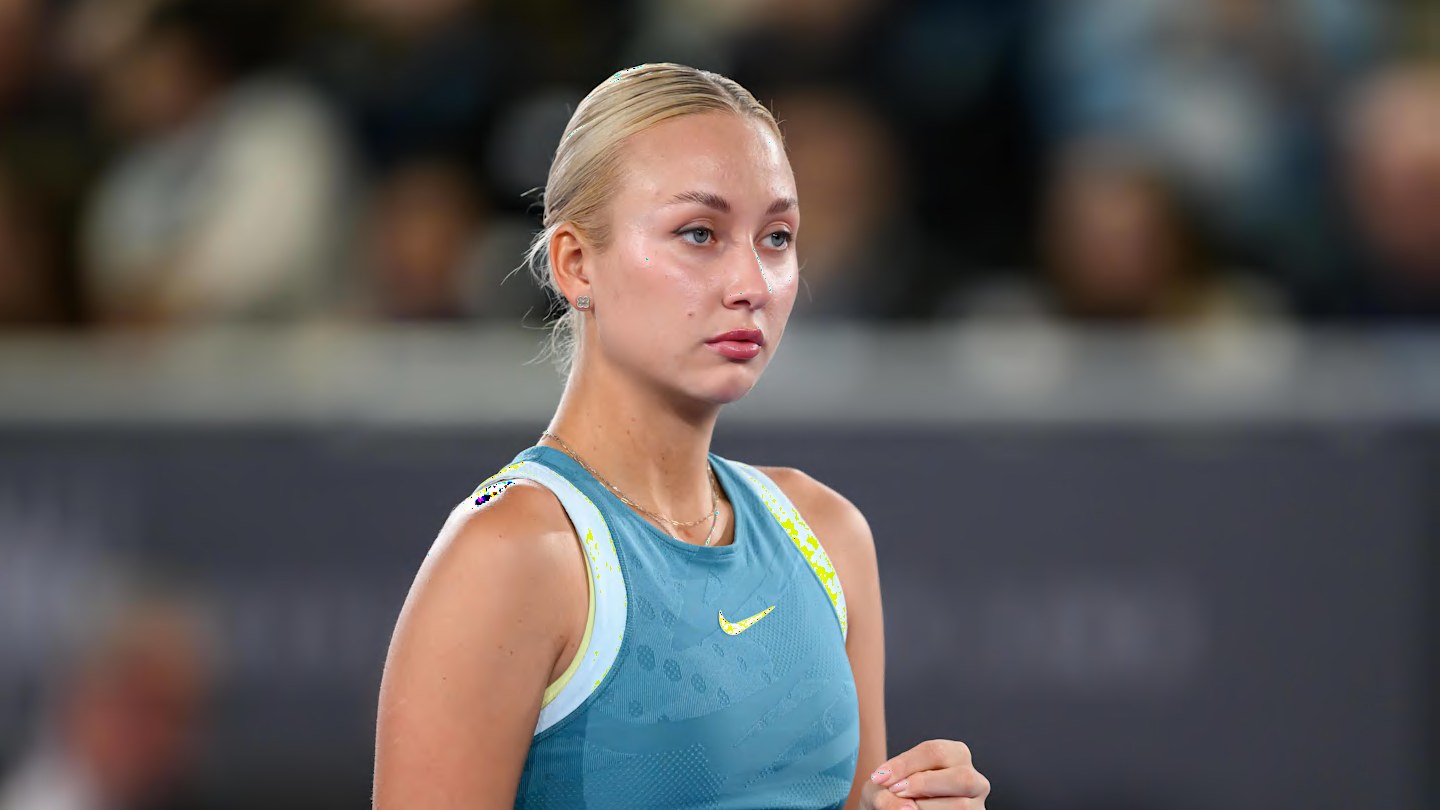
Just this week, Anastasia Potapova became the latest in a lengthening list of tennis players to successfully apply for citizenship outside of Russia when she revealed her newfound status as an adoptive Austrian national. In each of these cases, including Potapova’s, this switch has been a necessary precursor to changing the official country of representation in their professional careers.
“I am delighted to let you all know that my application for citizenship has been accepted by the Austrian government,” Potapova wrote on social media on Wednesday.
“As part of this I am proud to announce that starting from 2026 I will be representing my new homeland Austria in my professional tennis career from this point onwards.”
In March of this year, Daria Kasatkina – an outspoken critic of the war, as well as of Russia’s prohibitive laws on LGBTQ+ rights – became the highest-profile name to make the switch when she was granted permanent residence in Australia, opting to officially represent her new home ever since.
Mere days before Potapova’s announcement this week, fellow Russian Kamilla Rakhimova was reported to have changed her tennis nationality to Uzbekistani, where the 24-year-old has heritage through her mother. In October, Moscow-born Maria Timofeeva completed an identical switch to represent Uzbekistan, with her family having relocated to the country six months prior.
This follows the moves to French citizenship for both supremely talented youngster Ksenia Efremova and World No. 82 Varvara Gracheva in September and June of 2023, respectively, while Elina Avanesyan switched allegiance to Armenia in the summer of last season, where both her parents are from.
Doubles specialist Natela Dzalamidze appears to have started the trend, making an official move to Georgian representation in June 2022 – one that was primarily motivated by Dzalamidze’s desire to play Wimbledon that summer, the year Russians and Belarusians were banned, as well as compete in the Paris 2024 Olympics under an official national flag.
It is a curious truth that almost all of these cases come from the women’s side of the game, with Potapova’s former husband Alexander Shevchenko the ATP’s sole representative since February 2022, having becoming a citizen of neighbouring Kazakhstan in January 2024 – a country that is already well-established as a haven for aspiring for Russian players who struggle to receive adequate funding from the Russian federation.
Why Are Russian Tennis Players Changing Nationality?
There are, of course, substantial benefits to switching one’s sporting allegiance away from Russia. As outlined above, this removes the current barrier to entry for international team competitions, which hold immense prestige and precious tour ranking points in the BJK Cup and the United Cup, respectively.
The element of uncertainty around potential visa restrictions and tournament access is also lifted, while the hovering threat of further bans in unknowable circumstances is circumvented. Add to this the financial backing of belonging to a recognised national tennis federation, with all the support networks and access to coaching that this is packaged with.
The cynic – or realist, depending on how you view things – might conclude at this point that Russian players jumping ship is likely motivated more out of self-interest than anything else. It is a sound argument.
Yet there is also a tangible risk involved with what could easily be interpreted as a public shunning of Russian representation by a high-profile athlete. For example, Kasatkina’s switch to Australian citizenship was followed by an unsuccessful attempt from a Russian politician to have her listed as a ‘foreign agent’.
This is because there is also a cost to Russia. Aside from damaging optics, a country with such a proud sporting heritage, and an undeniable tennis powerhouse, is witnessing its global standing in world sports being eroded as its absence from global events is extended and the tennis talent drain continues to trickle away.
It is an issue that looks set to persist. While self-interest is a more likely motivating factor here than some vague expression of moral rectitude, Russian tennis players are still taking a calculated risk in their decision to switch allegiances. And it’s a decision that is apparently being deemed increasingly worthwhile.
More Tennis News
Frances Tiafoe’s explanation of firing his coaches shocked Venus Williams.
Interview: Nick Kyrgios reflects on his 2025 season and looks ahead to 2026.
Emma Raducanu is not sympathetic to players complaining about the WTA Tour schedule.
Novak Djokovic wants to “reconstruct” his body this off-season.