

Source: AWS
Artificial Intelligence in many people’s minds is still thought of as chatbots who take text inputs and then generate weird images of people with too many fingers (give me a high 6 if you’ve ever spotted a fake AI image because of a telltale hand).
The truth is, AI technology is changing so profoundly, and so rapidly, it’s nearly beyond imagination.
Fortunately in Canada, there are some very clever people who are being imaginative with the latest AI tools and they’re doing profound things many would never know are possible.
At AWS re:Invent (a tech conference in Las Vegas showcasing the very latest applications of AI and cloud computing) a few Canadian companies took centre stage to share the innovative ways they’re using AI.

Source: AWS
10s of thousands of people from around the world travel to AWS re:Invent each year.
Voxelis
Living in Canada means dealing with the anxiety of wildfire season. That is a space where Voxelis is standing out for their innovative tech approach to fighting fires.
Colin O’Neill, the CEO, describes their tech as “physical AI.” They have built a rugged device that straps onto existing helicopters—the ones already out there fighting fires. Usually, when a pilot is “tanking” (dropping water on a fire), they are too busy flying a complex machine to manually log data.

Source: geekingout.ca
Voxelis’ device can be mounted to helicopters allowing them to collect a variety of data pieces while in flight.
Voxelis uses edge computing (processing data right there on the chopper) to scan the fire boundary and track the effectiveness of water drops in real-time. It sends that intelligence back to the wildfire agencies. By doing this, they’re taking a traditional industry and giving it a massive high-tech upgrade to keep communities safe.
Plume IA
If you hear about AI and doctors, a red flag might go up. And rightfully so. We want to be very careful with the places we allow AI to be introduced to our lives and when it comes to a doctor’s visit, is there a place for it that still supports patient’s privacy and care?
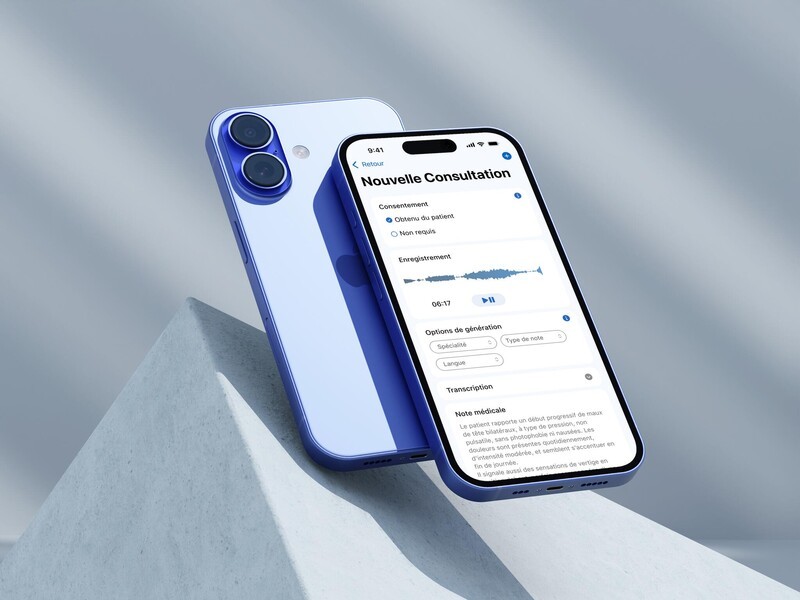
In the case of Plume IA, the AI is being used to keep doctors more present with their patients during an appointment and less burdened by standard paperwork after. It’s not being used to assess patients, it’s their to support the doctor’s post appointment work.

Source: Plume IA
The program can run on a phone or computer.
Marc-Andre Paquin from Plume IA has rolled out an AI-powered medical transcription service.
During a patient appointment, with all parties consenting, the doctor can record the audio from the session. Plume IA automatically generates a secure transcription, meaning the doctor doesn’t have to take notes during the appointment. They just chat with and listen to the patient. And then afterward they can review the notes, and more quickly book their patients for follow up care, prescriptions, or whatever else they need.
What kind of difference does this make? The stats are wild: this tech can reduce the time doctors spend on documentation by 50%.
Source: Plume IA
In some emergency rooms, this efficiency allows doctors to see 3 to 5 more patients every single day. Less paperwork for the doctor means more attention and focus for the patients in each appointment.
Shop Travel
Travel is fun! Booking travel is less fun. It can quickly turn into a vast wasteland of open tabs while you hunt for the best deals that match your tastes, itinerary, and budget.

Source: geekingout.ca
This app can suggest travel booking options based on info you may share like (somehwere with a great view of the fjords of Norway).
David Aeri from Shop Travel is showcasing a new way to do it using a “born in the cloud” approach.
They are building an AI agent that users can actually talk to in conversational English (and other languages) to book travel quickly and accurately that matches the person’s interests.
In a demonstration, a person booked a hotel in New York just by having a conversation with the pleasant and friendly AI assistant. The impressive part was the nuance—the person calling said they were traveling with “me, my wife, and my mother-in-law,” and the AI instantly understood that meant “3 adults.” You don’t need to speak in your authoratitve talking-to-tech voice where you have to precisely say key phrases or the AI gets lost.

Source: geekingout.ca
For beach getaways or business trips, Shop Travel aims to streamline bookings but also suport if there’s interruptions on your trip.
Shop Travel attempts to bridge the gap between what they call the “unknown journey” (just browsing) and a personalized booking, putting the power of a travel agent directly into a smartphone. But the system also allows for travel agents and other professionals to connect with the app to expand the reach of their travel-related services.
It’s also supposed to be smart enough that if it helps you make your initial booking and there’s a flight delay or cancellation, it can proactively take steps to get your travels back on track.
Coveo
Coveo is a veteran in this space—having been around since 2012—but they are doing some heavy lifting with Generative AI.
Richard Tessier, the Senior VP of Product, explained how they power the search and recommendation engines for massive companies that so many Canadians depend on each day.

Source: geekingout.ca
Coveo’s AI solutions power the tech behind some of Canada’s largest companies.
If you have ever searched for a laptop on the Dell website or looked for a flight on Air Canada, you have likely used Coveo’s tech without knowing it.
They are now using GenAI to help enterprise employees, like the staff at RBC, find the information they need to do their jobs faster. It is the invisible brain and brawn behind the websites we use every day. And it’s a Canadian company that’s using AWS tools to power these vitally important business functions.
AWS is betting big on Canada
It was great to see these Canadian companies shine at a conference that sees 60,000+ attend from around the world to learn about the newest AI and cloud computing tools.

Source: AWS
At this Canadian-centric panel, AWS highlighted some significant numbers regarding their commitment to the country.
AWS is planning to invest over $24 billion in Canada by 2037. This investment goes beyond just servers; it includes data centers, infrastructure, and a workforce that already numbers more than 9,300 full-time employees across the country.
Here are a few other key ways AWS is shaping the Canadian tech landscape:
Massive Economic Contribution: AWS estimates they will contribute over $42 billion to the Canadian GDP by 2037.
Rapid AI Adoption: According to their research, a business in Canada adopts AI every three minutes—a faster rate of adoption than we saw with the mobile phone or the internet.
Closing the Skills Gap: Recognizing that skills are the biggest barrier to AI adoption, AWS has already trained over 300,000 people in Canada with digital skills. They also run programs like “AWS Restart,” which helps underemployed individuals launch cloud careers with a 95% employment success rate.
Sustainability Focus: Amazon is the largest corporate purchaser of renewable energy in Canada. They are also aiming to be “water positive” by 2030 (meaning they return more water to communities than they consume), a goal they are already 50% of the way toward achieving.
AWS is also innovating with how smart a smart home can get.
It is clear that the cloud isn’t just about storage anymore; it is the engine driving some of the most innovative technologies in our country. And we’re fortunate to have so many innovative minds to imagine ways this technology can be used to shape our future.
Read more

Shootin’ Hoops
How AI is Changing Basketball (It’s Not What You Think)
AWS, the cloud based systems that are powering some of the coolest AI technologies in the world, are being embraced by sports leagues around the world. Recently, I got a firsthand look at how advanced AI is being used in basketball to help players and coaches and change the game-watching experience for super fans.

Good AI
Google Gemini’s Best Features You Need To Start Using
If you’ve upgraded to the Pixel 10 lineup, there’s never been a better time to dive into Gemini. Especially because you can upgrade (for free) to a better version of Gemini than ever. Here’s some of the tools you’ll get.