
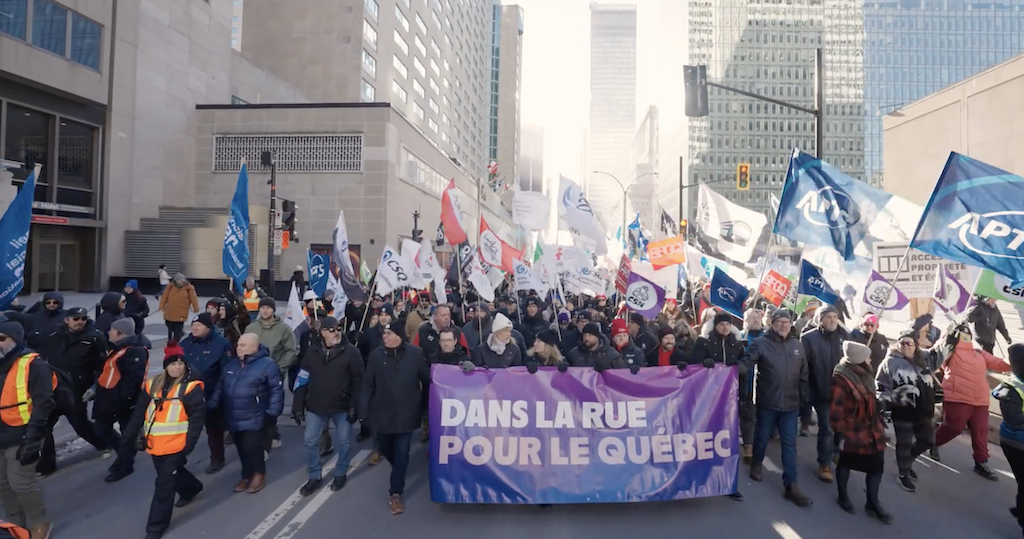
On Saturday, tens of thousands of demonstrators gathered in Montreal’s Place du Canada to protest the Quebec government’s recent legislation targeting unions and the right to strike.
The protest, organized by several major labour organizations in the province, drew an estimated 50,000 people and ended with a rally in front of Premier François Legault’s Montreal office.
“We want the government to understand that the middle class, workers, community groups, the people, need a government that listens and works with them,” said Magali Picard, president of the Québec Federation of Labour (FTQ), ahead of Saturday’s protest.
Legault’s Coalition Avenir Québec (CAQ) government has passed multiple pieces of controversial legislation targeting the province’s workers this year.
In October, the CAQ passed Bill 101, which introduced changes to the workplace health and safety system that critics say creates a two-tier system for workers in healthcare, education and social services. Later that month, the government passed Bill 2, imposing a new contract on Quebec’s doctors that ties their salaries to performance targets and fines physicians for protesting the changes. Ontario and New Brunswick have since seen a surge in license applications from doctors in Quebec.
But there are two particular pieces of legislation that are seen as an attack on the entire labour movement.
Law 14 (formerly Bill 89)
Saturday’s massive rally was held on the eve of Law 14 coming into force. Formerly known as Bill 89, the law amends Quebec’s Labour Code “to give greater consideration to the needs of the population in the event of a strike or a lock-out,” per its official English title.
It allows the government to suspend the right to strike or lock out, in order to ensure that services guaranteeing the population’s “social, economic or environmental security” are not disproportionately affected.
Law 14 also gives the province’s Minister of Labour the ability to order binding arbitration in situations where a conciliator or mediator hasn’t been successful and a strike or lock-out “causes or threatens to cause serious or irreparable injury to the population.”
“Bill 14 infringes on workers’ right to strike, disrupts the balance of labour relations, and places too much power in the hands of the Minister of Labour,” the leaders of five major unions, representing over one million workers in Quebec, said in a joint statement this week.
Finn Makela, a law professor at the Université de Sherbrooke, said Law 14’s strike-breaking powers are likely a direct result of the frustration the CAQ government felt over the Common Front, a coalition of four major union federations representing mainly education and healthcare workers — the aforementioned FTQ, along with the Confédération des syndicats nationaux, the Centrale des syndicats du Québec and Alliance du personnel professionnel et technique de la santé et des services sociaux — that staged a series of job actions over the winter of 2023-24. At one point, more than half a million workers in Quebec were on strike.
Makela said when the teachers went on a 22-day strike as part of the Common Front, the Legault government didn’t bother tabling back-to-work legislation.
“They were kind of stuck with the teachers, and ended up, I think, probably paying more to the Common Front than they had originally intended, and they felt that legally they couldn’t force them back to work,” explained Makela.
Since a 2015 Supreme Court of Canada ruling that found the right to strike is covered by the Canadian Charter of Rights and Freedoms, most back-to-work legislation that’s been ordered in Quebec has been challenged by unions on the grounds that it’s unconstitutional.
On Monday, a coalition of unions in Quebec announced that they filed coordinated legal challenges to Law 14.
Bill 3
This piece of legislation concerns union dues, which are the payments deducted from the paycheque of every worker in a bargaining unit to fund collective bargaining, legal representation and educational opportunities. In Canada, dues are generally mandatory for all workers in a unionized workplace, regardless of whether or not they signed union cards.
Bill 3 seeks to split union dues into “principal” dues, which would be mandatory, and “optional” dues. The details of the optional dues would have to be presented to a union’s membership at least once a year and put to a secret-ballot vote.
A union could draw from only its optional dues to fund legal cases that don’t directly concern a collective agreement or condition of employment. Any support the union provides to a political campaign, advertising campaign or social movement would also have to come from the optional dues. (Alberta implemented a similar set of rules in 2022.)
Additionally, the bill would require every union to produce a yearly report detailing how much it receives in optional and principal dues, the expenses of every person who holds an elected position in it, all expenses exceeding $5,000 and any expenses made using optional dues. Unions would have to make these reports available on request, free of charge, to every worker they represent.
The bill, which is still under consideration, has been condemned by union leaders across the province.
“The bill imposes measures that are impossible to apply, including the requirement for voting to be over 24-hour periods on recurring decisions, as well as an arbitrary division of union dues that directly limits the ability of unions to challenge government laws and decisions that infringe on fundamental rights,” Julie Bouchard, president of the Fédération interprofessionnelle de la santé du Québec (FIQ), which represents healthcare workers, said in a statement last week.
The FTQ’s Picard has called it a “direct attack on workers’ freedom of expression and association.”
Makela said it is unclear how unions are expected to conform to the proposed legislation. He said the distinctions the bill draws between which legal cases or social movements could be funded using principal dues are strange, since the scope of the Charter — which protects people from discrimination on the basis of gender, race, ethnicity, sexuality, disability and other factors — is so broad.
When speaking to the press during the CAQ convention in September, Labour Minister Jean Boulet singled out the legal challenge to Quebec’s secularism law by a federation of teachers’ unions, which he claims was done “without the approval of its members.”
The Fédération autonome de l’enseignement (FAE), which includes nine teachers’ unions, has joined a Supreme Court challenge of what Makela describes as the “centrepiece legislation of the CAQ”: Bill 21, introduced in 2019 with the help of the notwithstanding clause, which bans the wearing of religious symbols by public workers.
While the wording of the bill concerns workers wearing “ostentatious religious symbols,” critics have said that workers wearing Muslim headscarves are most likely to be targeted by the law.
Makela said the government’s position that unions have no place fighting laws that have nothing to do with working conditions is “a farce, because, of course, blocking hiring, transfer and promotion of Muslim workers is a labour issue.”
The CAQ has recently introduced legislation that would expand Quebec’s secularism regime to ban religious symbols in subsidized daycares and the education system.
Makela pointed out that unions are sometimes in the position of defending laws, or are required to participate in constitutional challenges in order to continue their efforts to unionize new workplaces, as in a 2006 case in which UFCW had to address Walmart’s contention that a section of Quebec’s Labour Code ran afoul of the Charter.
“But under the new regime, they wouldn’t be allowed to participate in that litigation, unless, of course, they used it from their special dues,” explained Makela. “You can’t know in advance when some multinational corporation is going to challenge Quebec’s laws. So how are you going to fund the litigation?”
Even if the language of the legislation is vague and contains loopholes, Makela said the additional work required to conform to the law, and the uncertainty around it, would likely still have an impact.
“It still has a chilling effect,” said Makela. “Every time a union wants to do something, they have to say, ‘Okay, well, which budget do we take this from?’”
Makela said the future for both pieces of legislation is unclear, especially with a provincial election set for next year. The FTQ has reportedly been meeting with Quebec’s opposition parties to push them to commit to repealing the laws if elected.
Legal challenges are also possible (and in the case of Law 14, currently under way), but Makela said given the restrictions that Bill 3 places on a union’s ability to challenge the province’s laws in court, such an undertaking could be difficult.
“There’s really good arguments for the unconstitutionality of portions of both of these laws,” said Makela. “Not saying they’re slam dunks, but there’s good constitutional arguments to say that they’re unconstitutional.”
Correction: A passage in this article has been amended to clarify that Finn Makela was alluding to a case involving UFCW and Walmart that was heard by Quebec’s labour board in 2006, rather than to a later case that didn’t involve a question of constitutional validity.
Our journalism is powered by readers like you.
We’re an award-winning non-profit news organization that covers topics like social and economic inequality, big business and labour, and right-wing extremism.
Help us build so we can bring to light stories that don’t get the attention they deserve from Canada’s big corporate media outlets.