
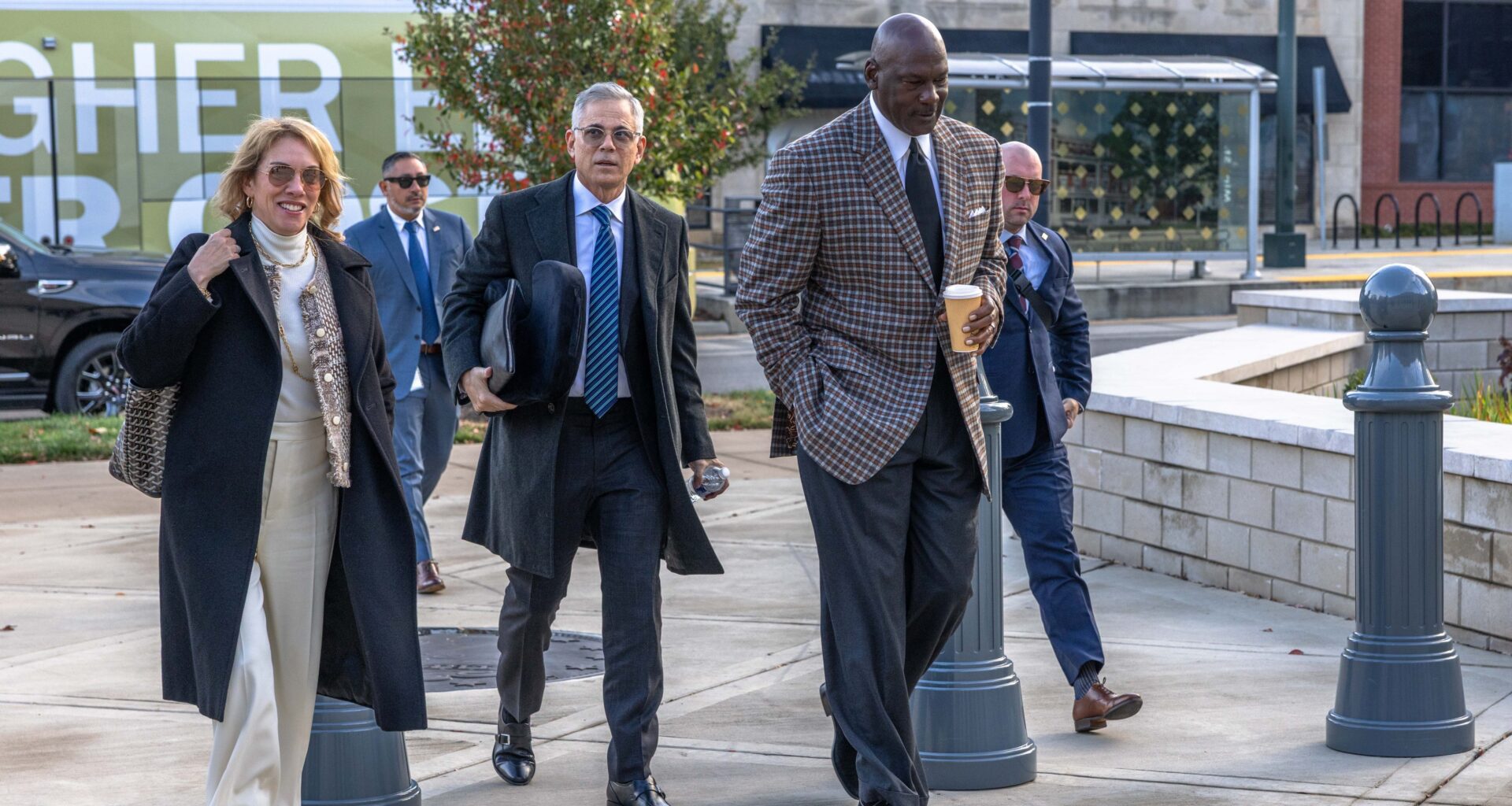
A busy week in a Charlotte courthouse pitted 23XI Racing and Front Row Motorsports against NASCAR and CEO Jim France. Now, this antitrust lawsuit trial will continue into its second week.
The legal team representing the Plaintiffs (23XI Racing and Front Row Motorsports) will continue presenting its case. This side aims to prove that NASCAR has used its monopoly status and anti-competitive acts to hurt teams while simultaneously enriching the France family.
The legal team representing the Defendants (NASCAR and France) will aim to prove that it did nothing illegal over the past seven decades, particularly in the charter era that began in 2016 and continued with the 2025 Charter Agreement.
Based on NASCAR’s line of questioning in the first week, it will also continue to highlight 23XI Racing co-owner Curtis Polk as a central antagonist of the charter negotiations that lasted from mid-2022 until Sept. 6, 2024.
Before heading back to the courthouse to kick off the second week of this trial, let’s look back at how the first week progressed.
The witnesses we have seen testify
The first day of trial only had one witness take the stand, James Dennis Hamlin, due to jury selection taking up considerable time. The NASCAR driver spent under an hour on the stand last Monday before returning on Tuesday for roughly three more hours.
The week continued with NASCAR Executive Vice President and Chief Strategy Officer Scott Prime taking the stand on Tuesday and Wednesday. Front Row Motorsports owner Bob Jenkins then followed on Wednesday and Thursday.
NASCAR President Steve O’Donnell followed Jenkins as he took the stand on Thursday. He remained there through the end of the day before returning on Friday.
The final day of trial featured three other witnesses taking the stand after O’Donnell. Joe Gibbs Racing co-owner Heather Gibbs, 23XI Racing majority owner Michael Jordan, and Race Team Alliance Executive Director Jonathan Marshall all provided testimony.
Gibbs and Jordan each had one hour on the stand. Marshall had multiple hours in front of attorneys for the Plaintiffs and Defendants. Marshall will return to the stand to kick off the second week.
The main points for Plaintiffs
The Plaintiffs have focused on a few different points while presenting the case against NASCAR and France. The first is the sanction agreements that NASCAR holds with the tracks it owns and those that Speedway Motorsports owns. These agreements have exclusivity language preventing other motorsports events unless NASCAR provides an exception.
IMSA, IndyCar, and Indy NXT are among the series that have the opportunity to compete at the tracks with the sanction agreements. NASCAR denied access to the now-defunct SRX series when Speedway Motorsports made the request.
Another key part of the Plaintiffs’ case is the concept of permanent charters. Lead attorney Jeffrey Kessler and other members of the legal team have used witnesses to highlight how permanent charters were one of the four pillars for the Team Negotiating Committee. His line of questions have focused on whether NASCAR could allow permanent charters without tying the economics of the sport to them.
Plaintiffs also used the first week to focus on France and the power he has within NASCAR. They brought up pieces of evidence talking about a “dictatorship” and how members of NASCAR’s negotiating team expressed frustration after meetings with France.
Scenes from the courthouse as we head into the weekend break. pic.twitter.com/0gPDJSArJI
— John Newby (@JohnNewby_) December 5, 2025
The financials were another point of emphasis for Plaintiffs during the first week of trial. Multiple witnesses discussed a survey conducted with a select group of teams, which they said showed it takes $20 million to field a car. Teams asked for this amount ($720 million total), but NASCAR only provided $12.5 million per car in the 2025 Charter Agreement.
These discussions also focused on the media rights revenue split. According to NASCAR, teams got 45% of the TV money under the new Charter Agreement. Yet, Marshall said this number is actually only 42.7% due to teams paying a broker fee among other fees. Witnesses also said that this is not 45% of total revenue considering that teams get nothing from the international broadcast rights, nor do they get any money from NASCAR’s sponsors.
We finished up today with direct and cross examination of RTA executive director Jonathan Marshall.
– plaintiffs counsel spent time talking about charter negotiations and financials. Said the 45% of tv revenue going to the teams is actually 42.7%. Teams pay a broker fee to CAA…
— John Newby (@JohnNewby_) December 5, 2025
The main points for Defendants
While Plaintiffs focused on alleged anti-competitive acts during the first week of the antitrust lawsuit trial, Defendants took a different approach. As one media member told FanBuzz during a break, the two legal teams were like ships passing in the night in how they focused on different themes.
NASCAR’s legal team focused on the length of negotiations and how the TNC started them much earlier than expected under false pretenses. When faced with damning texts and emails about the teams and/or France, the NASCAR executives on the witness stand just stated that they had grown more and more frustrated as negotiations continued.
NASCAR’s legal team also focused on the concept of growing the sport and the money required to achieve this. O’Donnell, in particular, testified that NASCAR had invested nearly $1 billion building and renovating tracks over the years. He added that NASCAR had lost tens of millions of dollars taking the sport to new venues, such as the city of Chicago and Mexico City.
One particular question from NASCAR’s attorney highlighted that teams had not invested any money into the tracks on the schedule.
The financial components of the sport continued with a focus on the teams themselves. NASCAR attorney Lawrence Buterman pressed Jenkins numerous times about money management while focusing on car sponsorship and the amount of money required to field a car.
O’Donnell focused on the concepts of a cost cap and cost floor. He said that NASCAR proposed a cost cap of $16-18 million, but the three big teams (Hendrick Motorsports, Joe Gibbs Racing, and Team Penske) shut down the idea. He said that two teams pushed back against the cost floor of $10 million.
NASCAR proposed a cost cap of about $16-18 million. OD says Hendrick, Gibbs, and Penske opposed this.
OD also said that they proposed a cost floor of $10 million. Explained this by using the Miami Marlins as an example. “They traded away all their players and didn’t put a good…
— John Newby (@JohnNewby_) December 5, 2025
Polk’s role in the negotiations played a prominent role in Defendants’ line of questioning. Attorneys for NASCAR asked both O’Donnell and Prime about the 23XI Racing co-owner and his approach to the two-plus years leading to this lawsuit. In fact, Defendants said that the plan all along was to file a lawsuit.
Speaking about Polk, O’Donnell testified that the 23XI Racing co-owner had once yelled at him and “threatened” to kick him out of his own meeting. He said that no other team owners had talked to him like that in 30 years. Prime called Polk adversarial and confrontational in their first meeting.
The concept of permanent charters also played a role in NASCAR’s defense. O’Donnell said that he did not support them. He added that they can’t grant these due to the unknowns surrounding schedules, cars, and TV revenue.
What is next for the second week
Barring an unexpected settlement between Plaintiffs and Defendants, the trial will go into its second week. Attorneys for 23XI Racing and Front Row Motorsports will continue calling witnesses and presenting evidence before eventually giving way to attorneys for NASCAR. This switch will likely happen on Wednesday.
First up on the witness list will be Marshall, who will begin Monday being cross-examined by Buterman. The witness list after Marshall remains murky. The expectation is that both Richard Childress and Polk will take the stand, but no one knows when.
France will also take the stand, as will Roger Penske if NASCAR can work out the schedule with the Team Penske owner. Penske’s only available time is Monday, but this will not fit into Plaintiffs’ schedule. The witness stand could also feature Rick Hendrick.