
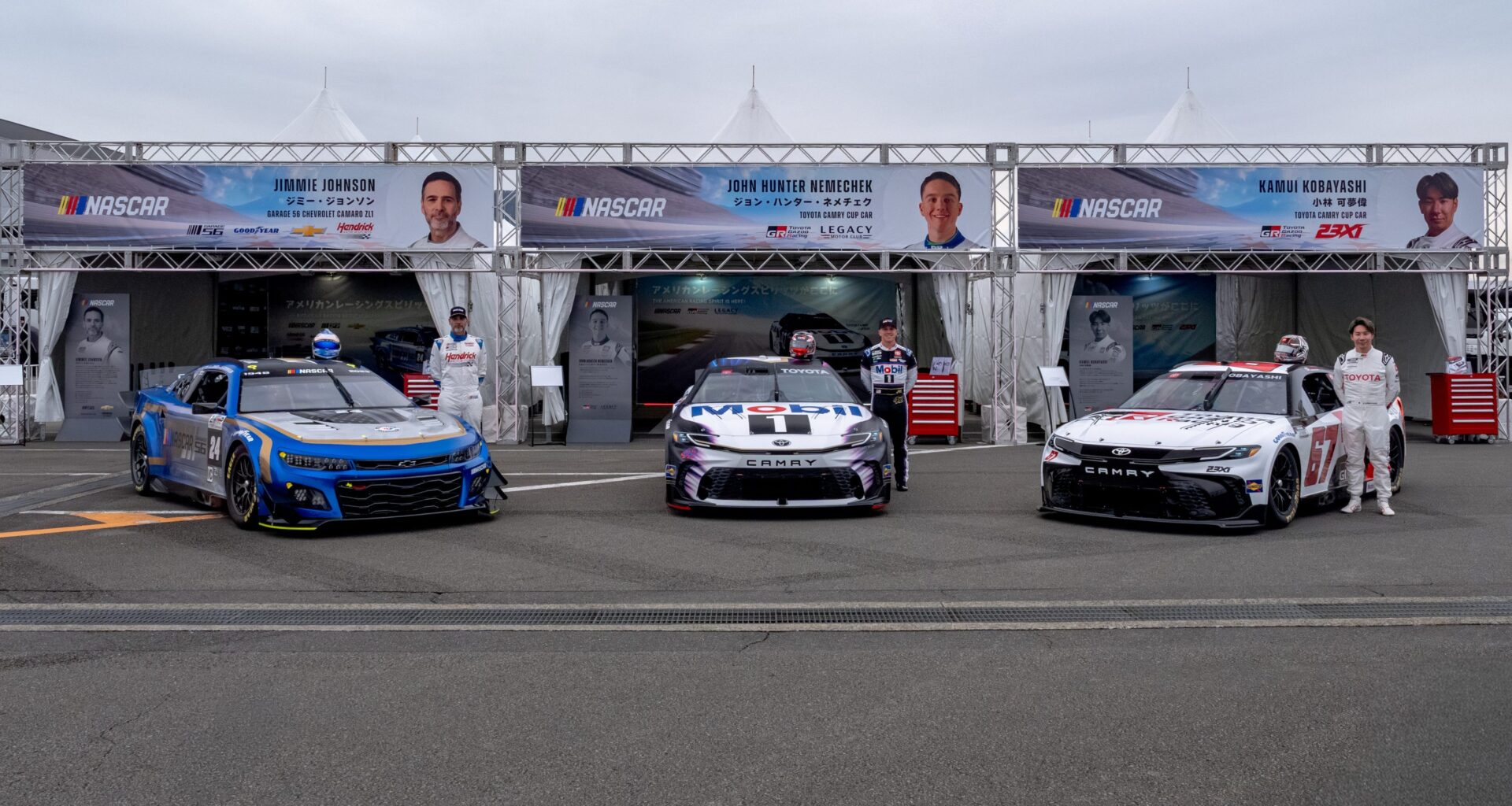
As Kyle Larson celebrated his second Cup Series championship on Nov. 2, teams throughout the garage prepared to head back East to start the offseason. Three other teams, however, prepared for an important trip to Japan to take part in an exhibition event.
Hendrick Motorsports, Legacy Motor Club, and 23XI Racing had to quickly shift their focus to the last-minute work required to get three cars, personnel, and equipment to Fuji Speedway. This was a massive undertaking after completing a grueling, 38-race season, one that featured a stretch of 28 weeks without a break.
“I would say the biggest hurdle was the tight turnaround,” Jacob Canter, Legacy Motor Club’s Director of Competition, said during a phone conversation with FanBuzz.
How much time did the teams have to prepare? It turned into roughly eight weeks. Toyota’s leadership in Japan made the request to have some Next Gen cars take part in an exhibition at Fuji Speedway, but the teams couldn’t just go ahead and accept.
As Canter explained, they had to call Toyota Racing President Tyler Gibbs to discuss a particular hurdle. They needed NASCAR’s approval to run the cars outside of a Cup Series event, per the 2025 Charter Agreement.
It didn’t matter that Legacy Motor Club planned to use a show car with two seats instead of a car that competed during the 2025 season. The team could not risk violating the Charter Agreement.
Get prepped for Japan
Once NASCAR approved this request, these Cup Series teams — along with representatives from the ARCA Menards Series — then had to dedicate time to prep the cars for flights to Japan.
They had to drain the fluids, make itemized lists for everything in the crates so they had no issues in customs, and decide on which extra parts to take in case anything broke in transit. They also had to figure out exactly how many team members to bring along.
“I don’t know if you know much about the trip to Mexico City, but it was like that on a much tighter timeline,” Canter explained while trying to fully encapsulate the in-depth planning required to pull off this feat.
In good company! pic.twitter.com/1nawNNO2z3
— LEGACY MOTOR CLUB (@LEGACYMotorClub) November 14, 2025
Fortunately for two of these teams, they could actually collaborate. This is one benefit of the Gen 7 car. Canter said that Legacy MC and 23XI Racing worked closely together while preparing for the trip, to the point that each team took specific sets of spare parts to cover as many potential failures as possible.
23XI Racing Director of Competition Mike Wheeler confirmed this timeline during an interview with FanBuzz. He said that Team President Steve Lauletta called and asked if they could possibly prep a car and take part in this event in Japan. In Wheeler’s eyes, they had to do it based on the relationship with Toyota.
So 23XI Racing started prepping for the trip in September and by October, they had the car picked out and ready to go. From that point on, they had to work on packing crates and gathering equipment without taking resources from the three full-time teams, two of which had drivers still in the playoffs.
Wheeler said that 23XI Racing, in particular, filled four ULine crates (measuring 48 inches wide, 48 inches long, and 36 inches high) with spare parts, two motors, the generator used on pit road, tires, and “other goodies.”
“It was our backup car for the Charlotte race and ended up not being on the schedule the rest of the year,” Wheeler said. “So we’re easily able to basically put a motor in that, wrap it, and do a little bit of development work for Fuji, and get the car ready to be shipped.
“So that was actually a low pull compared to taking resources away from the (Nos.) 23, 35, and 45 during the playoffs. The packing of the crates was definitely a little bit. I put a lot of my own time into that as well as (Director of Race Team Operations) Mike Lorusso.”
Fortunately for 23XI Racing, they had a separate car from which they could pull parts, pieces, and tools. The No. 67 is only a part-time car for Corey Heim, and it did not have any races on the schedule. The team also knew that Legacy Motor Club would fill in some gaps with the equipment they brought.
While Legacy Motor Club and 23XI Racing had the ability to share parts and pieces via the common Gen 7 platform, Hendrick Motorsports did not have that luxury. The team packed up the Garage 56 car built for the 24 Hours of Le Mans and flew it over to Japan for the exhibition event. This provided a vehicle for Jimmie Johnson to drive during the special race weekend.
How did Hendrick Motorsports get involved in this exhibition event put on by Toyota? On paper, this doesn’t seem to be a natural fit, but Toyota Chairman Akio Toyoda actually made the request. According to HMS Vice President of Competition Chad Knaus, Mr. Toyoda was a big fan of the Garage 56 program and the impact that it made on Le Mans.
Toyota Chairman Akio Toyoda took a Camry NASCAR Cup car and the Garage 56 car for a drive at Fuji Speedway. https://t.co/tt64e1QDUL pic.twitter.com/AzIB7M0t1X
— Bozi Tatarevic (@BoziTatarevic) November 13, 2025
As Knaus explained to FanBuzz, the Garage 56 car is a unique vehicle, which added some complexity to the trip. Sure, it has a foundation in the Gen 7 era, but this is an entirely different beast. It has headlights, after all.
The Chevrolet Camaro had to be different from Gen 7 so that the team could complete the 24 Hours of Le Mans, a grueling endurance race. This meant that the car had different parts and pieces that could potentially break on the flight to Japan or once the team arrived to unload.
“The G56 car is really one of three cars in existence and everything on it is bespoke to that vehicle, whether it be the uprights or the brake system, the electrical system,” Knaus explained.
“All of it is unique to that vehicle. So really it didn’t really help us at all that there were other Gen 7 cars. …A lot of the same manufacturers, but a lot of the components were made to either be more durable — obviously, for our events and the mileages that we put into place — or lighter so that we could get the performance out of the car.”
Like Legacy MC and 23XI Racing, Hendrick Motorsports fully utilized the ULine crates. They packed them full of necessary equipment to fix the car or address an unexpected issues. This included brake rotors, prop shafts, a transaxle, a replacement engine, and a full wiring system.
Did Hendrick Motorsports need all of this equipment for the trip? Knaus doesn’t know, but he and the team could ill afford to have an unfortunate breakdown with all of the attention on this car that had traveled to both Le Mans and the Goodwood Festival of Speed.
“We definitely overpack, I’ll be honest,” Knaus said while chuckling. “But again, we wanted to make sure that we were prepared for whatever could possibly happen. God forbid, we go over there and it’s a shakedown day and something happens and you damage the car.
“We had enough stuff that we were going to be able to fix the car, but there’s really no restrictions except for the restrictions you put on yourself. And we wanted to be as prepared as we possibly could to make sure that we represented NASCAR and Hendrick Motorsports to the best of our ability.”
Of course, setting the right amount of equipment is not the only prep work required by these three NASCAR teams. They had to decide how many employees to take to Japan and what roles they would play.
This was not a normal race weekend, so none of the over-the-wall athletes made the trip. Instead, all three teams focused the essential personnel who could get the cars prepped and onto the track. If needed, these team members could make some repairs.
Hendrick Motorsports had a larger group, which included veteran crew chief Greg Ives. The championship-winning team also brought along representatives from the content and PR departments.
Some on track G56 action for your Friday morning. pic.twitter.com/D33kxhy8LU
— Hendrick Motorsports (@TeamHendrick) November 14, 2025
Legacy Motor Club followed a similar path as Hendrick Motorsports by heading to Japan with a larger group. The team had crew members, drivers, and representatives from the PR and content teams.
23XI Racing took a different approach. According to Wheeler, the team ran a leaner operation. He brought along Lorusso, chief mechanic/”jack of all trades” David Bryant, car chief Michael Hobson, and mechanic Eric Grove. The team did not have to worry about a driver since Kamui Kobayashi met them there to control the Toyota Camry.
“We actually brought five people total,” Wheeler said. “I know some of the guys who brought a little more, they had drivers and they had PR and social with them as well as that.
“We were trying to keep it light because it was a decent pull and this was happening, we were scheduling this during the playoffs. So we really wanted to make sure we stayed focused on the playoff run more than the exhibition to Japan.”
Unexpected considerations
As the NASCAR Cup Series teams learned with Mexico City, they had to approach the situation differently than a standard trip to Sonoma Raceway. They had to worry about going through customs with expensive equipment, some of which could be considered dangerous. This includes batteries that they had to drain for the flight.
As a result, they ran the risk of losing equipment or having items show up at inopportune times. Even perfect planning with Yamato Transport did not mean that they would avoid unexpected setbacks.
Fortunately for 23XI Racing, in particular, they only encountered minor issues.
“The only surprise that we had late was when we got to the track on Wednesday of that week, we realized we didn’t have any batteries,” Wheeler explained. “The batteries obviously are a little bit of a dangerous goods and have to ship separately. And one of the things we learned about it is they had to be drained before they were shipped and we didn’t know that.
“A little bit of a miss on a few of those parts, but it’s something you learned by doing it. So they were a little bit delayed shipping it because of the amount of batteries we sent for our drills and our impacts. It got like kind of quarantined in customs in Japan and it missed it by a day.
“So instead of showing up on Wednesday with everything else, it showed up on Thursday. So for the first day I was walking around the garage area, they had a bunch of racers looking at our DeWalt drill saying, ‘Does anybody got a battery for this?'”
Day 1 at Fuji Speedway complete. @23XIRacing got the equipment unpacked and the car back running. All without batteries for tools as they are stuck in customs. The people were very friendly and many teams were helping with minor issues we had with supplies. Mount Fuji disappeared… pic.twitter.com/kSkShKG1JA
— Michael Wheeler (@MikeCWheeler) November 12, 2025
The other big consideration for the teams involved the cars themselves. They had to drain all of the fluids from the cars. In the United States, this is not a major issue considering the prevalence of the fuel and other fluids needed to get the cars to the race tracks.
This is a different story for a trip to Japan, but Toyota stepped in. According to Canter, the OEM partner helped the teams source all of the fluids they needed so that they would be available in the paddock area to start the weekend.
The paddock experience
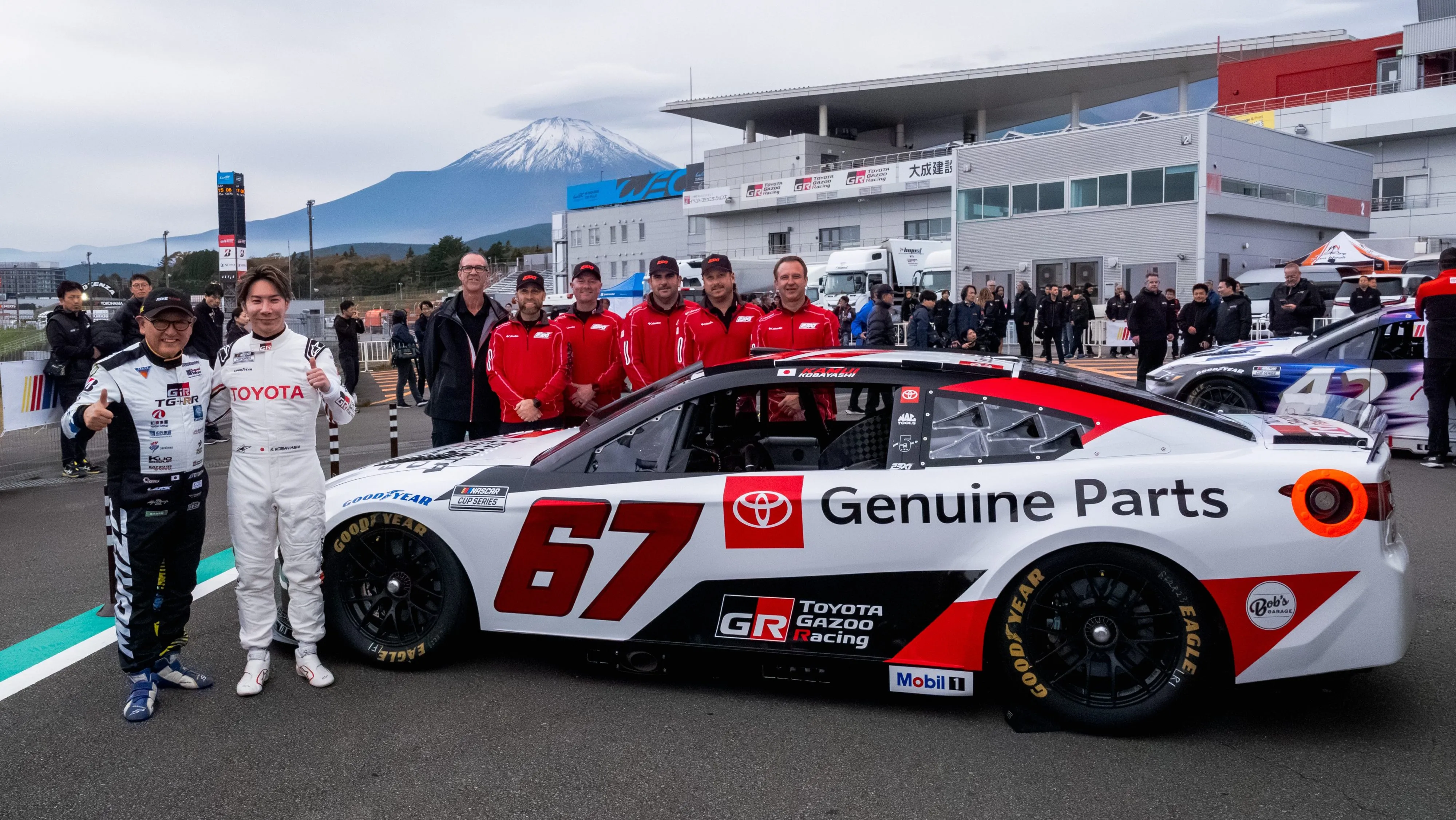
Photo credit: Legacy Motor Club
As Knaus, Canter, and Wheeler told FanBuzz, this trip showed the differences between racing fans in the United States and those in Japan. It also showed the similarities. At their core, these fans just love motorsports.
These teams had fans recognizing the branded gear at the hotel and throughout the city of Tokyo. The teams still received some questions about the engines and other components. They still delighted after seeing the cars race down the straights at 180 mph.
“Everybody’s asking ‘How much power does it make, weigh?'” Knaus said. “‘Where are the performance enhancements at?’ And I think everybody gets pretty impressed with that vehicle when you talk about it being hundreds of pounds lighter than a current Gen 7car, and it makes you almost twice the amount of downforce of the current Gen 7 car.
“And it makes… well, the car that we had there was roughly 850 horsepower as opposed to our current cars are 680 (horsepower).”
These NASCAR teams also had fans wandering the garage area and examining the Cup Series cars just as they do at Talladega Superspeedway, Phoenix Raceway, or any other track on the schedule. Yet, the fans showed some stark differences to those who follow the NASCAR circus across the United States.
This is not an insult to NASCAR fans in the United States. Those in Japan just approach situations differently.
“One thing I noticed is they were really respectful,” Wheeler said about the fans. “We allowed them to walk around the car and it’s actually our race car, which they see at the racetrack. We’re a little worried in America of having the fan get too close, lean on it, and hurt something.
“I heard this before I went, I saw with my eyes that the fans are really respectful about keeping their appropriate distance and not getting too close, even though they could walk right up to it. So that was kind of one of those nice surprises that you saw. As much as they’re passionate about seeing the actual race cars, they had the utmost respect for what it is as well.”
The teams also saw an assortment of NASCAR memorabilia in the garage, which caught some of them by surprise. They knew that fans in Japan had a love for motorsports; they did not expect to see the level of NASCAR fandom.
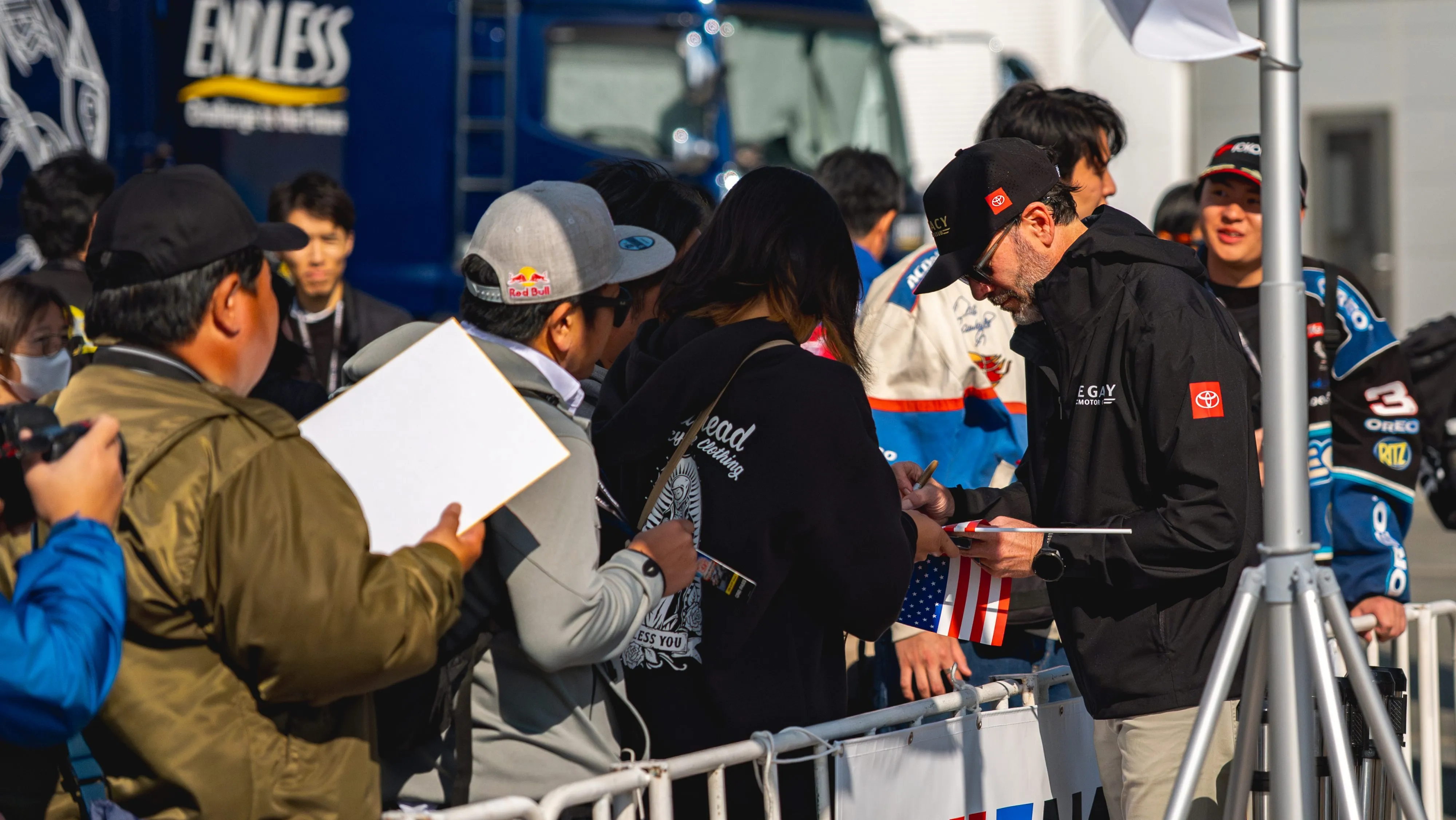
“I actually saw some fans with some old Legacy crew shirts,” Canter said. He added that many of the Japanese fans asked about purchasing memorabilia, which made the teams realize they had not prepared for that particular part of the trip.
“The reception in the paddock was great,” Knaus said, adding that he saw a ton of Kyle Larson merchandise. “A tremendous amount of people walking through wanting to get photos, being inquisitive about the car, asking questions. I was really surprised at how much of a NASCAR presence was there.
“A lot of fans came up, they had diecasts, they had memorabilia, they had little cars, big cars, they had hero cards, hats, shirts that they wanted our team and me and Jimmie to sign along with the other drivers. It was pretty cool to see how many people really identified with the car and knew what the car was.”
Lasting memories
Was this trip difficult? Absolutely. Did it put pressure on the teams as they tried to prep these cars at the same time they tried to close out the Cup Series season? Yes, it did.
Are these teams happy they put in the effort despite having only eight weeks to prepare for this massive undertaking? That is undeniable.
As Canter explained, he has three main memories that will stick out from this trip. The first two focus on the old 30-degree banked turn that has long been abandoned. All six of these cars from America parked on this turn for a photo opportunity.
Canter, a fan of NASCAR history, also used this time to sit down with Johnson and Nemechek for a special discussion about the track and their journey to it.
The third memory involved Toyoda, who has tested numerous cars for Toyota and provided crucial feedback as the company tried to build racier vehicles for consumers. Toyoda took the Garage 56 Chevy and a Camry Cup car around Fuji Speedway while basking in the race weekend experience.
Toyoda then gave Canter a sticker that said, “I love cars.” It’s a small gesture, but it is one that the Legacy MC executive will forever cherish.

Photo credit: Legacy Motor Club
For Knaus, this marked the third time that Hendrick Motorsports had taken the Garage 56 car to an overseas event. This particular trip did not have the same level of stress as the 24 Hours of Le Mans, but that doesn’t mean it was a vacation.
He said that the entire Hendrick Motorsports group was “smoked” after five days of trying to deliver for both NASCAR and the residents of Japan. Yet, as he sat in the hotel at the end of the trip, he did not regret a single moment.
“We only had a couple of months to prepare,” Knaus said. “So from a logistics standpoint and getting the people squared away and also trying to compete for a championship in the Cup Series, to go over there and have that go off without a hitch was a huge, huge relief.”