
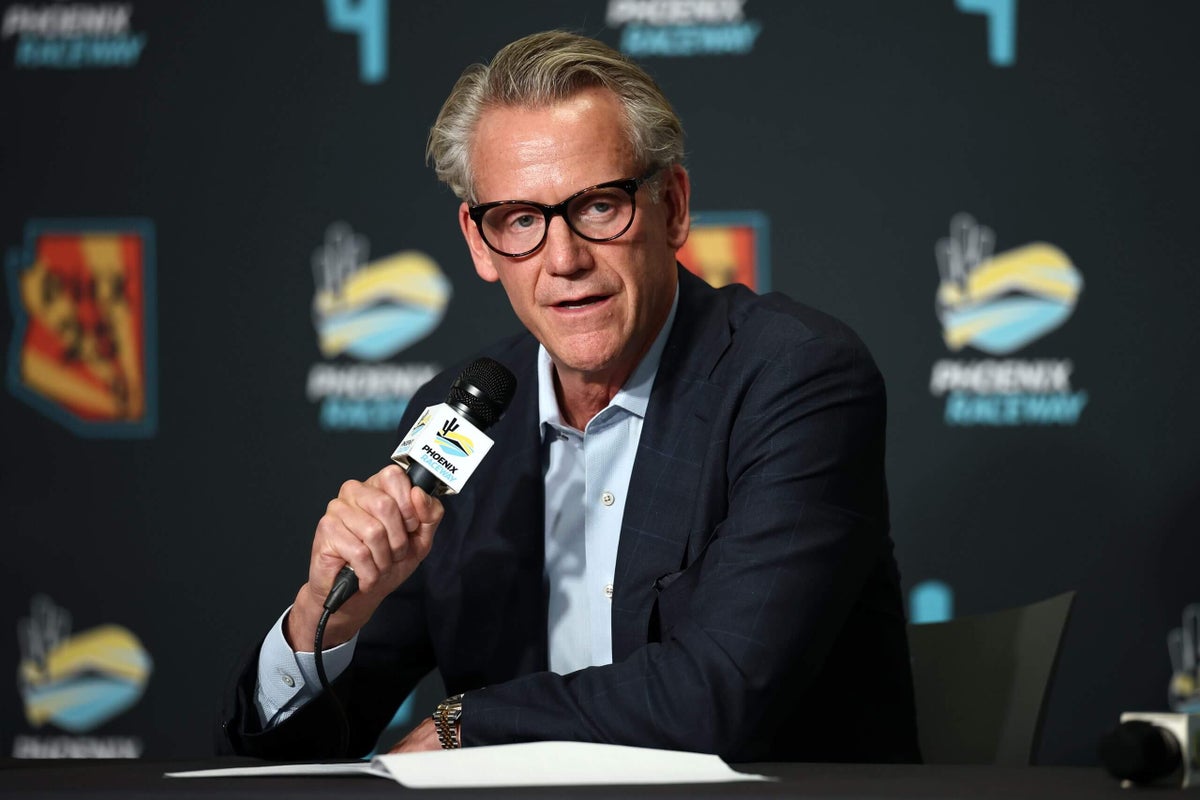
CHARLOTTE, N.C. — NASCAR commissioner Steve Phelps denied giving teams a much-discussed take-it-or-leave-it deadline to extend a charter agreement, calling the assertion “unfair” during testimony Tuesday in the NASCAR antitrust trial.
Phelps had been presented with an email in which he wrote there were “lots of options, but all have the same theme: Pick a date and they can sign or lose their charters. It is that simple.”
“They are playing with fire,” Phelps had written regarding the teams.
But Phelps, the self-described “head negotiator” for the charter deal — the one two teams rejected and led to this federal lawsuit — said it was “absolutely not” true to characterize the Sept. 6, 2024, deadline as a monopolist using its power to bully the teams into signing.
“That is not what happened,” he said.
“We’ll let the jury decide,” said Jeffrey Kessler, the attorney representing 23XI Racing and Front Row Motorsports, who filed the lawsuit last October after refusing to sign the charter deal.
Phelps repeatedly said he did not remember or recall various moments Kessler tried to flag as central to the issue of whether NASCAR violated antitrust law.
Phelps said he had “no idea” how or why exclusivity clauses were placed into track sanctioning agreements beginning in 2016. He had no recollection of a 2015 email discussing the race teams’ plan to run their own event (something NASCAR strongly discouraged and vowed to fight), nor did he remember seeing an email from Speedway Motorsports owner Marcus Smith, expressing agreement for his track company to “reject other competitor series that may present themselves.”
Phelps also had no memory of telling team owner Rick Hendrick, “We wish we could give you permanent charters, but Jim (France, the NASCAR CEO) doesn’t want that.”
“I don’t deny doing it, but I don’t remember,” Phelps said.
Nor could he remember receiving an email from an International Speedway Corp. (ISC) executive flagging a 2016 ESPN.com article that unearthed the track exclusivity agreements, nor a 2019 email from Roush Fenway Racing pleading for better financial terms from NASCAR.
Phelps also said he did not remember a 2020 meeting of NASCAR’s executive team, which discussed the threat of a series that eventually became known as SRX, short for Superstar Racing Experience.
But Phelps did recall being “concerned” about SRX “right out of the gate” and later texted fellow NASCAR executives that SRX “could turn into LIV if we don’t play our cards right,” a reference to LIV Golf, a breakaway circuit from the PGA Tour.
“Need to put a knife in this trash series,” he wrote in a later text.
Phelps explained his text messages by saying he was “frustrated our (team) owners were racing in a series using sponsors and colors and liveries that looked a lot like NASCAR.” He said NBC Sports executive producer Sam Flood complained to NASCAR that SRX was causing marketplace confusion.
But when NASCAR’s lawyers looked into potential violations, they found there was no infringement on NASCAR’s intellectual property.
Phelps, who acknowledged his compensation package from NASCAR is worth as much as $5 million per year, was asked about nearly $400 million being paid to the NASCAR-owning France family from 2021-24. Phelps said his understanding was $300 million of that was used to pay taxes, but later said he was unsure if that meant NASCAR’s taxes or the France family’s taxes.
Regarding the race teams’ initial request to be paid $720 million per year — enough to cover the estimated $20 million annual baseline costs per car — Phelps said that sum would have left NASCAR “bankrupt” (NASCAR is paying the teams $431 million instead).
“The sport would cease to exist,” Phelps said of the $720 million sum.
He called the charter agreement disputes “one of the most challenging and the longest negotiation I’ve ever been part of” but said his goal had been “to get it done” — and 32 of the 36 charters were ultimately signed. Holding a charter guarantees entry into races and certain revenues to owners.
Phelps was questioned about the France family taking ISC private — then selling Auto Club Speedway to pay down the debt from the purchase — but said the sale was vital for NASCAR’s scheduling flexibility.
“That was a really important and undervalued decision,” Phelps said, adding this year’s Mexico City race and the Chicago Street Race would not have been possible with a publicly traded company.
Earlier Tuesday, NASCAR questioned economist Dr. Edward Snyder on his contention that Formula One was the closest benchmark to NASCAR, with NASCAR attorney Lawrence Buterman saying IndyCar should have been a more comparable example.
After that, accountant Anthony Smith testified he received anonymized data from 12 race teams, nine of which reported a loss. However, Smith acknowledged he did not have the opportunity to certify or audit the finances of any team (though they were submitted under a court order requiring good faith).
Phelps is scheduled to continue his testimony Tuesday afternoon, followed by team owner Richard Childress and France, before the plaintiffs rest their case.
Childress’ session could be lively. The Hall of Fame owner has long been an outspoken critic of NASCAR leadership, even suggesting this summer he believed the league had an agenda against his team, Richard Childress Racing.
Childress’ appearance comes shortly after inflammatory text messages sent by Phelps were unearthed during the discovery process in advance of the trial. In the text messages, Phelps told another high-level NASCAR executive that Childress should be “taken out back and flogged” and called him a “stupid redneck who owes his entire fortune to NASCAR.” The remarks stemmed from critical comments Childress, a six-time championship-winning owner at NASCAR’s top level, made about the costs associated with the NASCAR-mandated Next Gen car during a radio interview.
After Phelps’ texts became public, RCR said it was considering legal action. Childress has not spoken publicly since the comments were revealed last month, and while Phelps’ remarks cannot be entered into evidence, they could still be referenced during Childress’ testimony.
Childress is the second non-litigating owner to testify, with Joe Gibbs Racing co-owner Heather Gibbs doing so last week. Unlike 23XI and Front Row, both RCR and JGR signed NASCAR’s take-it-or-leave-it offer on Sept. 6, 2024, that extended NASCAR’s charter agreement through the 2031 season.
In total, 13 teams signed the agreement, with 23XI and Front Row the only holdouts.