
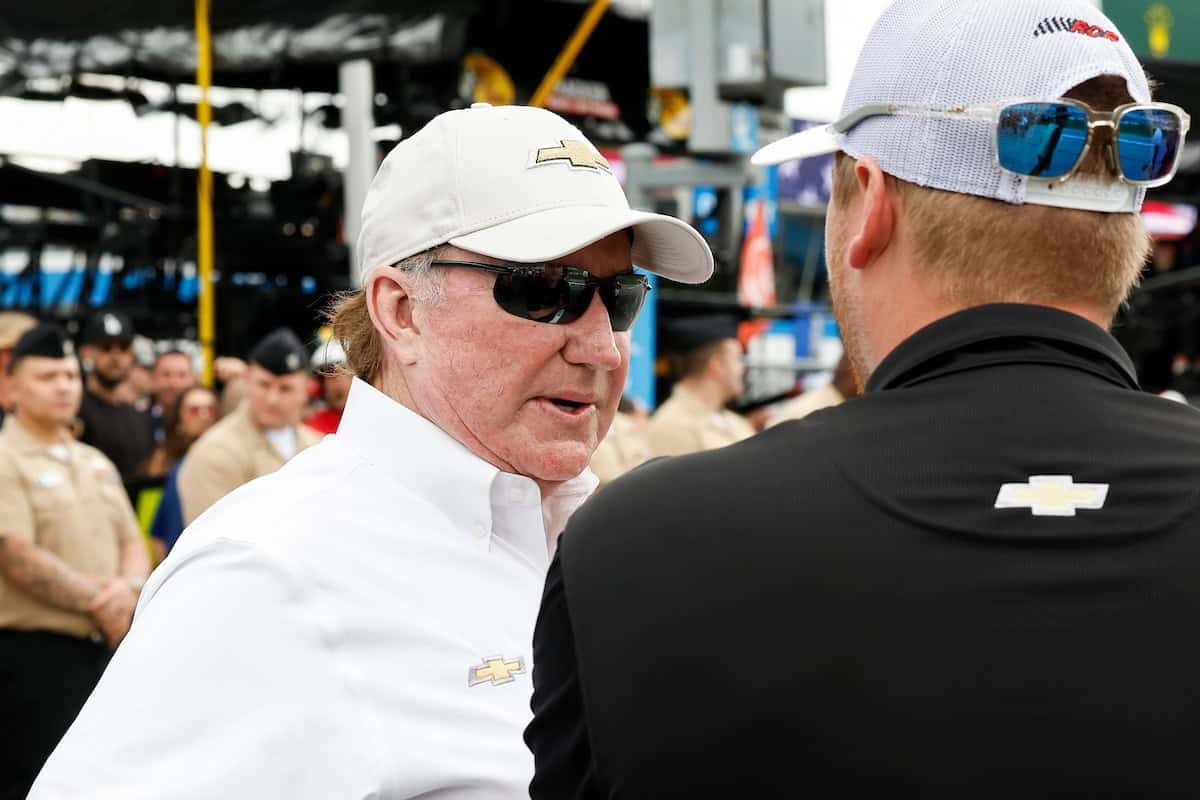
Additional reporting by FanBuzz’s John Newby
Tuesday, Dec. 9, kicked off day seven of the 23XI Racing/Front Row Motorsports vs. NASCAR trial.
Economist Edward Snyder completed his testimony and was followed by accountant Anthony Smith, NASCAR Commissioner Steve Phelps, team owner Richard Childress and NASCAR CEO Jim France.
The days have gotten longer in this case, as Judge Kenneth W. Bell requested on Monday for the jury to arrive 30 minutes earlier and to stay 30 minutes later because the current pace was going to extend the trial well beyond his two-week goal.
Before Snyder’s cross-examination was completed, the plaintiffs objected to a document set aside for team owner and future witness Childress. NASCAR’s side wanted to ask Childress his reaction to it, but Bell labeled it hearsay and instructed them to just ask Childress why he signed the charter agreement.
Bell then lambasted NASCAR attorney Lawrence Buterman, telling him his line of questioning from Monday about the past 55 years of racing was inappropriate, as there was no discovery pre-2014. Buterman disagreed, but Bell said, “The jury is giving us an extra hour per day. That is not an excuse to waste that hour.”
When Snyder’s cross-examination resumed, Buterman told him that if the Formula 1 benchmark is wrong, the damages are wrong. But Snyder defended his numbers, saying the multiples he went with were the lowest in F1 to be conservative. Had he gone with a different sport, the damages could be higher.
To that, Buterman said the NTT IndyCar Series would be a better benchmark, but Snyder replied that its financial data wasn’t available. Buterman then asked if Snyder had requested his legal council to get its financial data, to which the plaintiffs objected and Bell sustained.
Buterman then pushed Snyder hard to admit that F1 cost caps were beneficial and questioned if they would impact the multiples for damages. He asked a series of questions about returns on investments, to which Snyder responded by saying they were irrelevant. Bell got mad at the line of questioning and told Buterman to move on. He then asked another line of questions about a potential new stock-car series, which also annoyed Bell, who said, “Asked and answered.”
It was noted by Buterman that “majority” of the $400 million the France family netted over the past three years went to taxes and that paying $300 million more to the teams would put NASCAR at an operating loss. Snyder countered with the chart assuming no other changes and that the PGA didn’t have a pile of money laying around to combat LIV Golf. PGA executives made adjustments to their business plan, as “that’s what executives do, they make adjustments.”
Snyder’s cross-examination wrapped up at 9:14 a.m., with accountant Anthony Smith of GreerWalker, LLP taking the stand two minutes later. He was first questioned by plaintiff attorney Michael Tooney. Smith presented a chart he had assembled of the non-lawsuit teams’ financial data, keeping each team anonymous, from 2020 to 2024. One team had lost $246,672,000 in sponsorship, while seven of the 12 teams had net losses per car.
In Smith’s cross-examination, NASCAR’s attorney’s argument hinged on the accountants not receiving the accurate data from the teams. Smith’s testimony was the shortest so far, coming in at under 20 minutes.
Next up was Phelps, who explained that he was NASCAR’s president for six years before being promoted to commissioner. His responsibilities increased in October 2023, but he wasn’t officially promoted until March 2025, as it wouldn’t have been a good look while undergoing media rights deals and charter negotiations. He has a salary of $2.5 million with the potential of another $2.5 million in bonuses.
Phelps echoed what Buterman brought up earlier, that $300 million of the $400 million the France family netted went toward taxes. But 23XI/FRM attorney Jeffrey Kessler disputed that, saying it didn’t go to the IRS, rather all to the Frances. A deck from a May 2025 NASCAR board of directors meeting showed the tracks had $468 million in profits, NASCAR had $60 million and the teams lost $85 million.
It was revealed that the teams considered starting a stock-car series on dirt in January 2015. A conversation between then-NASCAR President Brent Dewar and Rob Kauffman (formerly of Michael Waltrip Racing) showed NASCAR was disappointed and was strongly opposed to it, with Dewar saying they would fight it. Dewar’s email also said the RTA had gone down the path of developing a car to run on dirt. Kessler claimed NASCAR threatened teams with not getting charters if the dirt series took place, but he showed no evidence.
Phelps said a cost cap would give the most enterprise value to teams and he wished they had put one in place. He said Roger Penske opposed a cost cap but wanted the Next Gen car because it would reduce cost, and “it did.”
After a brief break, Kessler went through a series of questions to Phelps to which nearly every answer was “I don’t recall” or “I really don’t remember.” When discussing the Camping World SRX Series, Phelps said it concerned him from day one because it looked like NASCAR. Phelps then expanded on the texts from NASCAR leadership shown last week that were critical of SRX, saying legal needed to take a look at it.
Phelps said lawyers did take a look at the series but determined it wasn’t crossing the line in mimicking NASCAR. He then mentioned seeing Chase Elliott win in the series like O’Donnell did, and said that NBC Sports Executive Producer Sam Flood called after and wasn’t happy.
Phelps looked into the possibility of giving the teams permanent charters. He told Rick Hendrick, “We wish we could give you a permanent charterers, but Mr. [Jim] France does not want that.” Kessler then asked about texts with O’Donnell and Chief Strategy Officer Scott Prime where they said France was “a brick wall about permanent charters” as well as a meeting with Executive Vice Chair Lesa France Kennedy that Phelps called insanity instead of productive. Phelps said it was just said in frustration in that moment in time as lead negotiator and that he wasn’t happy with that progress or the teams’ progress.
Echoing what Buterman said earlier, Phelps also relayed that the teams’ request for $720 million would have bankrupt NASCAR, saying it would’ve ceased to exist.
NASCAR attorney Chris Yates did the cross-examination on Phelps, who detailed how he’s worked at NASCAR since 2005, spending 14 years with the NFL in corporate sponsorships before that. He gave an update on Auto Club Speedway, saying NASCAR still owns 90 acres and still hopes to build a short track there.
Phelps talked about the COVID-19 shutdown in 2020, saying it was the biggest collaboration between stakeholders he can remember and that he and Kennedy France called 18-19 governors to get permission to race. Adding to what O’Donnell said last week about Prime Video wanting to get involved in NASCAR after seeing the Chicago street race, Phelps added Warner Bros. (TNT, HBO Max) had the same sentiment.
At one point, Phelps tried to quote conversations he had with Penske and Joe Gibbs, but Bell shut him down, saying to just say how he reacted. Phelps claimed the Next Gen car is the safest in all of motorsports, has produced great racing with the most green-flag passes and has lowered costs.
Phelps said the single most important thing to the teams was increased revenue, which Denny Hamlin shook his head at. He said he became frustrated with 23XI co-owner Curtis Polk he never wavered on the four pillars the teams wanted and didn’t take any middle ground.
With the next witness being Childress, Phelps was asked before his time was up if he respected the owners. While the “stupid redneck” texts about Childress did not get brought up or displayed, Phelps said he regretted saying it and had apologized to Childress months earlier.
Childress was one of the most anticipated witnesses by the general public, but it somewhat underwhelmed, only lasting about 45 minutes. The biggest revelation of his time as a witness was during NASCAR attorney Chris Yates’ questioning of him. Childress had looked into partially selling Richard Childress Racing to a group led by former NASCAR Cup Series driver Bobby Hillin Jr. earlier this year, as Chartwell Investments, which owns a portion of the team, wants out. Childress did not like this being brought up and claimed those involved signed NDAs. Childress said the deal didn’t work out because, “They didn’t have the money, period.”
Yates asked Childress a number of financial questions, which were all objected. Bell got on Yates afterward, saying the team owners didn’t want to be dragged into a fight, so the court will protect their financials.
Prior to that, Childress had discussed the need for permanent charters, saying that his bull-riding team in the PBR has one. He said the owners even discussed buying permanent charters from NASCAR, but to no avail. He noted the teams would go up and down with NASCAR if they had permanent charters. He also claimed that all his other businesses are what keep RCR afloat, as the team can’t survive on its own. Yates disputed this, but objections kept this from going deeper.
The last witness of the day was Jim France, who took the stand at 3:51 p.m. Kessler didn’t waste any time with background information and immediately went in on asking him about permanent charters. France replied that he said no to them but he didn’t like the phrasing.
It was revealed that France’s side of the family owns 54% of NASCAR, while his niece Lesa France Kennedy’s side owns 45.3%, but they both hold 50% voting power. Since becoming NASCAR’s CEO, he has only flown on private planes. He said he didn’t know Kennedy’s title or how much she was paid. Meanwhile, he earned a $3.5 million salary as CEO.
From there, France answered a series of questions with “I don’t recall” or “I don’t know.” He gave that answer to questions about a 2022 board meeting, to a meeting with Goldman Sachs and the revenue this year. He also doesn’t recall any time the board has overruled him, but he noted that it does have the power to do so.
Court is done for the day. I don’t think I’m underselling it to say Jim France’s testimony was shockingly bad so far. Just not good at all for NASCAR IMO.
— Jeff Gluck (@jeff_gluck) December 9, 2025
It was revealed that there is a France enterprises board that sits above NASCAR’s board of directors. It is comprised of mostly France family members including Jim’s daughter Jennifer Bates and Kennedy’s son Ben. The sole member not in the family is lawyer Gray Crotty.
One piece of evidence displayed was a letter from Hendrick to France in 2024 that said Hendrick Motorsports lost $20 the last five years despite winning two Cup championships in that timeframe.
The day wrapped up before France could complete his testimony, so he will resume it on Wednesday, Dec. 10. He is the last witness for the plaintiffs, so the defendants will begin calling their expected 16 witnesses on Wednesday as well.

Content Director at Frontstretch
Michael Massie joined Frontstretch in 2017 and has served as the Content Director since 2020.
Massie, a Richmond, Va., native, has covered NASCAR, IndyCar, SRX and the CARS Tour. Outside of motorsports, the Virginia Tech grad and Green Bay Packers minority owner can be seen cheering on his beloved Hokies and Packers.