
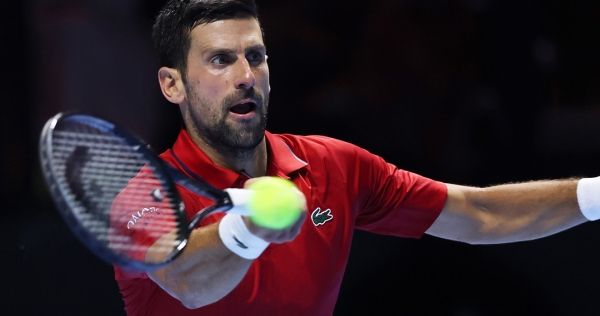
In addition to reaching all four Slam semifinals – making him the oldest man in the Open era to achieve that feat – Djokovic also collected two more ATP singles titles, scored three top-five wins, and will enter AO 2026 having won 27 of his past 31 matches.
The last of those wins came in his final match of 2025, an epic three-hour triumph in the Athens final over then-world No.9 Lorenzo Musetti, the fourth top-10 victory of Djokovic’s season.
“You are proving, still at your age, that you can kick us, like me today,” Musetti told Djokovic. “Every time I share the court with you, I take it as a lesson.”
It’s further proof Djokovic possesses the playing level, results and momentum to be a serious title threat at AO 2026, even in the ‘Sincaraz’ age.
While Sinner has won their past five meetings, Djokovic has had more consistent success against Alcaraz, winning four of their most recent six matches.
The most resonant of those was his pulsating four-set win over the Spaniard in the AO 2025 quarterfinals. While the physical exertion of that effort forced him to retire during his semifinal clash with Zverev, it was a reminder of what Djokovic can still produce on the game’s biggest stages.
It’s also true that Sinner and Alcaraz cannot continue winning every major. At some point, their uninterrupted reign will end, just as it did for the greatest Grand Slam men’s duopoly of the Open era: Roger Federer and Rafael Nadal.
Federer and Nadal, at their combined peak, collected 11 consecutive major titles from Roland Garros in 2005 to the 2007 US Open.
The player to snap that great streak? Djokovic, at Australian Open 2008.