

With the NHL’s holiday break approaching, the Vancouver Canucks are last in the league’s overall standings.
Beset by a multitude of injuries, severe underperformance and a lack of experienced NHL-level options down the middle of the forward group, Vancouver ranks 32nd by point percentage.
So deep is the early-season hole that Vancouver has dug itself, in fact, that even if the Canucks were to win their upcoming home game against the Buffalo Sabres on Thursday night and then also go on to sweep their five-game pre-Christmas road trip through the New York area, Boston and Philadelphia, that six-game win streak would only boost Vancouver to a .514 point percentage — good enough for 10th place in the West as the standings sit today.
Beyond the Canucks’ dreary medium-term outlook this season, we’re now 30 games into the 2025-26 NHL regular season, which has always been a critical analytical milestone in The Athletic’s coverage of this team.
Now that every team has played at least 1,250 five-on-five minutes and at least 1,500 minutes overall, we can begin to confidently parse signal from noise in evaluating the relative true talent level of the various NHL teams, and dissect what that means for Vancouver over the balance of the season.
It should come as no surprise to anyone who’s watched this team play, or glanced at the NHL standings, that this iteration of the Canucks is a deeply flawed team.
This year, however, things feel somewhat different at the bottom of the NHL standings. It’s flatter, with no truly hopeless rebuilding outfits in either conference.
There’s no team Vancouver is evidently superior to, which makes this slow start feel very different from what we saw when the Canucks struggled out of the gate in the 2021-22 and 2022-23 seasons. This time around, there appears to be no floor for this group, as Vancouver’s flaws look significant enough that this team should be expected to contend to finish at or near the absolute bottom of the standings.
Even strength
At the heart of Vancouver’s softness this season is its inability to control play with any regularity at five-on-five.
This is a side that has far too rarely possessed the puck or dictated play at even strength. As a result, the Canucks have far too regularly bled scoring chances against, and have done so while still generating scoring chances at a below-average clip.
Over the past several weeks, at the very least, the Canucks have found a way to somewhat stem the defensive bleeding that looked for a stretch in mid-November as if it might be truly critical. There was even a moment around the 20-game mark where it really seemed like Adam Foote’s side was trending to be a historically inept defensive team.
Of late, however, even as Vancouver continues to lead all NHL teams in goals-against per game, the Canucks have found some semblance of structural defensive spine in their even-strength minutes and have limited scoring chances like a more normal, overmatched side.
Perhaps this isn’t much to write home about, but Vancouver has at least begun to play teams to something more closely approximating a territorial draw over the past five or six games. It’s not as if Vancouver is controlling play or has fully turned a corner at five-on-five, but it has at least stemmed the bleeding, which represents a marked improvement over what this Canucks side was putting on tape in mid-November.
If we look at Vancouver’s cumulative expected goals differential, for example, we can see that since roughly mid-November, it has at least found a way to cauterize the five-on-five wound. The Canucks haven’t controlled games sufficiently well that they’ve begun to trend upward just yet, but they’re not being steamrolled territorially with the alarming frequency that we witnessed in the first 20 games.
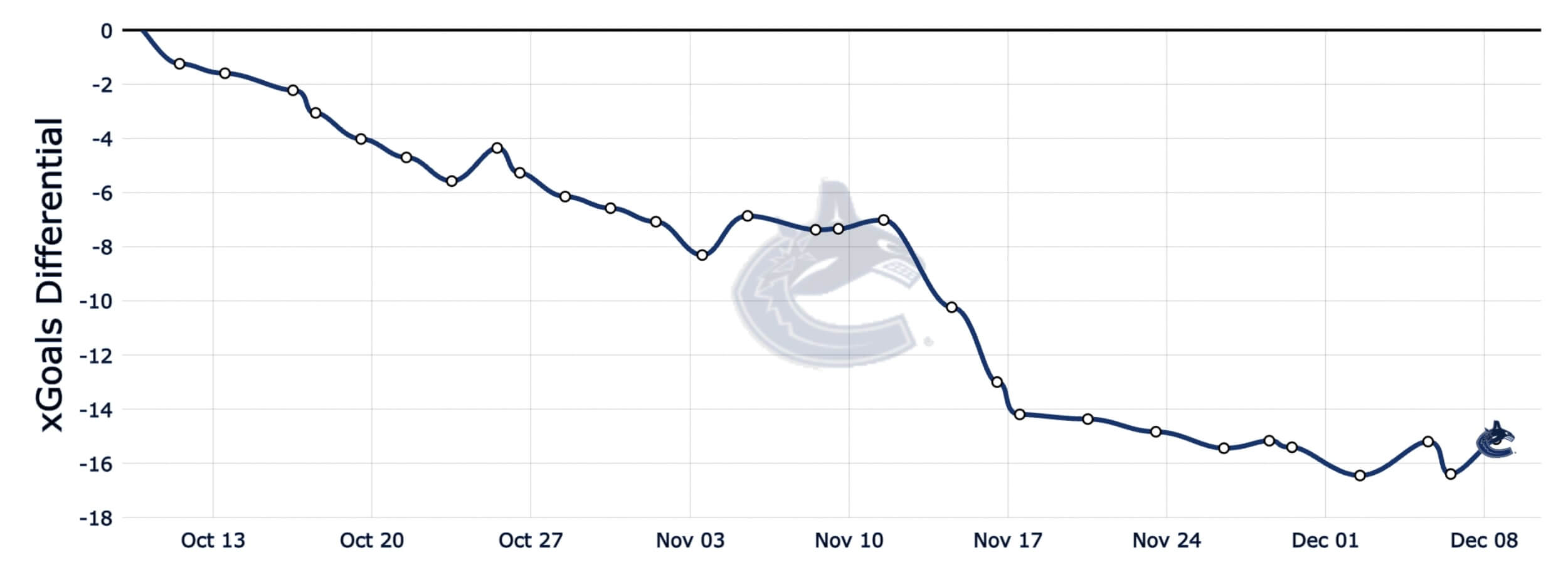
(Courtesy of MoneyPuck)
Vancouver’s recent improvement is commendable, but it shouldn’t cause us to overlook or write off the concerning form we witnessed earlier in the year when evaluating this team’s true talent level. There have been multiple stretches this season in which the Canucks have looked like a poor defensive team, and multiple stretches in which Vancouver’s defensive play has looked far worse than that. We should consider both equally, given that our sample has only just reached a significant enough size to be truly instructive.
Considering the whole, then, what we’re talking about is a porous defensive team that has surrendered shot attempts, shots and expected goals at a bottom-five rate relative to the rest of the league at even strength. The Canucks have been able to rely on a high enough level of goaltending quality at five-on-five — although that’s softened considerably of late as Kevin Lankinen has struggled while Thatcher Demko’s injury absence extended into mid-December — that Vancouver’s defensive permissiveness hasn’t been felt as severely on the scoreboard, where the club is surrendering five-on-five goals against at only the league’s 11th highest rate.
The Canucks’ issues aren’t isolated exclusively to the defensive end of the rink. At even strength, the Canucks’ offensive output has been closer to below average than it has been to league worst, but this is still a club that ranks 20th in the NHL by shot attempts for rate, 24th by shot rate and is generating expected goals at the 18th best rate in the league, according to Natural Stat Trick.
Vancouver is marginally more dangerous at generating looks in zone than it is off the rush, which is a match for its defensive profile (the Canucks are surrendering more of their scoring chances off the cycle, as opposed to off the rush), but this team is well below a league-average standard across the board offensively.
After 30 games, we can now confidently characterize the Canucks as among the league’s flimsiest defensive teams, with an offensive attack that appears to be below average and looks duly limited whenever their shooting percentage sits within a normal range.
In projecting what’s to come, should Vancouver get healthy enough to ice a full lineup at any point this season, it’s worth noting that the club’s significant five-on-five issues were apparent in a small sample of games even before Filip Chytil sustained a concussion in the club’s sixth game of the campaign against the Washington Capitals in mid-October.
Chytil himself was highly successful in his minutes prior to his injury, but overall, Vancouver was still outshot by over 30 shots on goal through the first six games of the season at five-on-five. Chytil’s return would be an enormous boost to this lineup, obviously, but it’s unlikely on its own to solve the more significant structural issues that have caused the Canucks to perform like one of the NHL’s least imposing defensive sides at even strength.
Teddy Blueger, meanwhile, who had an injury setback and isn’t expected to return before Christmas, is a useful defensive piece, but not a player that projects to fundamentally alter the five-on-five environment on his own either.
If Vancouver were able to get both centres back into the lineup for an extended stretch, you’d expect that to help the club get sustainably closer to a break-even level five-on-five. That would help, but it’s unlikely to be enough to make Vancouver an imposing five-on-five outfit.
What could more fundamentally change the trajectory of this team moving forward would be a significant Demko heater upon his return to the Canucks net. Certainly, the star netminder has proven himself capable of getting on dominant rolls throughout his career.
Overall, the Canucks’ five-on-five level has been suspect enough that Vancouver will either need to start to get very lucky or will have to perform at a level that we’ve seen scant evidence this group is capable of this season, and maintain that level for the remaining 52 games, to avoid finishing this season at or near the bottom of the Western Conference.
Power play
If there’s one area for genuine optimism in Vancouver’s team game through the first 30 games of the season, you’ll find it when you look under the hood of the club’s sputtering power play.
Through 30 games, Vancouver’s power play only ranks 18th in the NHL by conversion rate (18.8 percent), and that number might actually overstate the actual retail price of their effectiveness with the man advantage, given that only the San Jose Sharks have permitted more short-handed goals against than the four that the Canucks have permitted.
If the results look only about average, the underlying numbers suggest that the Canucks have been unfortunate with the man advantage. That’s been especially true across their past 10 games or so, as Vancouver has sagged to the bottom of the NHL standings.
The Canucks are currently generating shot attempts at a top-10 clip, shots on goal at an above-average clip and expected goals for at a top-five clip, which matches the eye test, given how the Canucks look to be snapping the puck around with the man advantage. A litany of stellar saves from opposition netminders and untimely posts and crossbars hit has prevented the Canucks from capitalizing on the pressure they’re generating five-on-four this season, and you’d expect more of those bounces to go their way over 82 games.
Overall, Vancouver looks to have a power play that should — provided its top players remain healthy and in the lineup — threaten to rank among the NHL’s top-10 power-play units over the balance of the campaign.
Penalty kill
Vancouver’s penalty kill has been a sore spot all season, but throughout the campaign, the underlying profile of the PK has been far better than its results. In fact, the Canucks are denying shot attempts and shots on goal at a top-10 rate through 30 games, but have been done in by a penalty kill save percentage well below .800.
Not all of this is bad luck, given the frequency with which opposition power plays are finding their way through seams and creating brilliant looks with east-west puck movement against Vancouver this season. To the eye, it looks as if the Canucks penalty kill makes it difficult for the opposition to set up and is structurally sound, but is error-prone in execution, especially when it comes to handling east-west puck movement. That’s burned the Canucks repeatedly, and may continue to.
If the club can get Blueger and Derek Forbort back into the lineup, that could give the penalty kill a boost. Still, I’d expect the penalty kill to struggle to be even average over the balance of the season, given the defensive personnel on hand and what we’ve seen through the first 30 games.
Summary
Based on their underlying profile, the Canucks are poor-to-unremarkable in every phase of the game.
If this team has a standout trait, in fact, through the first 30 games, it’s its defensive permissiveness, which is probably linked to the club falling beneath a baseline level of functionality at centre. That flaw has thoroughly sabotaged this team.
If we price in Vancouver’s slow start, and that both of the teams accompanying the Canucks in the cellar of the Western Conference standings at the moment, the Calgary Flames and Nashville Predators, have significantly more auspicious underlying profiles, it becomes crystal clear that any potential climb up the standings is likely to prove daunting.
Even if we think that the power-play effectiveness will improve, that there’s a some chance of save percentage regression for Vancouver short-handed, and even if the Canucks’ centre depth gets a significant boost as players like Chytil and Blueger return to the lineup, this side’s level of five-on-five play is low enough to prevent the team from getting hot down the stretch without a preponderance of bounces. And that’s before we consider the likelihood that Vancouver will weaken its roster by executing seller trades prior to the trade deadline.
This season, the Canucks genuinely look like a high draft lottery odds calibre team. And that’s even if everything goes right from this point forward.