
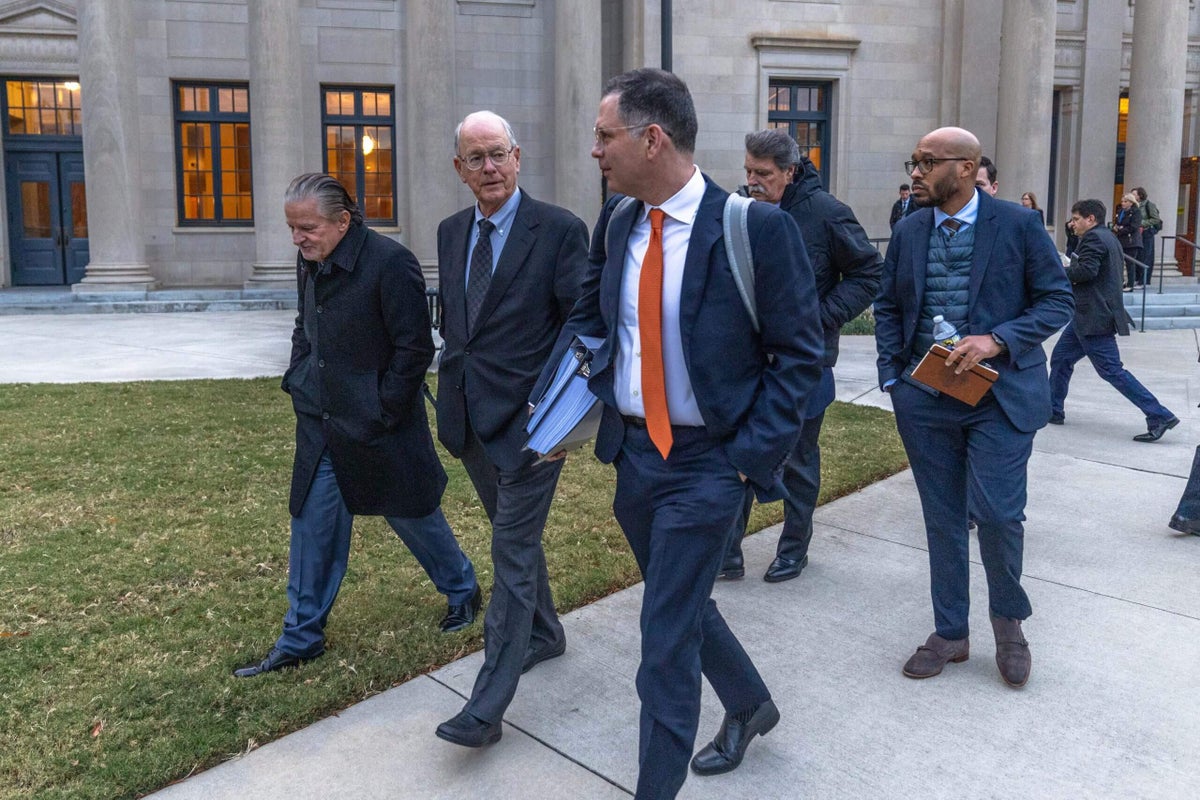
CHARLOTTE, N.C. — NASCAR chairman and CEO Jim France testified he could not offer race teams permanent charters because there was no conceivable contract “that could cover everything forever.”
“I don’t have a sightline to the future, and I don’t feel comfortable making a promise I don’t know if I can keep,” France said Wednesday on the eighth day of the antitrust lawsuit against NASCAR and France.
Two race teams, including one owned by Michael Jordan, are suing NASCAR for alleged monopolistic practice. The plaintiffs’ case, which rested Wednesday morning, revolved around showing NASCAR forced anticompetitive terms on the teams in an attempt to maintain its monopoly.
One of the primary factors was the denial of permanent charters, which are similar to professional sports franchises and come with certain revenue guarantees to teams — except NASCAR’s charters have expiration dates and must be renegotiated.
The teams begged France for permanent charters with an ability to only renegotiate the economic terms, but France refused again and again.
“I don’t know how you can set anything in this changing world we’re in as permanent,” France said. “I’m just not comfortable making agreements that go on forever.”
The 81-year-old France disagreed that NASCAR did not cede on any of the teams’ negotiating points, but acknowledged permanent charters were not an area in which he would change his opinion. It wasn’t only the ability to negotiate economic terms, he said; it was the unknown.
“Don’t know ’til we get there,” France said.
Jeffrey Kessler, the teams’ attorney, noted how France was proud that his family built the sport and planned to pass it down for generations. In that context, he asked France how it would feel “if a monopolist came in and said, ‘I can take this away from you at any time’ … with an expiration date and (terms that say) ‘either agree with what I want or lose it.’”
“I don’t understand what you’re trying to say here,” France replied.
France told jurors his management style is a “consensus builder” and said he believes his executive team is “the best team we’ve got in my history at NASCAR.” But he disagreed with his executives when they urged for more of a compromise with the teams.
France said that after becoming NASCAR’s CEO in 2019, he visited race shops and was taken aback to see the number of cars on the shop floors. In his view, race teams had become manufacturers and were in an “arms race” to make costly parts that he vowed to rein in.
He instituted a limited approval process for changes and then ultimately introduced the spec “Next Gen” car, which requires all teams to use the same parts from the same supplier.
The degree to which France was involved in the charter negotiations, and how he shaped them as the head of NASCAR, has been a focus of the plaintiffs’ case, alleging that France utilized anticompetitive measures to maintain control over the sport that his father was instrumental in founding in 1948 and has since remained in the family’s control.
Evidence presented Tuesday showed that NASCAR’s ownership is split between two France family trusts — one controlled by Jim France, who owns 54 percent of the company, and the other by his niece Lesa France Kennedy, who owns 46 percent. Jim and Lesa are on the seven-person NASCAR board. The other members are NASCAR commissioner Steve Phelps, NASCAR president Steve O’Donnell, longtime NASCAR employee Mike Helton, former NASCAR attorney Gary Crotty and Ben Kennedy, Lesa’s son.
The plaintiffs have argued that the insular nature of NASCAR’s board has allowed them to maintain monopolistic control of premier stock car racing.
The defense begins presenting its case
After France, the defense started presenting its portion of the case by calling John Probst, NASCAR executive vice president and chief racing development officer.
Probst defended NASCAR’s Next Gen car and heralded its cost-saving measures for teams after NASCAR spent $14 million developing the vehicle.
He argued with Kessler’s assertion NASCAR was doing something unconventional by protecting the car’s intellectual property with restrictions, since it owns several patents on the vehicle.
“Coke would not create a new recipe and immediately give it to Pepsi,” Probst said.
But Kessler said NASCAR could have created the Next Gen car “exactly as you did it without restrictions” on teams being able to use it in other series.
“All they have to do is ask,” Probst said. “No one has asked.”
Kessler countered by saying NASCAR and France would have never allowed that.