
Scientists have recorded a rare interaction between solar neutrinos and carbon for the first time.
The result marks an important step in understanding how low-energy neutrinos behave inside matter.
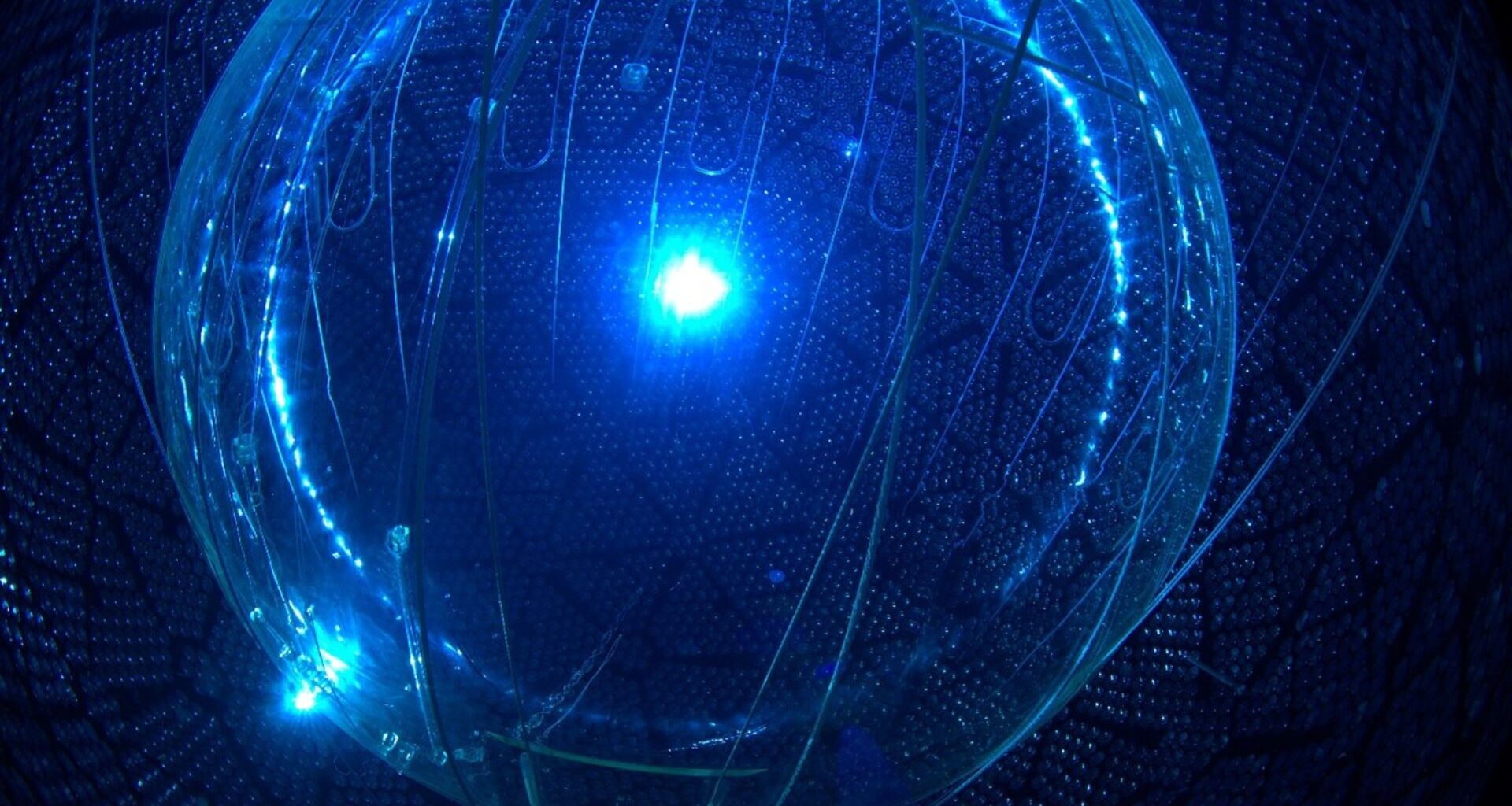
The SNO+ detector in Canada captured the elusive signal after more than a year of data collection.
The Oxford-led team used the SNO+ detector at SNOLAB, located two kilometres (1.24 miles) underground in a working mine in Sudbury, Canada.
The depth shields the experiment from cosmic rays and background noise.
That protection allowed researchers to isolate extremely faint signals produced when neutrinos strike atomic nuclei.
Neutrinos remain among the most mysterious particles in the universe. They rarely interact with matter. Trillions pass through the human body each second.
They emerge from nuclear reactions, including those inside the Sun.
Detecting them requires patience, precision, and enormous shielding.
The SNO+ team focused on interactions with carbon-13, a rare form of carbon present in the detector’s liquid scintillator.
When a high-energy solar neutrino hits carbon-13, it can transform the atom into nitrogen-13.
The new nucleus decays about ten minutes later.
Researchers relied on a delayed-coincidence technique. They looked for an initial flash from the neutrino strike.
They then searched for a second flash minutes later as nitrogen-13 decayed.
That paired pattern helps distinguish genuine events from background signals.
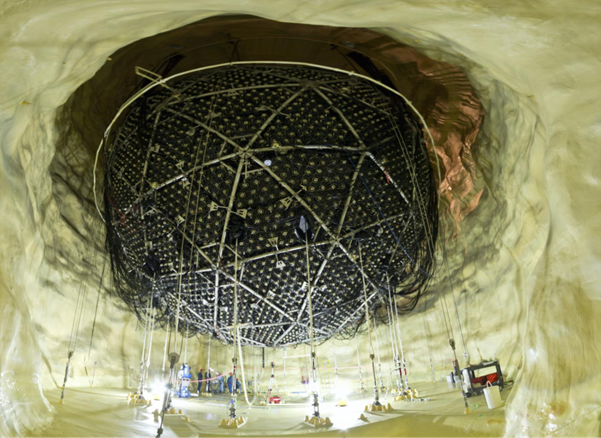 The Sudbury Neutrino Observatory cavity and detector under construction 1.24 miles underground in Sudbury, Ontario. Credit – SNOLAB
The analysis identified 5.6 such events over 231 days from May 2022 to June 2023.
The number aligns with the 4.7 solar neutrino events expected during that period.
Rare reaction confirmed
Lead author Gulliver Milton, a PhD student at Oxford, called the detection a major achievement.
“Capturing this interaction is an extraordinary achievement. Despite the rarity of the carbon isotope, we were able to observe its interaction with neutrinos, which were born in the Sun’s core and travelled vast distances to reach our detector.”
The result also builds on decades of neutrino research. Co-author Professor Steven Biller noted the history behind the work.
“Solar neutrinos themselves have been an intriguing subject of study for many years, and the measurements of these by our predecessor experiment, SNO, led to the 2015 Nobel Prize in physics.”
He added that understanding has deepened so much that researchers can now use solar neutrinos as a “test beam” for rare atomic reactions.
Foundation for future studies
SNO+ repurposes the earlier SNO experiment, which first proved that neutrinos shift between three types as they travel from the Sun to Earth.
Dr Christine Kraus, a staff scientist at SNOLAB, highlighted how the team used the natural carbon-13 in the target material to measure this specific reaction.
“To our knowledge, these results represent the lowest energy observation of neutrino interactions on carbon-13 nuclei to date and provides the first direct cross-section measurement for this specific nuclear reaction to the ground state of the resulting nitrogen-13 nucleus.”
Researchers say the achievement opens new opportunities to study rare neutrino interactions.
It may also guide future detector designs as scientists push to understand how these ghostlike particles shape nuclear processes and the wider universe.