
Additional reporting by FanBuzz’s John Newby
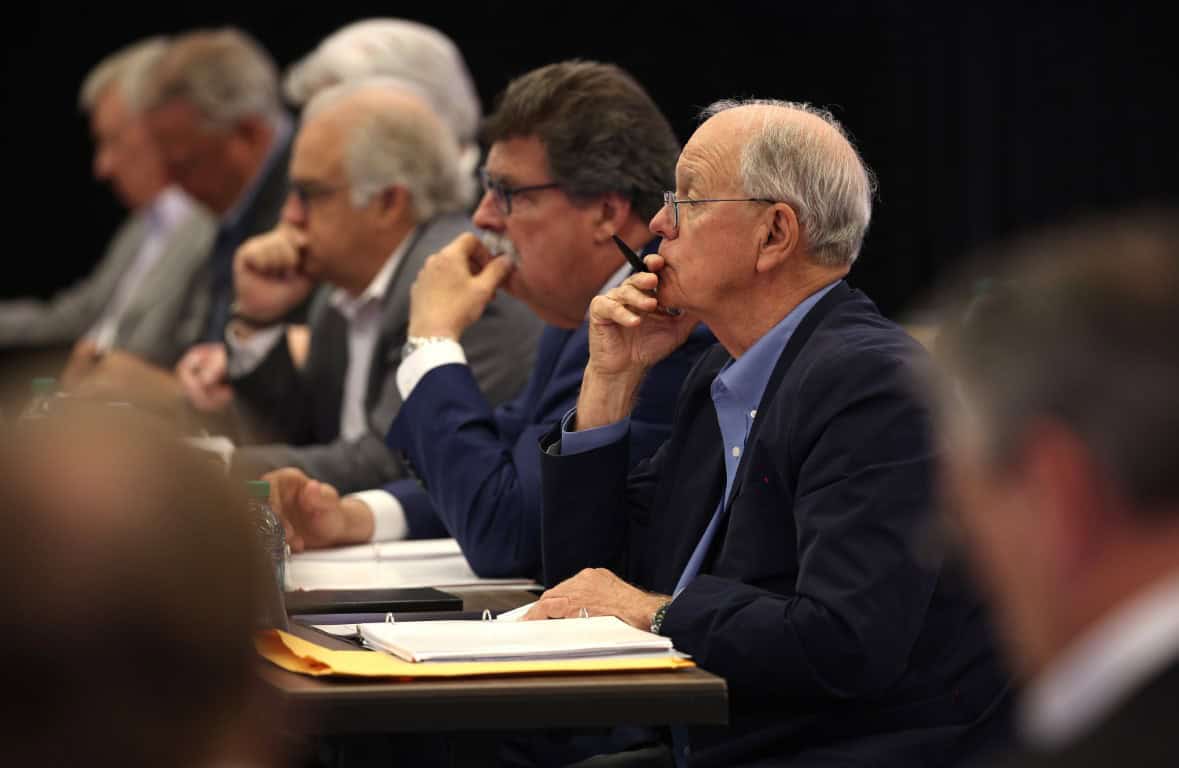
The ongoing 23XI Racing/Front Row Motorsports vs. NASCAR lawsuit continued on Wednesday, Dec. 10, as the eighth day of trial proceedings rolled forward.
It was a day full of legal “gotcha’s” and even a few laughs. But if you weren’t a fan of numbers, Wednesday was not the day to tune in outside of the first testimony.
The day began with NASCAR unveiling a shorter witness list that, in theory, should bring the trial to a close by its initially intended date of Friday, Dec. 12.
After that, the legal equivalency of Frank Costanza’s airing of grievances began, with NASCAR attorney Lawrence Buterman raising additional complaints about the testimony of economist Edward Snyder, who used Formula 1 as a benchmark for earlier testimony. This was followed by Buterman arguing that Judge Kenneth W. Bell did not allow NASCAR to pursue “a critical line of questioning” regarding pre-2014 information. Teams attorney Jeffrey Kessler said that NASCAR was sandbagging in this regard, and that it wasn’t the first time the teams had done so during the trial.
NASCAR CEO Jim France then took to the witness stand again. NASCAR attorney Chris Yates spent the morning allowing France to tell his backstory in the sport before pivoting to a brief back-and-forth about the financial status of France’s IMSA team, Action Express Racing. France said that the team is sometimes profitable, sometimes not, but that they stick with the sport because “it’s in the blood.”
Rolex 24 Entry List Revealed; Multiple Lineups Announced
The topic pivoted to the Next Gen car, with France testifying that Doug Yates of Roush Yates Engines originally came to him with the idea of the “single company” car. However, due to his work with Roush Yates, he couldn’t lead the project. Enter John Probst, the current Executive Vice President and Chief Racing Development Officer at NASCAR, who ended up leading the project. Yates then changed the topic again after France acknowledged that he and Denny Hamlin had a conversation in which team costs were mentioned at the NASCAR Awards.
This time, the topic turned to the reasoning behind not granting permanent charter status. France said he is not comfortable with anything permanent given NASCAR’s history. In doing so, he mentioned that at one point NASCAR paid the drivers rather than the teams, and that NASCAR couldn’t pay the teams if they had permanent contracts.
“I don’t have a sightline to the future, and I’m really not comfortable making a promise that I cannot keep forever,” France said.
Then, it was Kessler’s turn to question the NASCAR CEO, and this time, there were many fewer unclear responses. He opened by stating that France was concerned about a lawsuit from the teams back in 2015 when he set up a litigation fund, which France denied, citing that it wasn’t about the teams.
At that point, Kessler showed a text exchange between Lesa France Kennedy and Ben Kennedy in which they referenced the then-ongoing Race Team Alliance negotiations.
“Jim has been building a defense fund for years in case we get into this jam,” Lesa said. “Smart guy.”
France responded that the fund is for any litigation that could cause problems for the sport, not just for litigation involving the teams.
Kessler then pivoted to the charter negotiation process, stating that in 2024, NASCAR decided to conduct individual negotiations with the teams. Kessler then said that France was the leader of those negotiations, to which France replied that he had taken some meetings, but was not involved with the Team Negotiation Committee.
In response, Kessler showed a 2023 email from NASCAR Chief Strategy Officer Scott Prime with talking points for France to use in meetings with individual teams. France responded that charters weren’t the only topics discussed at these meetings, but each talking point Prime sent him focused on charter negotiations, as Kessler pointed out.
After that, France mentioned that another reason he didn’t want permanent charters was the unknowns within the NASCAR schedule. Still, Kessler rebutted, citing that teams negotiated personal charters with the ability to adjust economics in the future. France said he had never seen the proposal with that language. After a few more questions regarding permanent charters and NASCAR’s usage of team intellectual property on social media without compensation, which France denied having any knowledge of, France’s testimony ended at 9:45 a.m.
At that point, Probst took to the stand for the defense at 9:47 a.m. Probst offered just 40 minutes of testimony before a break at 10:26 a.m. During those 40 minutes, he detailed that NASCAR worked with a Canadian company to determine what an exciting race actually was. It was deduced that when a star driver wins a race, whether there are 17 lead changes, 1,000 passes or none, it is a more entertaining race than when an unpopular driver wins.
When the court resumed, NASCAR admitted several documents detailing U.S. government patents for the Next Gen car. NASCAR claimed it spent over $1 million developing the underwing and hundreds of thousands on the car’s diffuser flap. According to Probst, NASCAR spent around $4.5 million on safety testing of the Next Gen car before rollout and continues to pay $2.5-3 million annually on safety testing.
All of this testimony culminated in Probst concluding that the Next Gen car’s development was about safety above all else and breaking away from technology dating back to the hot-rodding days of the 1950s. He said that it was meant to allow NASCAR to build for the future.
Probst made sure to note that at no point did teams pay for any development of the Next Gen car. The defense then showed a slide stating that NASCAR would bear the brunt of the development costs, which was estimated at $10-12 million.
At that point, Probst pushed back on earlier claims by FRM owner Bob Jenkins that he was forced to buy seven chassis per charter, noting that they only ran six cars per charter in 2024.
It was then revealed that, in 2023, 23XI spent $1.446 million per car and just over $1 million on parts per car in 2024. Probst said that 23XI was one of the top three spending teams in Next Gen cars during the 2022-24 seasons.
Probst then shifted focus to parts vendors for the cars, noting that having more than one parts vendor ultimately leads to one vendor getting all the business anyway. He then explained that NASCAR goes through a very deliberate process when selecting these vendors, including reviewing invoices for new materials, customs costs and even power bills for the company’s factory.
After a brief discussion about Kaulig Racing’s addition of RAM to the NASCAR Craftsman Truck Series, the topic turned to the cost of fielding a car, which NASCAR estimated at around $19 million, excluding key startup costs and charters. The second car, without a driver salary or startup cost, would be $12.3 million.
The defense’s questioning of Probst ended around noon, with Probst stating that NASCAR provides Wi-Fi at the track and that it’s up to the teams whether they want to subscribe to it.
In Kessler’s questioning of Probst, he made sure to mention that the teams are not challenging the Next Gen car, just the restrictions around it.
“You don’t have to restrict these cars to achieve [interest, cost savings or more competitive racing],” Kessler said.
Probst said that he doesn’t understand the legalese of Kessler’s questions or the emotions surrounding the intellectual property of the Next Gen car and used an analogy of Coca-Cola developing a new recipe and handing it over to Pepsi when asked about licensing the teams to use the vehicle. He even mentioned that, at times, Gen 6 NASCAR Cup Series chassis were brought by Red Bull Racing to be used in the ARCA Menards Series, which was not owned by NASCAR at the time.
Regarding the Gen 6 car, Probst made several references to the Gen 6-Star car, an alternative option that NASCAR considered before opting to develop the Next Gen car. At this point, Kessler showed an email in which Probst said that the Gen 6-Star car would “increase the risk to NASCAR of a copycat series.”
Probst also made sure to mention that NASCAR is fine with competition and that, in reference to NASCAR Commissioner Steve Phelps’s “putting a knife in” the SRX Series, Phelps would have to answer any questions about that.
Kessler then diverted to asking Probst about the Gold Codes document, which Probst contributed to heavily, using some data from NASCAR’s estimates for funding cars. The Gold Codes were one of the options NASCAR came up with for if the teams didn’t sign the new charter deal, which featured NASCAR fielding its own cars for Cup. When the teams signed the charter agreements, Probst received a text saying, “RIP Gold Codes,” to which Probst replied, “YES.” This was followed by Probst stating that he had no idea why the teams were still holding out on the charter agreement. The court then broke for lunch.
The next witness for the defense was NASCAR CFO Greg Motto, who testified against the teams’ financial claims. Motto said that, in 2020, teams received 39% of NASCAR revenue. Motto testified to the existence of several properties and assets that NASCAR owns, but said that to pay the teams, NASCAR would have to sell off some of these assets, and that process is not sustainable.
Motto said that the distribution of profits to shareholders is a cash transaction and does not appear on expense and revenue forms. Additionally, Motto noted that NASCAR has spent well over $600 million to renovate tracks like Daytona International Speedway, Talladega Superspeedway, Richmond Raceway and Phoenix Raceway in recent years and said that NASCAR wouldn’t have had enough cash on hand to pay $1.06 billion to teams between 2021-24.
After further elaboration on NASCAR’s financial situation under the previous media rights deals, Kessler began his cross-examination of Motto, starting with the ever-thrilling topic of taxes and catching Motto off guard by citing a contract that says it will pay France and Lesa France Kennedy’s taxes.
“That’s like a contract between me and myself,” Kessler said.
He went on to say that it was just a matter of moving money back and forth between the family.
Kessler then produced a 2024 document in which Motto detailed a plan to shareholders to reduce the France family’s taxes. In this same series of documents, Motto showed NASCAR’s Beta profit margins at 21%, 18% and 17% from 2022-24, which Kessler was quick to point out were much higher than the operating margins shown to jurors, which were all under 10%.
In explanation of this, Motto said that NASCAR has completed multiple large projects since the ISC acquisition, such as the production facility and installing Wi-Fi at tracks, which Kessler was quick to point out that teams must pay for.
Motto then said that NASCAR revenues are down by probably $10 million of $1.7 billion. Amid NASCAR’s redirect, Motto said that NASCAR’s interest rate on the ISC loan was 3.5% and that it would have increased to a 7% variable rate in 2024 if NASCAR hadn’t paid down its debts. Motto ended his testimony at 3:31 p.m.
Judge Bell followed this by stating that RFK Racing had a car on display in the baseball field across the street and jokingly asked if anyone planned on an off-site jury viewing.
At that point, Dr. Mark Zmijewski began to testify as NASCAR’s own expert economist. It’s important to note that Snyder, the economist evaluating damages to 23XI and FRM, assessed their damages at $163.8 million and $96 million, respectively. This was based on using F1 as a benchmark for market value.
Zmijewski said that F1 was not comparable as a benchmark, and that Snyder vastly overestimated the damages and market value of the two teams. He said that F1 had a 70% growth rate between 2021-24, and that NASCAR’s is at 7%.
In cross-examination, Kessler pushed back on this point, stating that in sports, evaluations are based on revenue, not profits. Zmijewski used profit margins in his presentation to critique Snyder (and to publicize his book, not joking).
At that point, the teams’ lawyers stated that, in no part of Zmijewski’s hour-plus-long testimony, did he mention whether the anticompetitive nature of NASCAR could be holding itself back. To back up this claim, the plaintiff’s team presented multiple pieces of evidence in which senior NASCAR executives say they’re shooting themselves in the foot, holding themselves back and not growing the sport.
Just before the day concluded, it was determined that Zmijewski was not asked to recalculate the teams’ damages, but to prove Snyder incorrect and that it took hundreds of billable hours to do so.
The court adjourned to stop for the day at 5:26 p.m. Day nine of the trial will take place on Thursday, Dec. 11, with Zmijewski completing his testimony. FOX Sports Bob Pockrass reported he believes NASCAR has at least five more witnesses after.


Tanner Marlar is a staff writer for Sports Illustrated’s OnSI Network, a contributor for TopSpeed.com, an AP Wire reporter, an award-winning sports columnist and talk show host and master’s student at Mississippi State University. Soon, Tanner will be pursuing a PhD. in Mass Media Studies. Tanner began working with Frontstretch as an Xfinity Series columnist in 2022.