
Music, in its purest, most potent form, doesn’t just have the power to entertain; it also has the power to change lives for the better. Probably no one understands that more than James “JJ’88” Jacobs, a formerly incarcerated musician who found hope during a double-life prison sentence by penning freedom songs from solitary confinement.
At that time, freedom (at least in the figurative sense) came by way of Jacobs’ craft, which allowed him to liberate his mind behind bars during what was arguably the darkest period of his life, next to the violent act he committed that landed him in prison. Just three days after he took a life on the streets at age 15, his brother’s life was taken from him, too.
It took years for a then-incarcerated Jacobs to unpack the events that led to that tragic loss and traumatic point in his youth. However, through soul-baring raps and self-reflection in solitude, he was finally able to make sense of them, so the story goes in the award-winning film he helped compose, “Songs From the Hole.”
Developed in unique partnership with director Contessa Gayles and producer richie reseda, the acclaimed documentary-visual album — which debuted on Netflix earlier this year following its 2024 SXSW premiere — is both a portrait of Jacobs’ life before, during and after prison, as well as a testament to the solace and clarity he found in the lyrical journal entries that helped him confront his internal struggles.
From the moment that “Songs From the Hole” begins, it’s evident that it’s no ordinary film. The first voice you hear is Jacobs’, carried over the static of a jailhouse phone call as he describes the profound isolation of being locked up in solitary confinement (“the hole,” as he calls it) with nothing but his thoughts. His words materialize on screen one at a time as handwritten script on lined notebook paper, just like the kind he used to record his rhymes during the two-and-a-half months he spent in the hole.
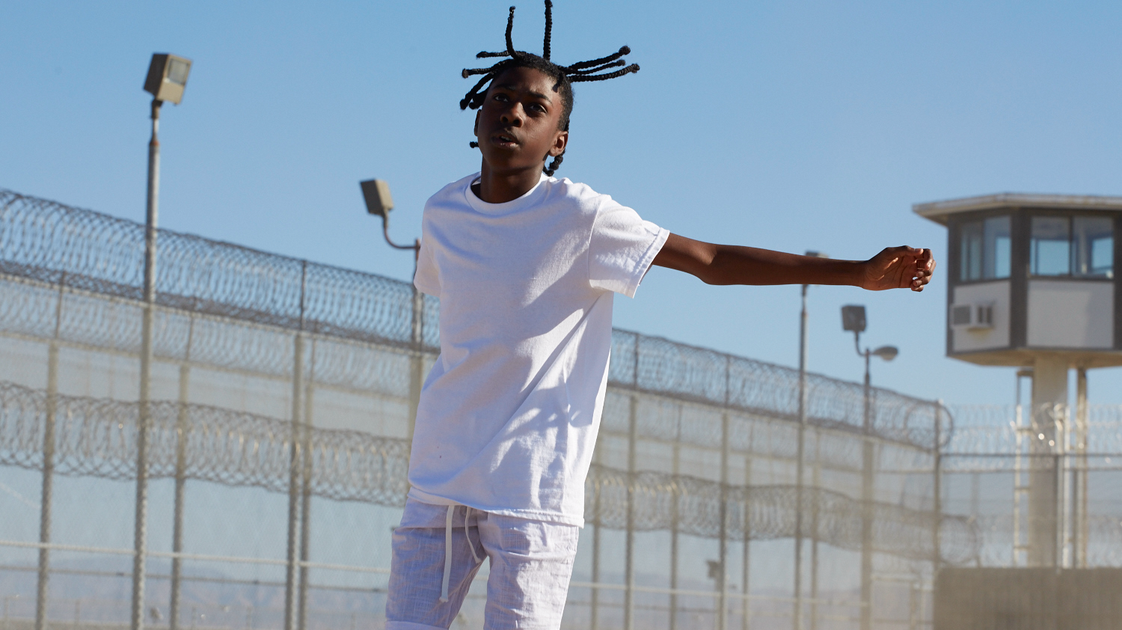
The screen cuts to black before you hear Jacobs, still unseen, singing over a jazzy instrumental of brassy horns and steady drums. A young boy dressed in all white then appears, jumping around freely in a dirt prison yard, his long braids flopping in the air. Jacobs, narrating, says, “If I could go back and talk to 15-year-old James, I would have a conversation with him about who he is.”
This is the rhythm of many sequences in “Songs From the Hole”: narrator Jacobs offering a keen insight over the phone alongside raw documentary footage, or one of his songs playing against the backdrop of a striking music video that brings to life an imagined memory or dream of his, each one peeling back another layer of his tumultuous story.
It’s an experimental structure that Jacobs developed with reseda and Gayles — the latter best known for directing the CNN documentary “The Feminist on Cellblock Y” — early on in their film’s roughly five-year production. Drawing on 15-minute jail calls with Jacobs, interviews with his family and old photos, the filmmakers weave a compelling tale that blends inspired visuals and documentary footage with revelations about Jacobs’ real-life testimony, all set to his poignant music. The result is a redemptive story in which Jacobs finds peace, understanding and, most of all, the radical power of forgiveness.
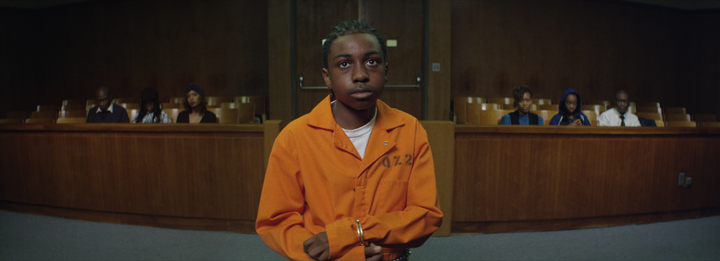 At age 15, a grieving Jacobs (portrayed by Myles Lassiter throughout “Songs From the Hole”) was sent to prison with a double-life sentence, during which he turned to music to find healing and accountability for the violent harm he both committed and experienced.
That’s ultimately what makes “Songs From the Hole” — the 96-minute film and the accompanying hip-hop album Jacobs wrote and recorded while incarcerated — such a resonant display, unlike anything else to emerge from within the U.S. prison system. The project isn’t another examination of modern incarceration that focuses solely on Jacobs’ time behind bars, but rather his personal transformation during those years, using a musical odyssey to take viewers on an emotional coming-of-age journey that he is still grappling with himself.
“It’s a completely different approach to telling an incarceration story because it is music first and centers ’88’s own artistic expression, first and foremost, as the tool and main vehicle for telling his story,” Gayles explained to HuffPost.
“Unlike most of the world, we respect incarcerated people beyond just the fact that they’re incarcerated,” reseda added. “I feel like our film centers the spirit of a human, as opposed to centering the system that oppresses them.”
Hence, you never see the inside of the prison where Jacobs served 18 years of a life sentence in the film. Gayles said the choice was both accidental and deliberate, spurred during her preinterview calls with Jacobs amid the COVID-19 pandemic that ultimately became the film’s main narration.
“We started recording them once we realized that, with COVID-19, we couldn’t get into the prison,” she explained. “Then, when things opened back up, we decided that actually was a much more effective way to tell the story. That was a creative solution that made a lot more sense for our film.”
A humanizing one, too, as the approach smartly allowed “Songs From the Hole” to delve even deeper into Jacobs’ moving story, which began long before he killed a young man on April 16, 2004, and was convicted of murder.
!["Our intention was to share our family's story, in the hopes that people can see themselves in it," Jacobs said of his visual album's aim. "And then also to have people who may not be impacted [by the prison system] see the humanity of those of us who endure what we endure."](https://www.newsbeep.com/ca/wp-content/uploads/2025/12/6939761c19000096ee7f3c03.png) “Our intention was to share our family’s story, in the hopes that people can see themselves in it,” Jacobs said of his visual album’s aim. “And then also to have people who may not be impacted [by the prison system] see the humanity of those of us who endure what we endure.”
“Our intention was to share our family’s story, in the hopes that people can see themselves in it,” Jacobs said of his visual album’s aim. “And then also to have people who may not be impacted [by the prison system] see the humanity of those of us who endure what we endure.”
Before Jacobs was sent away to a California state prison, he grew up in North Long Beach. He was raised in a supportive family: his father, William, was (and still is) a preacher and his mother, Janine, directed the church’s children’s choir, in which Jacobs and his sister, Reneasha, sang. Their older brother, Victor, meanwhile, watched over them throughout their childhood, even when he, like Jacobs, was drawn to the streets.
Jacobs, a rapper, singer and songwriter, had a love for music growing up in the church, identifying it mostly as a spiritual tool, he said. However, he didn’t begin using it as a means of self-expression — and, by extension, a cathartic outlet — until he needed it most, when he went away to prison as a teen.
“I wasn’t taking it that seriously until I was incarcerated,” the rapper shared with HuffPost, “where I was like, I can actually write these songs and talk to some of the homies who in here locked up with me. And we could talk about our life and escape through this and process what we’re going through.”
Incarceration not only revealed Jacobs’ musical gifts but also other creative talents, like his knack for envisioning vibrant storylines and turning them into tangible narratives, much like those seen throughout “Songs From the Hole.”
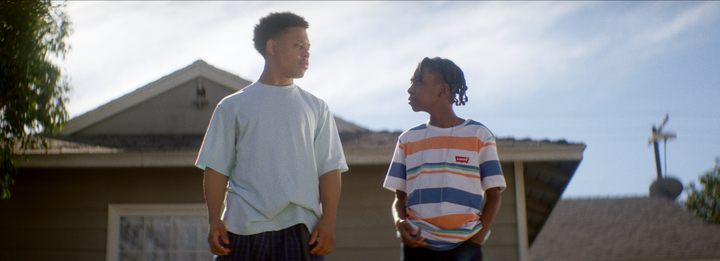 Myles Lassiter, right, as Jacobs and Jovon Times as his older brother, Victor Benjamin, in a visual sequence from “Songs From the Hole.”
Several of the film’s music videos feature young actors portraying Jacobs and his older brother during their adolescence, capturing moments of both joy and anguish — from witnessing Victor’s arrest to the tragic moment he was shot and killed. Other visuals illustrate Jacobs’ inner turmoil during his incarceration, such as a half-animated sequence in which an actor embodying him stands helpless behind cell bars while Jacobs raps about “livin’ in a steel grave.”
“I’m not formally trained,” Jacobs said of writing the visual album’s music video treatments, crediting assistance from Gayles’ “brilliant edits” and reseda’s additions. “But I do have a love for film. Growing up, especially when I was in YA and juvenile hall, and even when I went to adult prison, I did read scripts [and] treatments. I was interested in music videos, filmmaking and the process.”
Jacobs continued, “Honestly, because my creative process comes with not just sounds in my head, with these lyrics and melodies, but also visuals, and being a very visual person, it was easy to write the [treatments] down.”
“It wasn’t necessarily easy to make it into a more cohesive piece,” he added. “… [But] over time, and through Contessa’s mentorship and guidance, it became more of a cohesive story for our intention.”
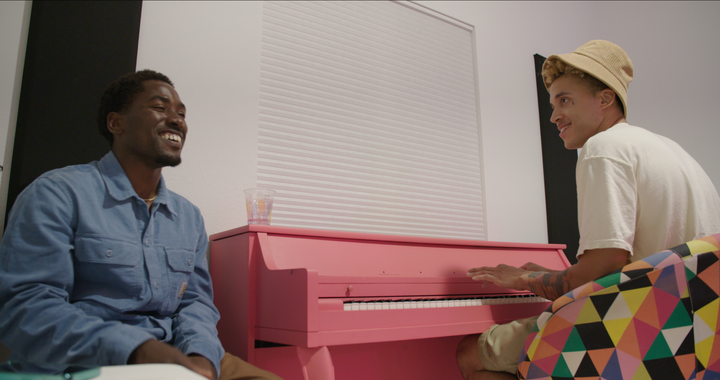 “Songs From the Hole” producer richie reseda immediately resonated with Jacobs’ music when the men met in a California prison. “There was a deep spiritual draw that I had to his work,” he told HuffPost.
The collaboration of “Songs From the Hole” came about somewhat naturally. It began shortly after Jacobs met reseda, a fellow musician and formerly incarcerated producer, after being transferred to the same prison. Coincidentally, this was right around the time reseda had recorded, produced and released his own album on his 25th birthday while still behind bars.
“When ’88 came to the prison, everybody was telling me, you need to meet this kid,” the producer recalled to HuffPost. “And when we did meet through our homie Talib — who’s still fighting for his freedom now — I was like, he could rap very well; he could sing very well.”
“His approach to the stories that he was telling was not one that was glorifying nor judging,” reseda continued. “There was also a deep spiritual draw that I had to his work. There was a spiritual commitment in his work, and he knew what he wanted. He also put in the time to be clear about what his vision was for the project.”
According to reseda, who also produced the original music for “Songs From the Hole,” Jacobs drew heavy inspiration from classic soulful works like D’Angelo’s “Voodoo” and Kendrick Lamar’s “To Pimp a Butterfly” when shaping his visual album’s creative direction. That made the producer even more excited about the vision Jacobs was intent on pursuing in an effort to share his lived truth.
“I really got to know his story through making the music with him,” said reseda, noting that he initially didn’t understand the intricacies of Jacobs’ journey, including how he unknowingly met the man who murdered his brother.
“When we finished [the album], we just knew it was too big,” reseda continued. “It wouldn’t do it justice to just have it posted online. This album had the power to heal community. That’s how it felt to me, so we were like, let’s do a visual album.”
Enter Gayles, whom Jacobs and reseda already knew from appearing in her 2018 documentary on a rising feminist movement within their all-male prison. According to reseda, the two were particularly impressed by Gayles’ approach to the subject, specifically how she portrayed it with authenticity without including prison officials or anyone who represents the institution.
“And so I trusted her with this story,” the producer continued of “Songs From the Hole,” jokingly adding that Gayles was also “the greatest and only director that we knew” for the project.
Luckily for them, “she said yes to directing it.”
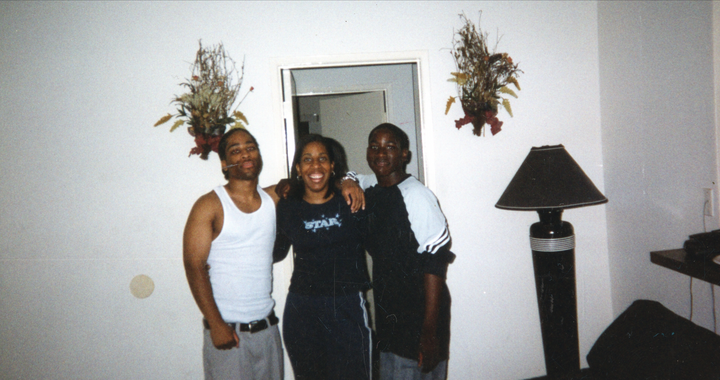 Jacobs, right, pictured with his real-life brother, Victor, and their mother, Janine.
The first time Gayles heard the tracks that would become the “Songs From the Hole” album was during her last day of filming “The Feminist on Cellblock Y,” when Jacobs and reseda were performing in the prison’s gym.
“They had the rental keyboard in the gym on a trash can, and richie was on the keys, and ’88 was singing and rapping some of the songs,” the director remembered. “Some of their friends were gathered around and knew all the lyrics.”
“I was really taken with, one, their friendship and collaboration,” she added, “but also with ’88’s talent with the lyricism [of his songs].”
It wasn’t until after Jacobs and reseda asked Gayles to helm their visual album that she got to hear the more polished cuts of the “Songs From the Hole” tracks that the two recorded together in prison. And after receiving Jacobs’ handwritten lyrics through snail mail, “I got to see the storytelling and the intricate poetry that’s in there, and really appreciate it more,” Gayles noted.
It was over the course of more conversations that the filmmaker connected the dots between Jacobs’ story and the context in which his gut-honest music was written in the hole.
Jacobs spent much time in that 6-by-6 cell, lying on the floor, thinking about the most devastating month of his life and the “worst thing” he had ever done. Between taking another young man’s life and being in the same prison as the man who took his older brother from him, not to mention no longer having his own freedom, grief weighed heavily on his spirit. Music, oftentimes, was his escape from that cycle and circumstances, and so Jacobs made a habit of making beats on his chest or bunk that eventually became full-blown confessional songs. In the midst of this therapeutic journey, Jacobs was able to forgive his brother’s killer, who, before knowing his true identity, inspired him to reflect on the significance of his own wrongdoings and repent.
“I was like, whoa, this is incredibly powerful,” Gayles said of the revelation, which is all the confirmation she needed to help bring “Songs From the Hole” to life.
“Like richie said, [the film] has the potential to really affect culture and heal community through the music and the story,” Gayles said. “And if we can figure out a way to make them sing together, then we’d have something really special.”
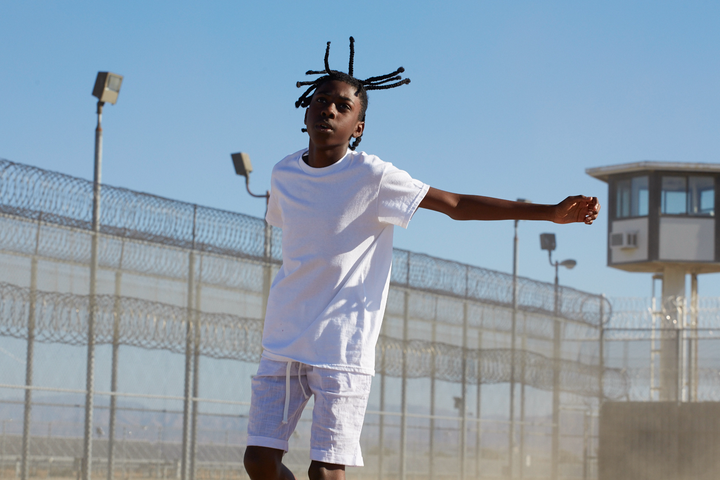 Before he was released from prison in 2022, Jacobs wasn’t sure he’d ever get to see the ideas he birthed for “Songs From the Hole” from the other side of a cell. “Being an incarcerated person, our visions for our lives, our art, it’s not often we get to see them while we’re in prison,” he said.
The vision for “Songs From the Hole” was ambitious from the start. Still, putting it together while Jacobs was serving out his sentence — which included multiple, emotionally fraught attempts at parole, as seen in one particularly heartbreaking scene in the film — proved extraordinarily challenging throughout much of the project’s lengthy development.
Gayles noted that roughly one music video was filmed per month over the course of a year, with material still being rewritten up until the shoots. At the same time, interviews with Jacobs’ family were conducted, a process that ultimately benefitted the visual album creatively and logistically.
“As I was learning the story more deeply from everyone’s perspective and getting to know them better, there were things that I was writing into the treatments that worked their way into the music videos,” Gayles shared. “That was really intentional, but also like a gift that we had time in between each [music video] to continue to rewrite them and let the project be really iterative in that way.”
In the midst of this, Jacobs was still deeply involved in the filmmaking process, even from far away. He said reseda would often make trips to CVS or Walgreens to print out screenshots of dailies from the shoots and mail them to the musician so he could keep track of how his vision was coming together.
“That was a cool experience to be able to have some things that went from in my head to on paper to now seeing screenshots of things that were exactly in my head, too,” shared Jacobs. “There were some things that started off one way in my brain, and over the course of collaboration, it took a fuller form. And then there were other things that were exactly how I saw it in my head, and it was just like, this is crazy.”
“Especially being an incarcerated person,” he added, “I just want to stress that our visions for our lives, our art, it’s not often we get to see them while we’re in prison. But I had the privilege of being able to collaborate with Contessa and richie and be able to see my visions and ideas come to fruition, while I wasn’t even sure if I was going to be able to see them on the other side of the gate.”
“It was just cool knowing that it was happening.”
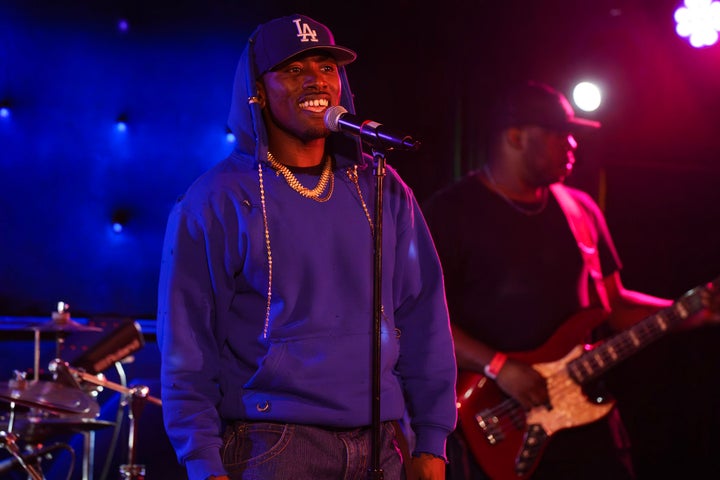 During his time in solitary confinement, Jacobs would imagine performing for a crowd of thousands with a full orchestra behind him. In November, he performed songs from his visual album at a solo show in Los Angeles (pictured above), where he was backed by a live band.
In 2022, Jacobs was released from his life sentence. No longer confined to imagining what “Songs From the Hole” might look like from inside a prison cell, he returned home about eight months into the film’s editing process and eventually got to see it for himself, although that first viewing was admittedly tough with his time inside still painfully fresh.
“It was hard to watch,” Jacobs said. “I was trying to put myself in artist mode and think about this like an artist. But once we finished and started to show the film [publicly] early on, there were a couple of scenes that I was just gonna cry on automatically, because it took me back to that moment. Especially the moment of seeing me and my dad on the phone after hearing that I didn’t get found suitable and paroled.”
“That was a hard thing to watch fresh out of prison, because it was still fresh in my spirit,” he continued. “But the more and more I watched it, the more and more it became clear that I’m watching it from this side [as a free man].”
There was a time when Jacobs didn’t know whether he’d ever see the world beyond prison walls again. Since his release, though, he’s been making the most of his freedom, screening his documentary-visual album in prisons, museums and community centers across the country as part of a collective healing movement, as well as pursuing music professionally.
Just last month, the musician held a solo show in Los Angeles, performing tracks from “Songs From the Hole” for a crowd he once could only picture from behind bars. When I asked whether he had ever believed such a moment might be possible while he was incarcerated, Jacobs replied, “I hoped it would.”
“I imagined being on stage in front of people and sharing this music,” he said, a slight smile growing on his face as he excitedly described the theme of his live show, inspired by “jam sessions in solitude.”
“In solitary confinement, I would have a full band,” Jacobs shared. “Sometimes I would have a whole orchestra around me, and be in my cell, but in my mind, it’s 50,000 people [in the crowd], and I’m going nuts. And then when you peek into the window of the cell, it’s just a guy standing there, a cappella, rapping lyrics.”
“I would imagine these moments,” he concluded, “and now that they’re here, I’m truly grateful.”
“Songs From the Hole” is streaming now on Netflix.