Who doesn’t love Shark Tank? I’ve actually never seen an episode, but I can at least say that I love the concept.
It’s a concept that has broken through the fourth wall and embedded itself all over the place, including, of course, the U.S. military. It’s also rather popular within American higher education’s hallowed halls (just Google “Shark Tank competitions at U.S. universities”).
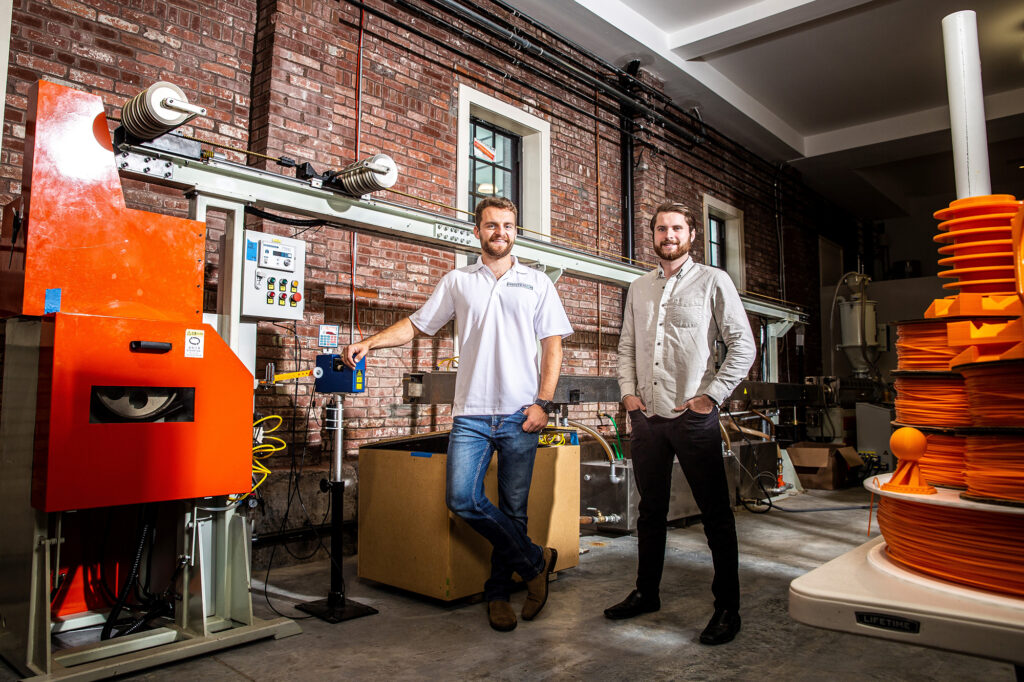
Apparently, some of these competitions even result in viable enterprises: in 2020, the University of Missouri (UM) awarded $5,000 to two undergrads, Trent Esser and Hayden Seidel, in UM’s Entrepreneur Quest (EQ) competition. They planned to start a business centered around creating additive manufacturing (AM) feedstock from recycled plastic.
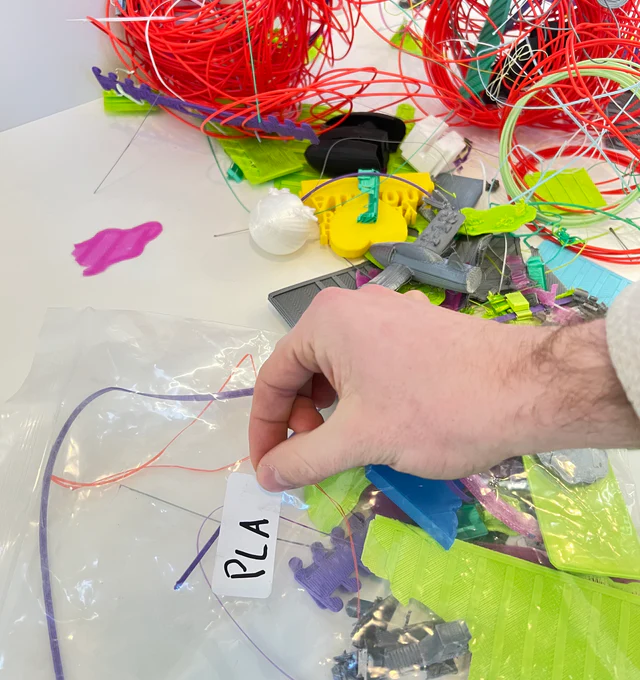
Recycling plastic. Image courtesy of Printerior.
In 2021, the business Printerior received a $50,000 grant from the St. Louis Arch Grants program, which allowed Esser and Seidel to open their first feedstock production facility. Since then, Printerior has continuously evolved, progressing from a materials manufacturer and supplier to also operating a print farm.
Now working out of a 25,000 square-foot facility in St. Louis, with 13 employees on hand, Printerior produces millions of parts a month with FDM, SLS, and SLA printers. The company is also currently in the process of getting large-format robotic arm systems off the ground.
According to Esser and Seidel, Printerior will do nearly $4 million in revenue in 2025, with expectations of over $10 million next year. The company plans to support that growth by going all-in on automating its processes and doubling its warehouse space.
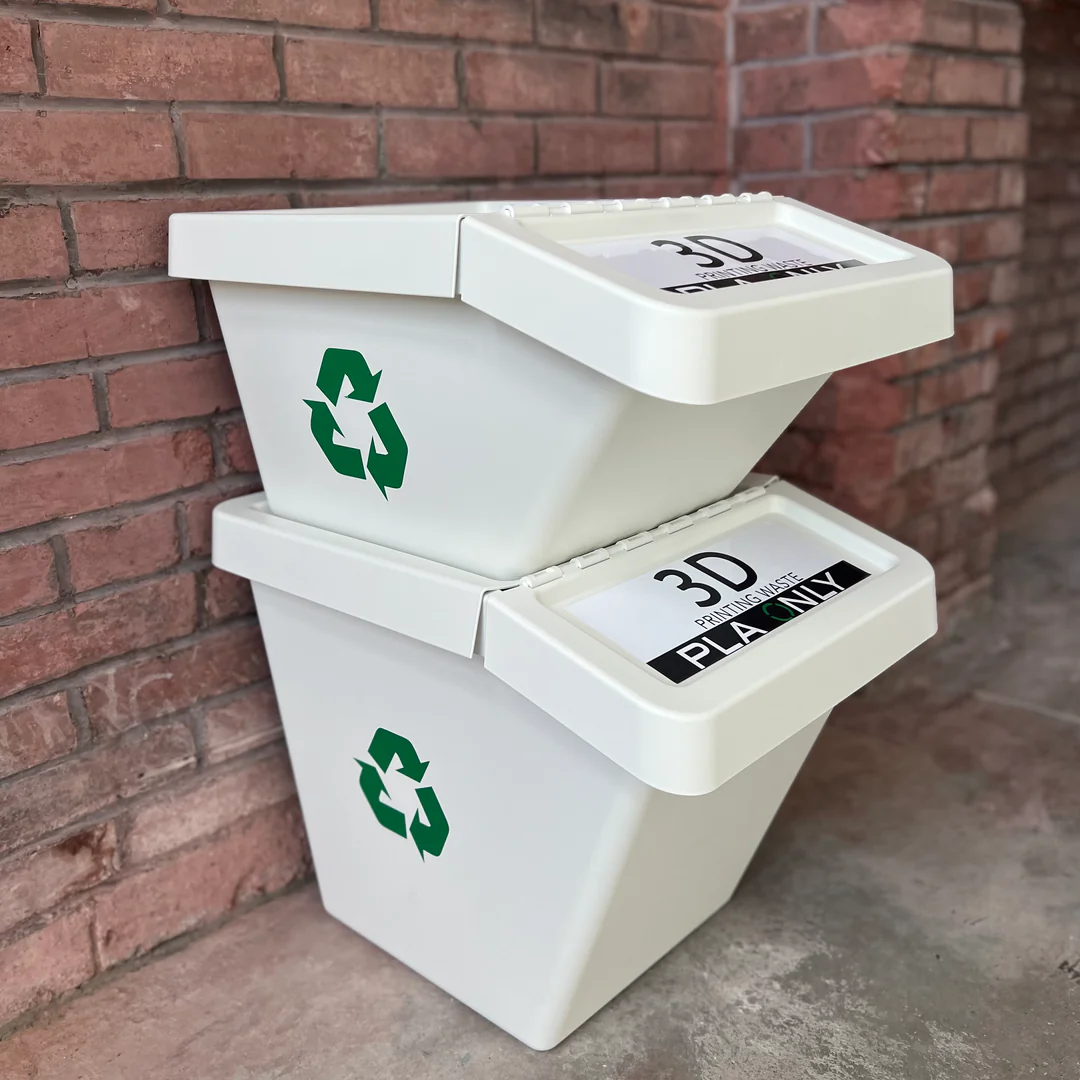
Recycling bins used in Printerior’s 3D printing material collection program. Image courtesy of Printerior.
In a University of Missouri article about Printerior’s path from spinout to scale-up, Esser told Sara Diedrich, “Being part of the second year of the EQ program was especially valuable. It gave us the chance to pitch a bold idea, validate it and eventually secure seed funding. That experience was a major stepping stone. It proved our concept and set us on the path we’re on today.
“[Our vertically-integrated] approach, combined with our advanced automation systems, gives us a significant competitive edge. We’ve spent years developing a technology stack that coordinates all robotic operations, quality control and product management through a fully integrated digital system.
“Currently, we produce about 3 to 5 million parts each month. Within the next few years, we expect that number to reach hundreds of millions. Achieving that growth will require expanding our infrastructure, refining our processes and scaling up sustainably to meet demand.”
I keep coming back to this post I wrote a few months ago about why the U.S. so desperately needs the resurgence of publicly funded manufacturing R&D at universities, as signaled this year. As I discussed in that earlier post, part of the reason is that publicly funded R&D fills gaps because, beyond a certain point, private industry isn’t economically incentivized to fund manufacturing research.
As I also discussed, another major reason why the U.S. needs a resurgence in manufacturing R&D is that the spinout companies that result tend to have a far higher success rate than their competitors. Printerior is perhaps an unconventional, extreme example of this in terms of how R&D was funded and the levels of ROI, but it’s an example nonetheless.
At a time when there are mounting reasons to question the validity of the idea that everyone should aspire for a college education, Printerior’s story is an example of why college is still a good thing. The story also suggests how easy it would be to replicate the advantages of a college environment for individuals who have no interest in traditional higher education: colleges could sponsor startup competitions in partnership with technical schools, for instance.
Everything is changing, perhaps at a faster pace than ever before, and the changes will only keep happening even more quickly. It’s reassuring to see that the institutions society relies on to prepare people for a changing future are coming up with solutions that fit the challenge.
Featured image courtesy of the University of Missouri
Subscribe to Our Email Newsletter
Stay up-to-date on all the latest news from the 3D printing industry and receive information and offers from third party vendors.
Upload your 3D Models and get them printed quickly and efficiently.