
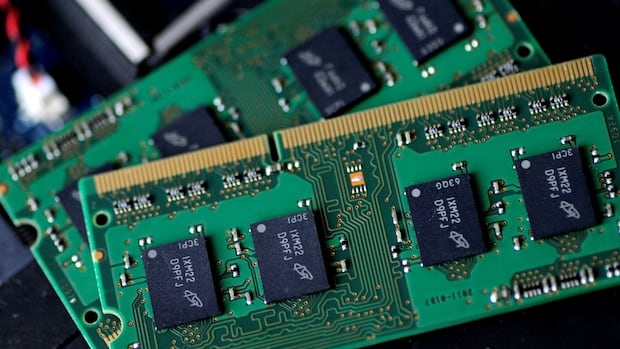
From computers to cellphones and even certain features in cars, a lot of electronics rely on random-access memory, or RAM. It’s the fundamental hardware your computer processor needs to run applications, open files and let you surf the internet.
But if you’ve been in the market recently for RAM, you’ve probably noticed a major spike in prices as memory manufacturers pivot more of their production capacity away from consumer products to supplying AI companies instead, which are rapidly building out data centres that need massive amounts of memory to operate.
“Prices have absolutely skyrocketed since the beginning of November,” Mark Chen, store manager at Uniway Computers, which sells custom-built PCs with RAM in Calgary, told CBC News in an email.
Back in October, Chen said he could find a 32GB DDR5 memory kit for under $130. By mid-November, the price had more than doubled to around $300.
Now, Chen says, it’s difficult to find that same memory kit for less than $400.
In the latest blow to the consumer market, Micron Technology Inc., considered to be one of the three major RAM manufacturers in the world, announced last week it is retiring its consumer-focused brand Crucial — instead turning its focus to supplying memory and storage to fast-growing AI data centre customers.
Willy Shih, a professor of management practice at Harvard Business School, explained that Micron is reallocating its manufacturing resources to AI companies, “where, frankly, they can make a lot more profit.”
“I have never seen a price spike for RAM of this magnitude before,” Chen said. He said he’s seen similar volatility with graphics cards a couple of years ago due to the cryptocurrency boom, but never for memory.
AI boom fuels a global memory shortage
As the demand for AI soars, companies like Open AI, Meta and Google have been scrambling to rapidly develop data centres — becoming more lucrative clientele for chip manufacturers in the process.
AI data centres use large amounts of high-bandwidth memory, a kind of high-performing dynamic RAM, or DRAM, necessary to process the high workload of AI. Whereas an average personal laptop may operate with 16 gigabytes of memory, an AI memory component will have closer to 200 gigabytes, Shih explained.
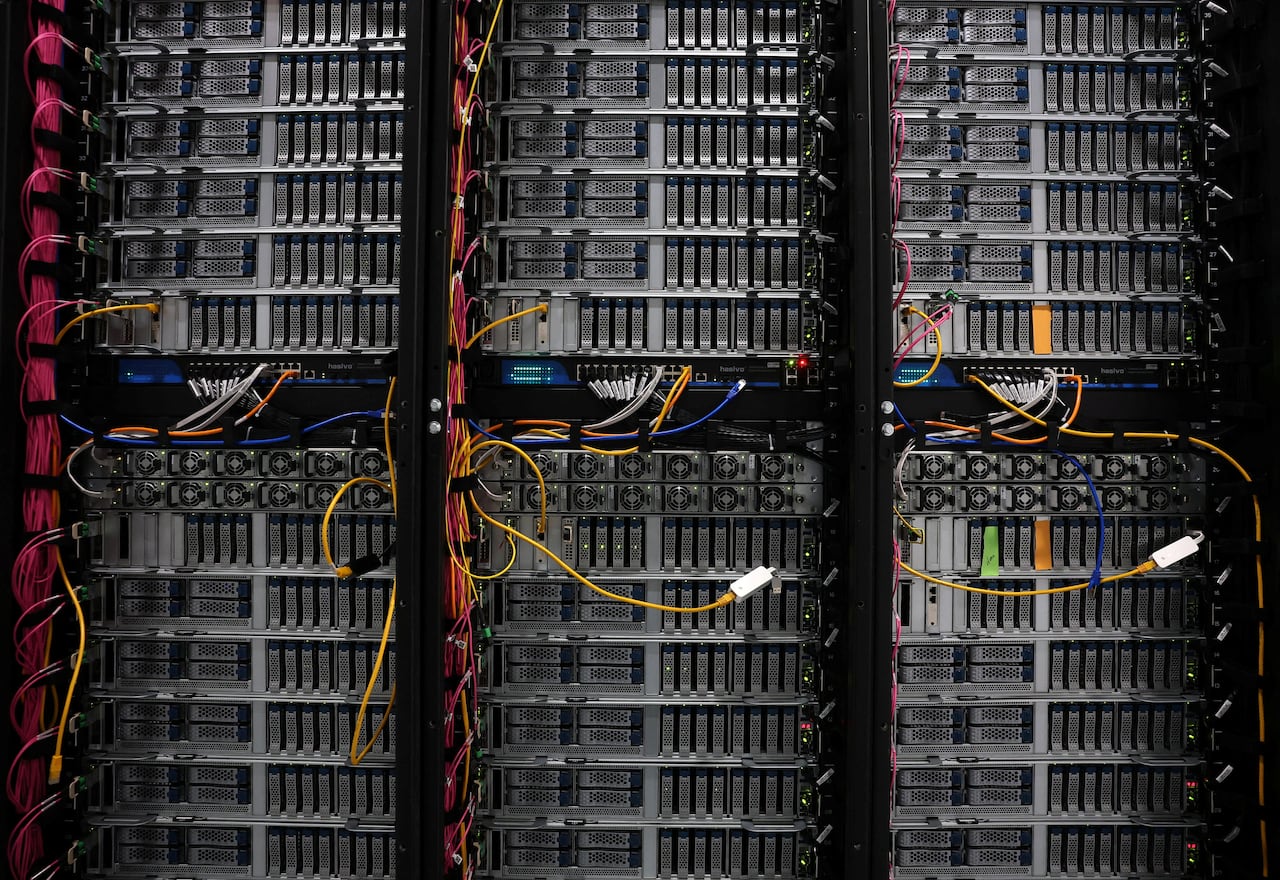 A photo shows racks for data servers, GPUs and CPUs inside the Nebius AI UK data centre, a new facility hosting NVIDIA and other computer firms, at Ark Data Centres, in Chertsey, U.K., Nov. 6, 2025. (Toby Melville/Reuters)
Micron and its two major competitors, Samsung and SK Hynix, are “all racing to fill this demand for memory” — sending consumer prices soaring, Shih said.
It’s a logical business move, he added: if a factory has limited capacity for making chips, it will make the higher value, in-demand units designed for AI tasks.
The demand is so great, in fact, that Lenovo has been stockpiling RAM because of the unprecedented supply crunch, according to Bloomberg.
And OpenAI’s massive Stargate data centre initiative, set to launch in 2029, has already secured commitments from Samsung and SK Hynix for up to 900,000 wafers (the foundation for memory chips) of DRAM per month. That’s the equivalent to nearly 40 per cent of DRAM output globally, according to Tom’s Hardware, a computer technology publication.
 Willy Shih, a professor in the Technology and Operations Management unit at Harvard Business School, holds up a wafer, a foundation for memory chips. (CBC)
DRAM, which is used in both consumer electronics and data centres in different forms, is especially under pressure. With manufacturers pivoting their focus to developing those high- bandwidth memory chips, Shih said there’s less production capacity allocated to developing the kind of DRAM you find in personal computers.
Last month, Reuters reported Samsung raised the price of certain memory chips by as much as 60 per cent, compared to just two months prior. The company’s memory division now brings in nearly as much revenue as its mobile phone business, setting an all-time high for quarterly sales in the third quarter of this year.
PC market first to bleed
While the race to capitalize on the AI boom has sent consumer memory prices skyrocketing, it might not stop there.
“Everything that uses memory, the prices are going to go up,” Shih said. That’s essentially every electronic product from cellphones to smart fridges to modern cars.
LISTEN | A computer shop in Nanaimo B.C. is also seeing sky-high RAM prices:
All Points West7:18Are you looking to buy a new computer? Be prepared for sticker shock due to RAM prices
The International Data Corporation, a marketing research company based in the U.S., is already predicting 2026 will see fewer smartphone sales because of memory component shortages.
But the immediate effect is being felt in the personal computer market, by parts retailers across Canada and customers like PC gamers and video editors who purchase those individual parts to custom build their own PCs.
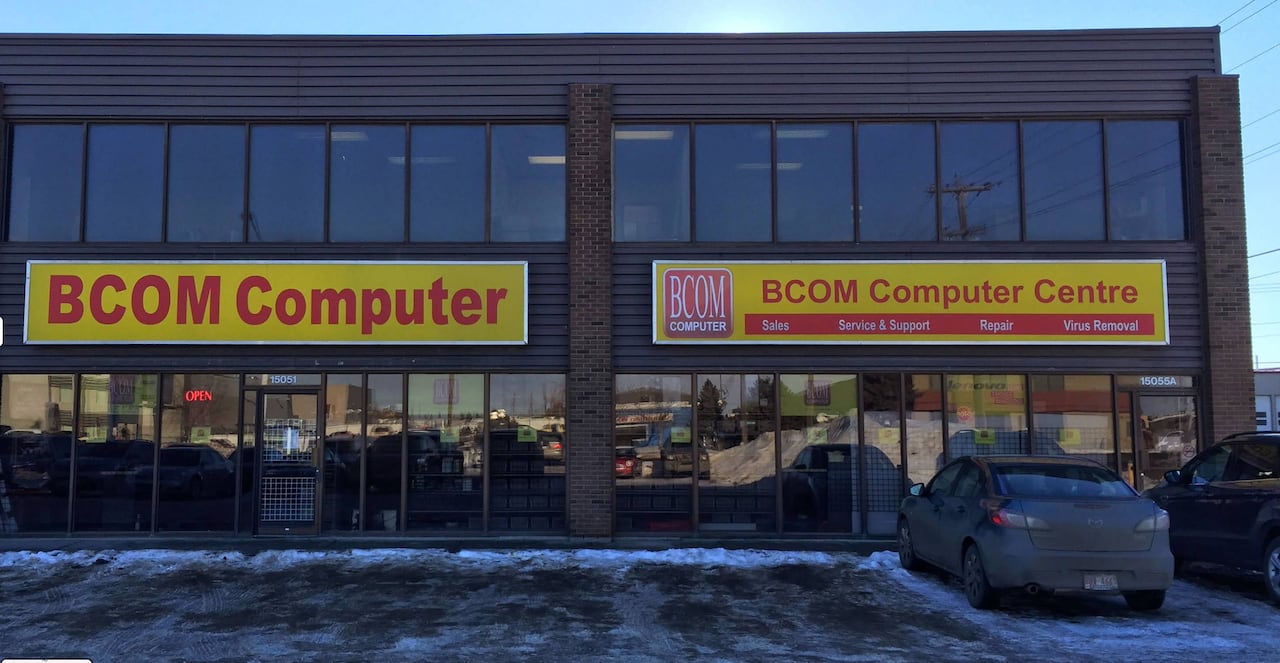 Edmonton’s BCOM Computer Centre is seeing prices for memory components skyrocket. (Submitted by Dustin Grant)
Chen said suppliers have raised the prices they charge Uniway Computers for RAM components, “so we have no choice but to reflect those higher costs in our final build prices.”
And the memory price surge is discouraging customers from building their own computers, Chen observed, with more customers shifting towards pre-built systems from major PC manufacturers.
At Edmonton’s BCOM Computer Centre, corporate sales manager Dustin Plant is feeling a similar strain.
“Because the manufacturers are pivoting … to cater to those [AI] demands, they are not building the stuff that we do sell, you know, day-to-day,” he said. “So supply is dried up right across the board.”
LISTEN | Corporate sales manager Dustin Plant on RAM prices surging:
Edmonton AM5:49RAM shortage
The prices for computer components are rising rapidly. Dustin Plant is the sales manager at BCOM Computers.
Plant said it’s not just RAM that’s increasing in price at what seems like a weekly pace: the cost of solid-state drives is also creeping up.
And video cards may be the next obvious casualty to the market, given their RAM use, he added.
So, how long will prices stay high?
That’s hard to say, according to Shih. Although memory components are experiencing a major boom cycle driven by AI demand, there’s fear from investors of an AI “bubble” that may just pop.
“There’s a huge amount of investment going on and at some point, that has to earn a return.”
WATCH | Investors are pouring billions into artificial intelligence:
If the AI bubble pops, will the whole U.S. economy go with it? | About That
On the PC front, Shih expects computer manufacturers to potentially pass the added factory costs on to consumers in the form of less generous memory configurations in PCs or fewer sales promotions.
Plant said anyone who can hold off on getting an upgrade should consider doing so, adding that it’s hard to predict how long the price surge will last.
 Dustin Plant is the corporate sales manager at Edmonton’s BCOM Computer Centre. (Submitted by Dustin Plant)
And with Micron leaving the consumer memory market and focusing on AI clientele, he said, “that’s just going to make a bad situation worse.”
As for those other products that rely on memory, like cellphones for example, Shih said many companies secure contracts for RAM components in advance, so consumers won’t see those products’ prices climb right away.
“They’re buying, you know, six months or a year ahead, right. So they may have locked in the price. So when you see the increase will depend on … how much your supplier had on hand,” Shih said.