
A version of this story appeared in CNN Business’ Nightcap newsletter. To get it in your inbox, sign up for free here.
New York
—
On the surface of it, Disney’s plan to invest $1 billion in OpenAI while licensing its characters to Sora looks a bit like Goliath capitulating to David. Why would Disney open its precious intellectual property to the masses to do whatever they please? The same IP its lawyers historically would have sued you over if you so much as thought of baking a cake in Simba’s likeness for your kid’s “Lion King”-themed birthday party?
And why would it license that IP to OpenAI on the same day that it sent a cease-and-desist letter to Google, claiming the search giant was infringing on Disney copyrights on a “massive scale?” This is the same Disney that just six months ago teamed up with Universal to sue Midjourney, another generative artificial intelligence company, for doing essentially what people using Sora will now be able to do with Disney’s blessing.
The answer is that Disney needed a hedge on the future of AI.
After all, the outlook for the technology is murky at best, and investors are increasingly questioning the wisdom of the industry’s – and particularly OpenAI’s – massive spending commitments.
But the global entertainment behemoth can’t be seen missing the boat if the tech does end up transforming the way people create and engage with the world. And Disney, being Disney, found a way to have a seat at the table without opening another legal battlefront.
Much like Goldilocks – an IP that Disney does not own, thank you very much – OpenAI is just right for the House of Mouse.
“I think that Midjourney is too small… and Google is probably too big,” Matthew Sag, a professor of law in AI and machine learning at Emory University, said in an email. “Disney and Google bump heads on so many issues (just think of YouTube) that it would take forever to resolve all of the commercial conflicts. Also it’s hard to imagine Disney getting an equity stake in Google.”
To be clear: Disney is not handing the keys to its IP over to OpenAI indefinitely. In an interview with CNBC’s “Squawk on the Street” Thursday, Disney CEO Bob Iger clarified that the three-year licensing deal comes with only about a year of exclusivity for OpenAI. After that, Disney can shop its IP to other AI companies.
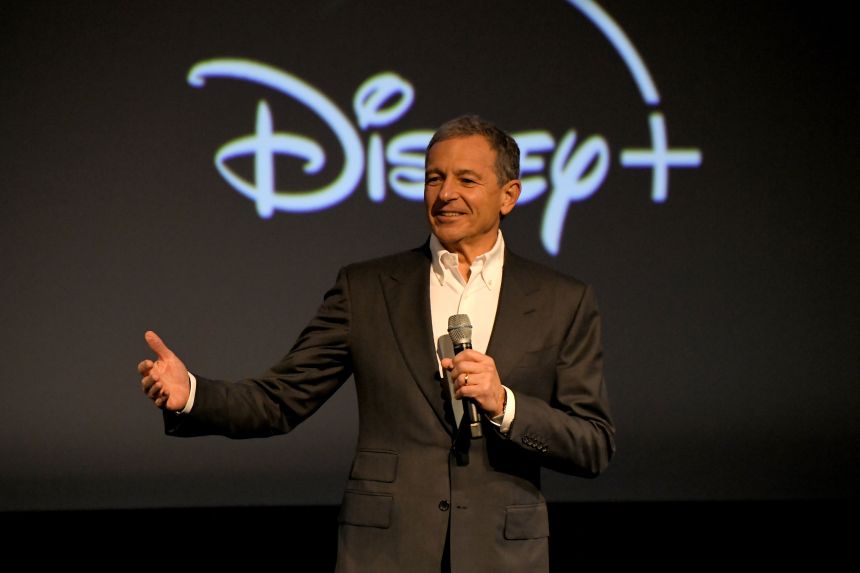
And, crucially, Disney is not including the characters’ voices in the deal — a fact Iger emphasized more than once in the interview alongside OpenAI CEO Sam Altman. (That’s a very Ursula move. Ariel did fine without her voice, of course, but a bunch of AI-generated Moanas who can’t sing or Yodas who can’t speak seem like they’d get super boring, super fast. On the other hand, next time you hear Donald Duck he might sound a bit different. Maybe even more eloquent?)
“We have always viewed technological advance as opportunity, not threat,” Iger told CNBC. “No human generation has ever stood in the way of technological advance, and we don’t intend to try.”
So to sum up: Disney gets to put some limits around how its characters appear on Sora, collects licensing fees from OpenAI, and — icing on the cake — gets $ 1 billion worth of equity in one of the biggest startups on the planet.
OpenAI? It gets to feed its AI video generator some 200 Disney characters that users will be able to manipulate in just about any way they’d like. It also gets some much needed cash, though $1 billion isn’t much compared to the $1.4 trillion it owes to various companies over the next few years.
Perhaps most importantly for OpenAI, it gets to be not sued by Disney, at least for a while.
Iger’s strategy isn’t without risk. Allowing your most valuable IP to enter the world of AI slop — even if it’s sophisticated slop like Sora’s — risks diluting the brand and alienating the human creators behind the beloved characters. But Iger appears to be wagering that the IP could be vulnerable either way if generative AI becomes as powerful and popular as evangelists like Altman say it will. And for the bargain price of $1 billion, he’s able to get a seat the table.
The deal offers Disney OpenAI’s assurance that it won’t let users generate illegal, harmful or age inappropriate content, the companies said. Iger also emphasized on CNBC that being on Sora doesn’t mean people will be able to make their own feature-length “Ratatouille” fanfic videos, or anything like that.
“Let’s be mindful of the fact that these are 30-second videos. We’re not talking about creating either shorts or movies,” Iger said. “This is a way for us as a company really to provide experiences to particularly younger audiences engaging with our characters in new ways.”
(Translation: Sora ain’t exactly Pixar, folks — it is a toy for children. At least, for now.)
Bottom line: Disney and Iger see in OpenAI a popular brand with lots of potential, but one that they can push around relatively easily. OpenAI, which has never turned a profit and desperately needs consumers willing to pay for its products, needs Disney far more than Disney needs OpenAI.