
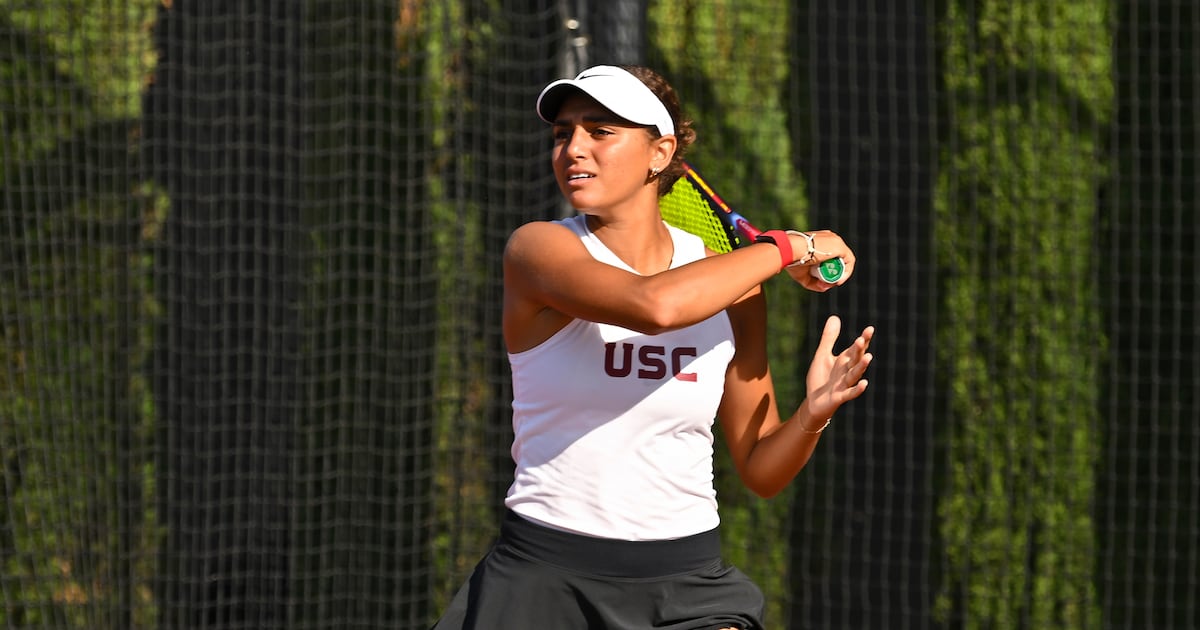
When Jana Hossam is struggling mentally, or feels like she’s a little short on inspiration, she hops on YouTube and watches videos of Novak Djokovic.
She doesn’t check the highlights; she watches full matches of the 24-time Grand Slam champion, so she can spot how he reacts during tight moments.
“I look at how he deals with stuff and actually write it down and then try to work on it on myself,” the 18-year-old Egyptian tennis player tells The National.
“He’s my all-time favourite, honestly. I just love his mental side more than anything. He’s insane on the mental side.”
She certainly picked the right person to try and emulate, and her notes came in handy when the University of Southern California (USC) sophomore reached the final at Regionals to qualify for the NCAA Division I Championship – a goal she had set for herself before the fall semester began.
Last month at NCAAs – the biggest college competition in the United States featuring the best players from the best universities from across the country – Hossam made a heroic journey to the semi-finals, where she lost to eventual champion Reese Brantmeier in three sets.
She didn’t have high expectations heading into the championship but walked away as a worthy semi-finalist and ranked No 16 in the Intercollegiate Tennis Association national rankings.
“I was playing with a lot of confidence, like nothing, no hesitation in my game,” she beams.
“I learnt a lot about myself. I’m really proud of how my mental side was actually in the week of NCAA, because I realised that was my best week I’ve been like mentally, because I had so many tough moments throughout the matches.
“And then I actually ended up going through it because of my mental side. So yeah, I feel like my mental side has improved so much. And my competitiveness has improved a lot. And also my tennis.
“Going into the spring, I’m actually excited to keep competing more and to be a consistent point on the board for the team to keep winning.”
Hossam first picked up a racquet when she was six years old, joining her two sisters – one older and one younger – at the tennis courts of Smouha Club in Alexandria.
Her sisters didn’t stick with it but Hossam was hooked. A coach told her parents that she was gifted and she remembers winning the first tournament she ever contested as a youngster.
Hossam didn’t have a private coach in Alexandria and mostly had group training with other kids. With time, she realised she had to start training in Cairo to gain access to better coaching.
At 16, she switched to online schooling and began making the commute several times a week from Alexandria to Cairo (a distance of over 200km), sitting in a car for nearly five hours combined, so she could practice.
“I used to wake up at like 5.30 in the morning to go to practice at 9 or 8.30. And then going back the same day,” she recalls.
Her father worked abroad, and her mother couldn’t leave her sisters to travel with her to Cairo each time, so Hossam often made the trip alone. She would stay at hotels or rented apartments in the Egyptian capital so she would avoid the daily commute until the family finally bought a place in Cairo, where Hossam could stay on practice days.
“I didn’t get to see my family that much,” she said.
On the ITF junior circuit, Hossam was doing fairly well, and reached a career-high No 67 in the world junior rankings. When she played at the Orange Bowl and Eddie Herr – two of the world’s most prestigious junior tennis tournaments – she caught the eye of several college tennis coaches and was suddenly fielding offers from some of the best universities in America.
“I actually didn’t know anything about college tennis,” she said. “But from then on, I started to actually realise that, yeah, it’s a big deal. And it’s actually serious, because a lot of top players, they played college tennis, and then they’re now in the top [professionally]. So yeah, from that time, I started to take the idea seriously.”
The decision-making process was overwhelming as Hossam tried to choose a university that had a good coaching staff, good academics, and a safe environment.
She ultimately landed on USC without even visiting the campus before making the call.
There was understandably an adjustment period, especially given she had to find a way to juggle her studies and her sport within an academic system that was alien to her.
“My first semester was one of my toughest,” she reflected.
“I’m used to travelling away from home, so I was fine with that. But I had so many responsibilities, I had to do so much work.
“I have to balance my school, I have tutoring, I have to meet my advisor. And on the other hand, I have to go to practice and then it’s like really long days. But it’s also fun because I’m always busy. So I like that.
“And it also makes me grow my personality; I’m more mature and more aware of what I have to do to be more organised too. So it’s tough, but I actually enjoy it so much.”
Hossam ended up having a great freshman year, going 22-9 in singles and 17-5 in doubles.
Choosing when to turn pro is always an issue for a tennis player. For Hossam, she is encouraged by the fact that her fellow Egyptian Mayar Sherif spent five years playing college tennis – she was a standout at Pepperdine University – before she moved up to the professional circuit and rocketed up the WTA rankings to a career-high No 31 in the world a few years after graduation.
“I did follow Mayar actually,” said Hossam, who is studying communications at USC. “When the idea crossed my mind, should I turn pro now or no? Then I thought, well, maybe if I stay in college, then I can do it because Mayar, she stayed for five years, and then she actually made it and she turned pro and she reached like the highest ranking by any Egyptian, she reached the top 40. So yeah, it does give me belief.
“I’m actually happy that she managed to do that because I look up to her from this example, like, yeah, she actually did it. So I also can do it.
“I want to take the experience of playing college tennis, because it’s going to change me; it’s going to change my tennis, it’s going to change me personally on court, off court. So I want to take the experience.”
After her freshman year, Hossam dipped her toes in the professional circuit – without accepting any prize money to maintain her NCAA eligibility – and played some ITF tournaments in Turkey and Tunisia.
It was a different atmosphere, playing at lowly tournaments with minimal attendance, compared to the rowdy college matches she plays with USC, where her coach and teammates are always behind her.
“It feels lonely, like you’re playing alone. When you win an insane point, there’s no cheering,” she said.
“So you kind of have to cheer for yourself, you have to be your biggest fan.”
While Hossam is thriving at USC and is loving her college experience, she has high ambitions for her post-university life.
“My biggest dream is actually to be number one in the world. And to play all the Grand Slams. I want to play on the biggest stages in the world. And obviously win a Grand Slam,” she says without hesitation.
For now, though, she’s happy to rep the USC Trojans and wants to carry over her momentum from NCAAs into the spring semester.