
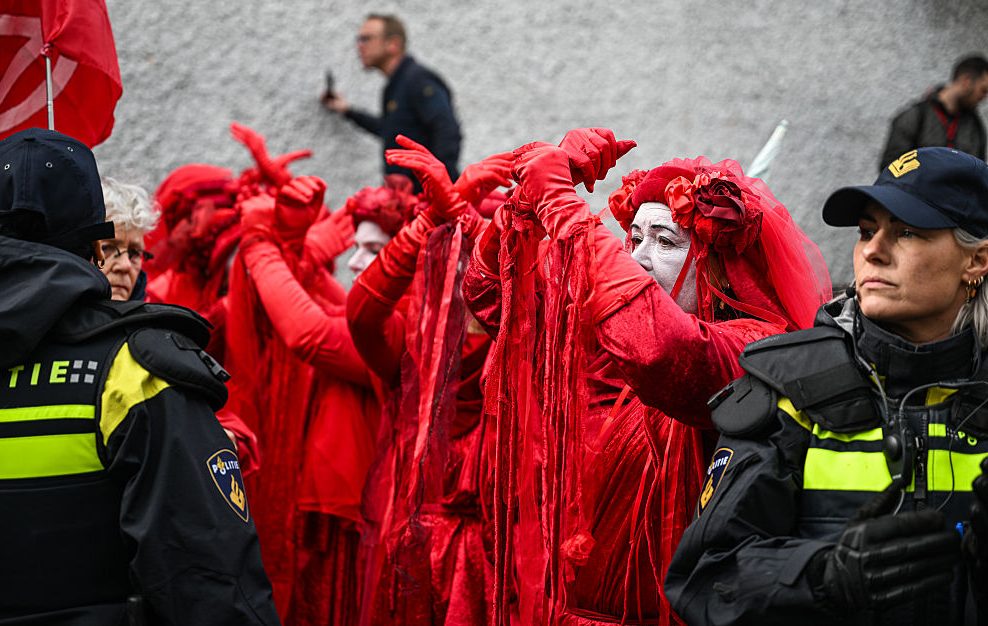
The Paris Agreement, signed on this day in 2015, thrust the global climate crisis into the public consciousness. Three years later, a 15-year-old Greta Thunberg began a solitary school strike that snowballed, swiftly turning her into the climate movement’s defining figure.
By 2019, she was scolding world leaders at the UN for talking big but doing little: “How dare you?”
The accord turns ten today, just weeks after Thunberg and her allies marked the thirtieth annual “COP” summit by dyeing parts of Venice’s canals fluorescent green and staging a mock funeral for climate action.
The Swedish activist, who has more recently trained her fire on Middle Eastern causes, has one thing right: the era of “dollhouse” performative climate negotiations watched zealously by the global activist community is over.
A decade of manoeuvring shaped by cold, hard economic self-interest looms. COP30 – where the EU came away largely empty-handed and with a painful reminder that the global winds were no longer at the old world’s back – was only a taste of what’s to come.
Ten more years
“Without the US … we stood alone with a few Western allies … too few of the most vulnerable countries in the Global South joined our alliance,” Lars Aagaard, Denmark’s climate minister and co-chair of the talks, said on Thursday.
“If this is what the next ten years will be like, I, personally, think the EU will need to consider a new way forward.”
Gathered in a freezing cold room in a remote corner of the European Parliament building in Brussels, accompanied by the chirping of a defective air conditioning unit that evoked birdsong, the architects of the 2015 deal gathered to chart that course.
“The good thing about the Paris Agreement is that everybody sees it as their own,” said Laurence Tubiana, who helped design the accord for France and now oversees billions in philanthropic funding as CEO of the European Climate Foundation.
“That’s the best solution … because then there is real ownership,” she said, addressing a sparse audience – a sign that global climate negotiations are no longer the draw they once were.
Still, a climate-friendly world is far more imaginable than in 2015. Then, detractors claimed a net-zero trajectory required a return to cave-dwelling. Today, renewables make up 50% of the EU’s power mix, and heat pumps and EVs are competitive technologies rather than fringe alternatives.
Slow progress
Bas Eickhout, co-leader of the Greens group, argued that the Paris Agreement had shifted the world from trajectories implying more than 4°C warming to roughly 2.5°C. “But let’s be honest: there has not been much progress since Glasgow [COP26 in 2021],” he said. “I think this is a big concern.”
Teresa Ribera – the EU’s most senior socialist, a Commission vice-president and its competition czar – voiced a sentiment increasingly present at successive UN climate summits.
“Some of you were participating in the Belém COP and there was this sentiment: what is this exercise for, how can the COPs evolve,” the Spanish former environment minister said. The broader question, she added, was “to what extent is the Paris Agreement, and the capacity of the multilateral agenda to deliver, still alive?”
Vive Paris!
Yet, Ribera and other EU officials caution against prematurely discarding the Paris framework. The answer is, she suggested, more than one would assume.
The need for reform “is not as strong as it used to be,” with the Paris deal “providing this general framing, regulatory conditions that allow all of us to work.” The annual climate jamborees provided space to “assess, take away and provide orientation.”
That could be read as an acceptance that COPs, once relied on by activists to jolt an indifferent political class into action, have morphed into something akin to collective therapy sessions – a place to take stock while real policy choices unfold elsewhere.
Others are more blunt. “We need to insist that the Paris Agreement has to deliver mitigation. Otherwise, it will not matter,” said Denmark’s Aagaard, whose country has long been a member of the bloc’s most ambitious climate coalition.
The Paris Agreement, he said, “has to show that it can be a framework for action, and not an excuse for inaction.”
Unfriended
Tubiana’s prescription for Europe – increasingly struggling to balance China’s expanding global footprint – is a shift in diplomatic strategy.
“I do think the system we have – with MoCA [a meeting where government ministers discuss climate action], the Petersberg Dialogue [ditto, in Berlin], and the Danish meeting [an annual summit in Copenhagen] – hasn’t delivered what we need,” the French economist said.
“I don’t want to be undiplomatic but in this new, very fragmented context, maybe we need other formulas,” she added. “I think a European diplomacy using the member states and all these levels could be very, very useful.”
“Finally, we need friends. We didn’t have so many friends in Belém, that’s for sure,” the architect of the Paris Agreement said. “We could have many more, but we need … to not patronise any more.”
“We are not the example that everybody should follow,” she told the audience in Brussels. “Understanding the political economy on the other side … is important.”
(rh, cz)