
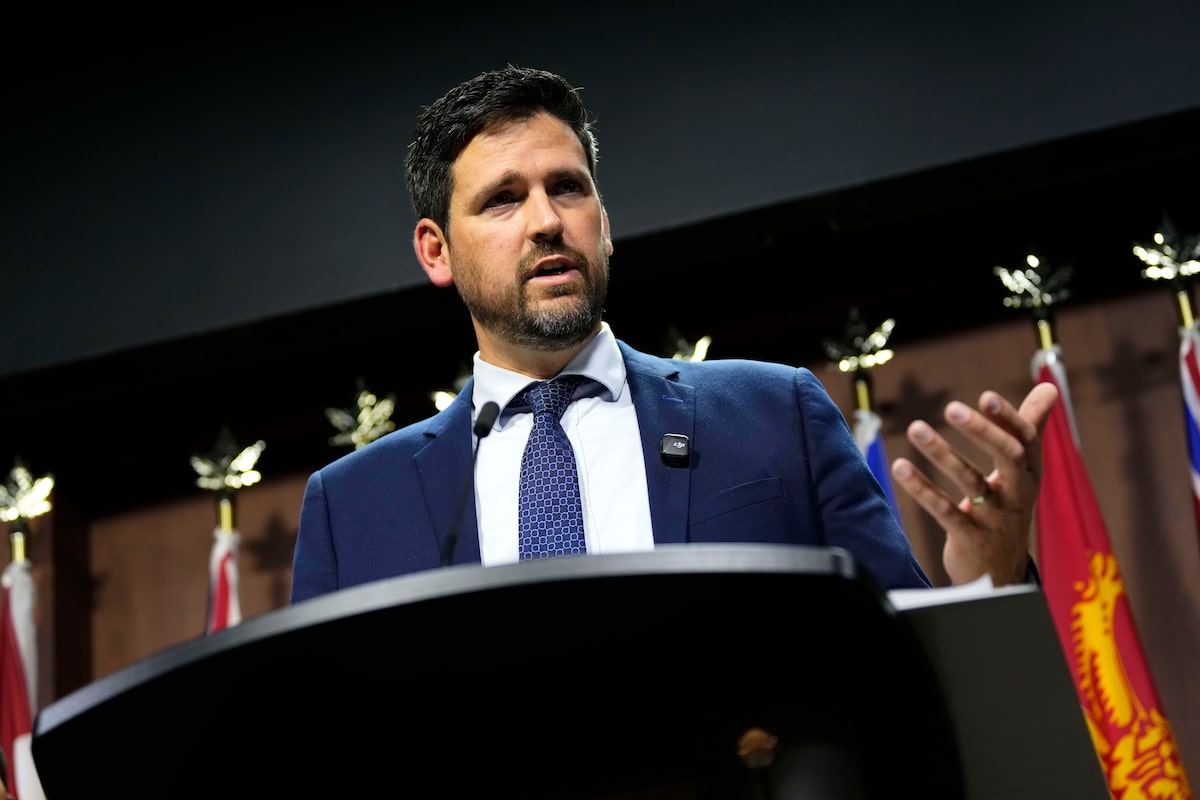
Attorney-General Sean Fraser and the government are using the fact that the religious exemption has not been successfully used in court to justify its removal, writes Robyn Urback.Justin Tang/The Canadian Press
In the late 1990s, a Toronto man named Mark Harding was busily spreading his “gospel” around the city. His proselytizing took the form of printed pamphlets and telephone messages, which warned that Muslims in Canada are “like raging wolves in sheep’s clothing,” and “full of hate, violence, and murder.” Mr. Harding’s materials suggested that all Canadian Muslims are actually terrorists who want to take over the country and persecute infidels.
Mr. Harding was charged with three counts of willfully promoting hatred against an identifiable group, under section 319(2) of the Criminal Code. He tried to mount a defence based on section 319(3)(b), which carves out an exemption for “good faith” expressions of “a religious subject or an opinion based on a belief in a religious text.” But the judge didn’t buy it.
“The accused’s communications did not just contain religious opinions about the falseness of Islam,” the judge wrote. “They also contain alarming and false allegations about the adherents of Islam calculated to arouse fear and hatred of them in all non-Muslim people.”
MPs remove religious exemption from hate-speech laws
The judge noted that sec. 319(3)(b) does not function as a get-out-of-jail-free card that insulates any and all hateful speech from criminal charges; if it did, “religious opinion could be used with impunity as a Trojan horse to carry the intended message of hate.”
Mr. Harding was convicted. In fact, there are no known cases of Canadians charged with hate crimes successfully mounting a defence using the religious exemption in the Criminal Code. That was confirmed by Attorney-General Sean Fraser, whose government this past week backed an amendment to its Combatting Hate Act, or Bill C-9, to repeal section 319(3)(b) of the Criminal Code.
The government is using the fact that the religious exemption has not been successfully used in court to justify its removal, implying that Canadians are not really losing out on a free speech defence if it hasn’t actually been used, though there’s no way of knowing how many cases were not pursued because 319(3)(b) meant there was no reasonable chance of conviction. But the inverse could just as easily be argued: if, as Mr. Fraser claims, no one is getting away with hate speech because of the religious exemption, what’s the point in removing it?
The point, of course, is political. The Bloc Québécois has been pushing to scrap the religious exemption for years, and the Liberals could use their help in getting C-9 passed. The Liberals also know that this move is an easy sell: what decent person would be against tightening regulations on hate speech, after all?
The Bloc began their campaign against 319(3)(b) in earnest back in 2023, when an imam named Adil Charkaoui called for the extermination of “Zionist aggressors” and led a prayer for Allah to “kill the enemies of the people of Gaza and to spare none of them,” in front of a Montreal crowd shortly after the Hamas attack in Israel on Oct. 7 of that year. Though the RCMP launched an investigation, the Crown decided not to pursue charges, concluding it could not make the case beyond a reasonable doubt that the statement incited hatred against an “identifiable group,” as defined by section 319(1).
Whether that was a reasonable conclusion is a matter of debate (who, I wonder, was Mr. Charkaoui referring to when he called for the killing of Zionists?), but the religious exemption under the Criminal Code is not what got him off the hook. And even if Mr. Charkaoui was charged with hate speech and he decided to lean on 319(3)(b) as a defence, the Crown could still make the case that his statements were not a “good faith” reading of a religious text, and that he was willfully promoting hatred with an intention that went well beyond an interpretation of scripture. It seems the problem here – as with many other instances of, for example, protesters intimidating people outside of their homes or places of worship, or individuals spreading hateful messages at public events – is one of enforcement of existing laws and a willingness to prosecute, and not of a subsection defence in the Criminal Code.
It is easy to see why many people would think scrapping the religious exemption is a good thing. Why wouldn’t we want to remove any crutch upon which bigots can rely to get away with spreading messages of hate? But on principle, we should demand government restrictions on speech to be as narrow as possible, so that the law doesn’t end up criminalizing good-faith readings of religious texts. In his capacity as chair of the House of Commons Standing Committee on Justice and Human Rights, Marc Miller, now the Minister of Canadian Identity and Culture, cited Bible verses he personally considers “hateful.” That’s fine as a matter of personal opinion, but alarming when the government is opening the door to criminal conviction.
The law, as it is currently written, is working just fine. It’s the enforcement of hate speech laws that needs the government’s actual attention.