
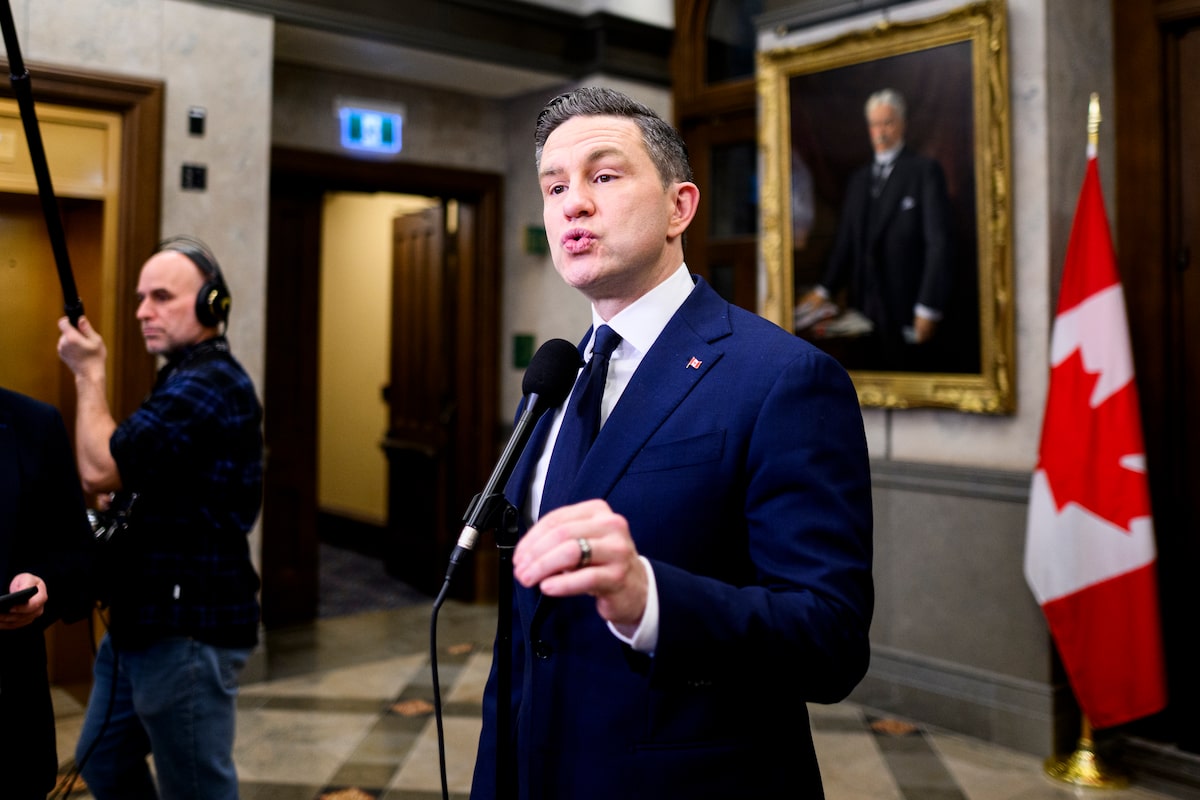
Conservative Leader Pierre Poilievre on Thursday accused the Liberals of blocking repeated attempts by his party to move on swiftly to the bail bill.Spencer Colby/The Canadian Press
Parliament wrapped up for its holiday break Thursday, as MPs ended a standoff over a handful of bills that they agreed could advance to the next stage toward becoming law.
The minority Liberal government has clashed with opposition parties over bills in committees and on the floor of the House of Commons in the past few months, in often acrimonious exchanges.
In a stunning finale to the fall parliamentary sitting, Conservative MP Michael Ma crossed the floor to join the Liberals, which brought Prime Minister Mark Carney one step closer to a majority.
Before Parliament adjourned Thursday, MPs reached a deal to allow a number of bills to progress.
Conservatives criticize Major Projects Office’s approach to private-sector recruitment
A flagship border-security bill that tightens immigration and asylum rules and a tax bill that confirms existing tax breaks cleared the House entirely on Thursday and were sent off to the Senate.
A bill on approving funding for the federal civil service received royal assent in the Senate before senators adjourned for the holidays until early February.
On Wednesday, MPs allowed the government’s omnibus budget bill to move beyond the opening stages of debate and on to committee study.
In the final days of the parliamentary sitting, MPs on the justice committee sparred over a bill combatting hate, which the Conservatives asserted could threaten freedom of religious expression.
On Tuesday, Liberal and Bloc Québécois MPs on the committee had voted to remove a long-standing religious exemption to Canada’s hate-speech laws despite lobbying by Christian and Muslim groups to retain it.
The exemption to the Criminal Code currently allows a person who quotes from a religious text to escape prosecution for hate speech. The Bloc has argued for years that this can be used as cover for promoting homophobia, racial abuse and antisemitism.
The Conservatives said removing the religious exemption could stop people reading the Bible and other religious texts, an assertion refuted by Justice Minister Sean Fraser and legal and constitutional experts.
Some Conservative MPs turned up to the justice committee on Thursday with Bibles that they displayed on their desks to reinforce their arguments.
The impasse over the anti-hate bill has caused a logjam in the justice committee’s timetable, preventing another bill, on bail changes, from moving forward for consideration by the committee.
Conservative Leader Pierre Poilievre added his voice to the parliamentary squabble at Question Period on Thursday, criticizing the removal of the religious exemption and accusing the Liberals of blocking repeated attempts by his party to move on swiftly to the bail bill.
Government House Leader Mark MacKinnon at a press conference after Question Period blamed the Conservatives for using what he called obstructionist tactics in Parliament to hold up government bills.
“Make no mistake, this is a minority Parliament. And in that scenario, the opposition parties have the ability to hold up government legislation,” he said. “Responsible opposition parties do that in a responsible way to offer alternatives and present reasoned arguments.”
Government House Leader Mark MacKinnon blamed the Conservatives for using what he called obstructionist tactics in Parliament to hold up government bills.Spencer Colby/The Canadian Press
He accused the Tories of pursuing a “self-serving and selfish” strategy whose aim is to “obstruct, obstruct, obstruct.”
Mr. Carney did not attend the rowdy final Commons Question Period before the holidays, with Mr. MacKinnon standing in for the Prime Minister.
Mr. Poilievre was rebuked by the Speaker for mentioning the Prime Minister’s absence in the chamber, which is not allowed under Parliament’s rules of decorum.
Before Question Period, Mr. MacKinnon told reporters that it had “been an incredibly productive session” with a number of government bills, including to protect victims of crime, being introduced.
But Kennedy Stewart, of Simon Fraser University’s School of Public Policy, said the fall sitting has not been as fruitful as claimed.
“For all the chatter and hullabaloo, not much got done and Canada is pretty well in the same place it was when the session began,” said Prof. Stewart, a former NDP MP whose academic research includes democratic governance.
The fall sitting, which began in September, saw what is known as the Lost Canadians bill become law. The bill, which received royal assent in November, means Canadians born abroad now have the right to pass on citizenship to future generations.
Andrew Coyne: Something is wrong with Canadian democracy
With the election earlier this year, MPs have spent far fewer days than usual in the House of Commons this year. They are scheduled to return to Ottawa on Jan. 26.
On the last day before the parliamentary break, the Conservatives supported sending the government’s border-security bill, known as Bill C-12, to the Senate.
To secure the opposition’s support, the Liberals voted with the Conservatives on Thursday for an amendment tabled by Michelle Rempel Garner, Conservative immigration critic. Earlier this month, she suggested the amendment was crucial to securing her party’s support for the bill.
The amendment would restrict the use by the immigration minister of new powers in the border bill to cancel or vary immigration documents en masse. The government has said that this power could be used in cases of fraud or in the interests of public safety.
But Ms. Rempel Garner’s amendment would prevent the immigration minister using the new power to extend work and study permits en masse so temporary foreign workers and international students can stay in Canada.
With reports from Bill Curry and Emily Haws