
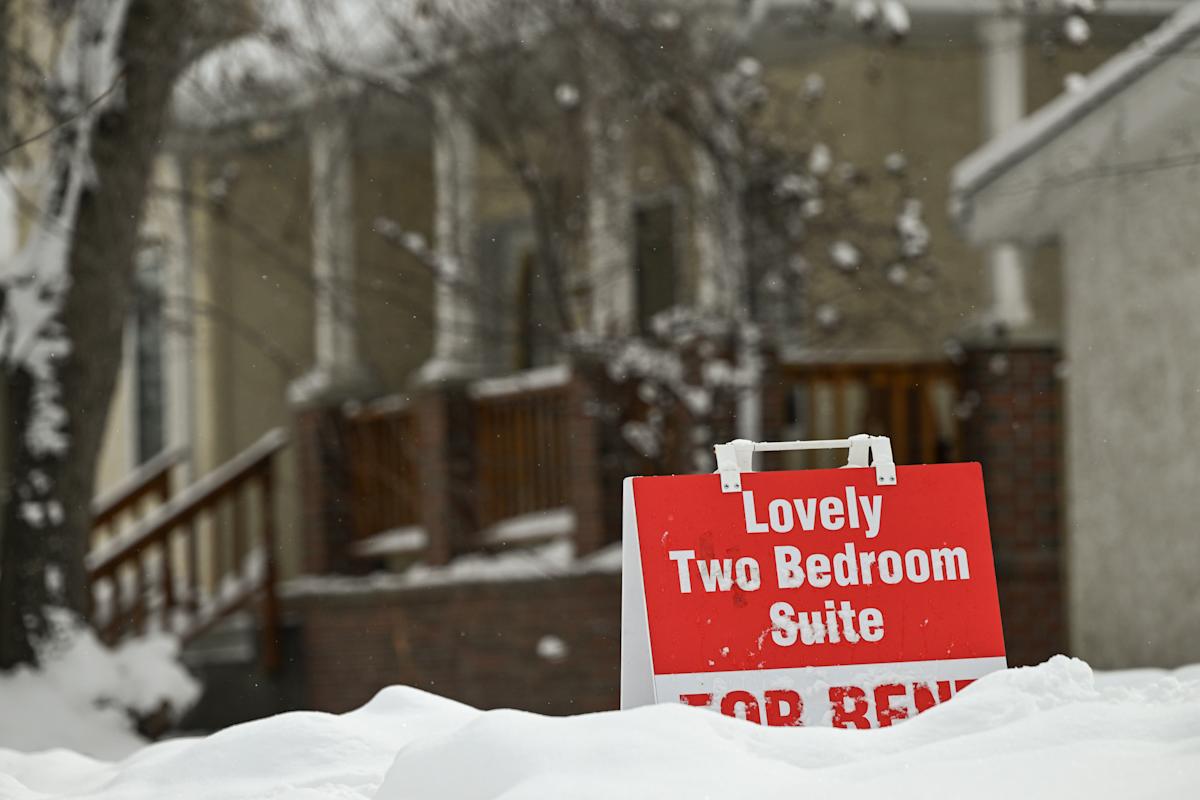
Canadian rental prices could hit a floor sooner than expected because of a significant underestimation of people sharing homes due to affordability issues, according to new research from CIBC Economics.
The proportion of the population “doubling up” in homes, grouping together extended families, multiple families or a number of roommates, has grown significantly in recent years, economist Benjamin Tal says, but is substantially undercounted. Declining rental prices are likely to entice some to seek their own accommodation.
“Doubling up is the most common response to deteriorating housing affordability but also can be seen as shadow demand ready to be utilized in an environment of improved affordability,” Tal wrote.
In an email to Yahoo Finance Canada, Tal says the impact would be seen mostly in rental units but potentially also small condos that have seen price declines. “If you are a young couple living in somebody’s house, you might stretch things a bit and try to buy that small condo,” he wrote.
Housing affordability remains a central issue for Canadians. National average prices have come down from post-pandemic peaks, but remain elevated. Rents are also generally far higher than they were before the pandemic, in spite of national average asking rents dropping for 14 straight months.
As rental prices decline, doubled households are more likely to undouble, Tal notes. And he argues that the scale of that cohort is likely much higher than policymakers think. Typical measures of demand and affordability are usually calculated by looking at people leaving parental homes and net international arrivals, Tal says, a methodology that “does not account for doubling up and basically assumes that the number of families and unattached individuals (adjusted for age) equals the number of households.”
“This of course is not the case,” Tal added.
Tal uses Canadian census data in an effort to better estimate the doubled-up population. Those numbers from 2021 show “doubled-up” households increased by around 20 per cent over 10 years, accounting for 17 per cent of the population – a figure that climbs north of 20 per cent in high-rent hubs like Toronto and Vancouver. Over the same time period, non-doubled households increased by 7.2 per cent, though they made up 70 per cent of the total population.
“A more recent Statistics Canada survey found that two or more person non-family households grew by just under 26 per cent between 2018 and 2022, continuing the strong growth momentum,” Tal said.
Those numbers, however, are likely still not representative, he adds, because non-permanent residents (NPRs) are “dramatically” undercounted and students’ actual living circumstances are not properly recorded in the census. “Those two groups naturally have a high propensity to double up,” Tal said, “and therefore undercounting them means underestimating the actual doubling-up rate.”
As a consequence, there may be many more households more likely to undouble, and thus much more potential demand for units than currently understood if affordability improves, Tal says.
“Household formation among non-family individuals is highly sensitive to changes in income and price,” he wrote. “Any improvement in affordability can potentially increase the number of newly created low-income households even if it means spending a higher percentage of their income on housing.”
New supply of affordable housing could be absorbed by such a shift, Tal says, reducing pressure on vacancy rates and “potentially establishing a floor for rents of units that are at the more affordable end of the rental market.”
John MacFarlane is a senior reporter at Yahoo Finance Canada. Follow him on X @jmacf.
Download the Yahoo Finance app, available for Apple and Android.