
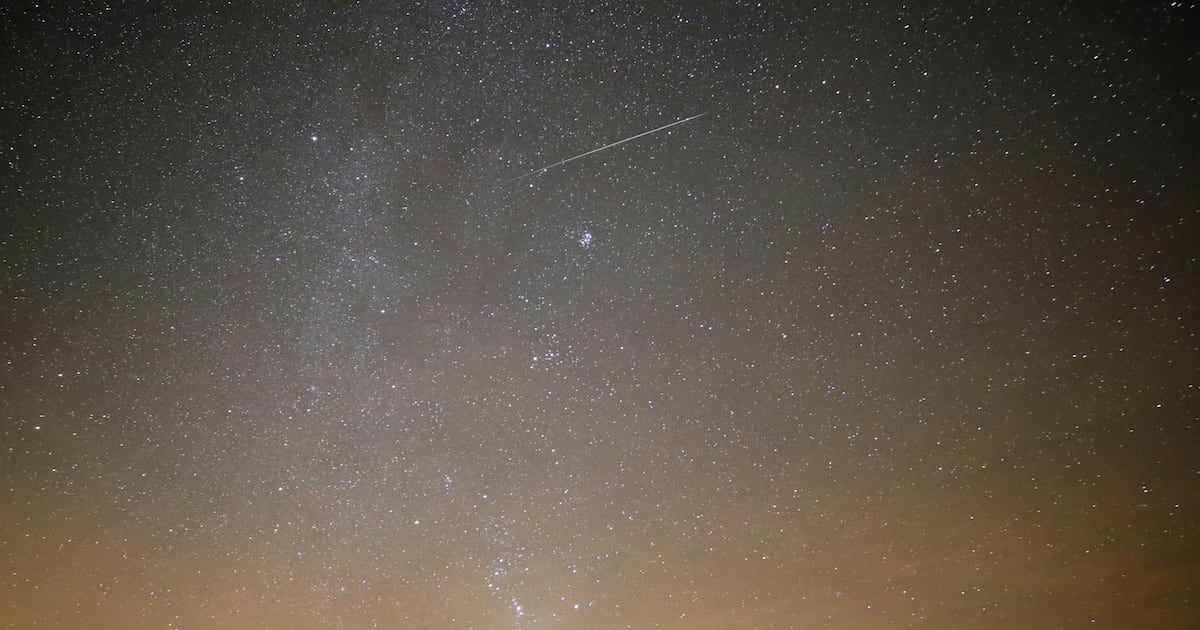
One of the most spectacular celestial shows of the year is set to peak this weekend, and lunar conditions are expected to provide convenient viewing windows on Friday and Saturday evening for people across Canada – as long as clouds don’t get in the way.
The annual Geminid meteor shower, named after the constellation Gemini, is considered to be one of the best and most reliable times to spot meteors as they streak across the sky.
The Geminids are bright, fast and tend to be yellow in colour, according to the National Aeronautics and Space Administration (NASA). The shower started on Dec. 4, so some viewers may have already caught a glimpse, but it’s set to peak on Saturday evening into early Sunday morning.
At its peak, up to 150 meteors can be seen in the sky in a single hour.
Last year on Dec. 13, the Geminids were difficult to spot at times due to a bright waxing gibbous moon that rose in the evening, making it harder to make out some of the dimmer meteors in the sky, according to The Weather Network.
But this year, the moon is a less-bright waning crescent, which won’t appear in the sky at all until the early hours of Sunday, making for a darker sky and better viewing conditions most of the night.
“This shower is considered one of the best opportunities for young viewers since (it) starts around 9 or 10 p.m.,” NASA says on its website.
Of course, the Geminids can only be seen with a clear view of the sky unobstructed by cloud cover, and for most of Canada this weekend, it does “not look promising,” according to The Weather Network.
In the East, the clearest conditions are expected to be over eastern Newfoundland, central Nova Scotia, eastern New Brunswick, P.E.I., and parts of northern Ontario; mostly to the north and east of Lake Superior, the network forecasted on Tuesday.
In the central and western part of Canada, clear skies are expected over a large area spanning from Thunder Bay, Ont. through most of southern Manitoba and Saskatchewan.
A strip along the eastern side of the Rocky Mountains in Alberta is also expected to have clear skies on Saturday, along with much of B.C.’s interior.
For best viewing, NASA recommends finding an area as far away as possible from city lights or streetlights.
“Lie flat on your back with your feet facing south and look up, taking in as much of the sky as possible,” NASA said.
“After about 30 minutes in the dark, your eyes will adapt, and you will begin to see meteors. Be patient – the show will last until dawn, so you have plenty of time to catch a glimpse.”