
Breadcrumb Trail Links
A community paramedicine program is improving the health of clients in Lambton County but provincial funding isn’t keeping up with costs.
Published Dec 09, 2025 • 3 minute read
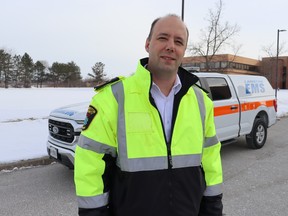 Stephen Turner, Lambton County’s manager of emergency medical services. Photo by File photo /The ObserverArticle content
A Lambton County community paramedic program is working to improve the health of its clients and reduce emergency room visits, but its provincial funding isn’t keeping pace.
Advertisement 2
This advertisement has not loaded yet, but your article continues below.
Article content
The program began in 2017 with paramedics visiting county residents facing barriers to health care, but this year it had to reduce staff by a full-time position by not filling a job opening, according to a county report.
Article content
Recommended Videos
Article content
The $1.3 million in provincial funding the program receives annually has remained relatively static over the last five years as wage and others costs have increased, it said.
Lambton’s provincial funding for the service comes from Bluewater Health, Ontario Health and the Ministry of Long-term Care, which provides the largest share at about $875,000.
While the cost of 911 paramedic services are split between the county and province, community paramedic programs are fully funded by Ontario, said Stephen Turner, manager of Lambton’s emergency medical services.
Advertisement 3
This advertisement has not loaded yet, but your article continues below.
Article content
The province said in August community paramedicine funding would become permanent, after initially only being awarded on a yearly basis.
“The announcement was quite welcome, to know that the funding would become permanent, but the challenge for us is that there hasn’t been any indexing or inflationary increases,” Turner said.
While the funding hasn’t increased, wages and other costs have, he said.
“That’s meant we’ve had to cut the program expenses,” Turner said. “Things like purchase of materials, and fuel, vehicles — those kinds of things.”
It’s delivered by seven full-time paramedics who receive additional training, with part-time paramedics filling in when needed, the report said.
The program hasn’t had to reduce the number of clients it serves, Turner said.
Advertisement 4
This advertisement has not loaded yet, but your article continues below.
Article content
“We’re trying to work to balance our intakes and our discharges from the program so we can continue to serve the clients in need,” he said. “Those clients who need our services, we’ve been able to get to all of them.”
But the funding situation “will put pressures on future intakes, and we’re just trying to evaluate how best to do that in a way that doesn’t negatively impact the community,” Turner said.
The program’s clients are mostly older adults living with chronic conditions such as heart failure, COPD, diabetes or cognitive decline, and are without a family doctor or other primary health care provider, the report said.
They have a “higher risk of calling 911 with more frequency,” Turner said.
Community paramedics work with other agencies while providing in-home assessments, chronic disease management and preventative care, while also helping clients navigate the health system.
Advertisement 5
This advertisement has not loaded yet, but your article continues below.
Article content
Providing help early, and connecting them with other health-care providers, such as home care, can prevent clients from needing to go to hospital, Turner said.
“It absolutely helped divert people from emergency departments, and to make sure they get the care and treatment that they need at home,” he said.
Over the last 12 months, the program received 380 new referrals and community paramedics completed 4,100 in-home visits and about 2,100 wellness checks.
They were also involved in local wellness clinics run with McMaster University and local health providers, as well as events and programs in partnership with area First Nations, the report said.
“We’re well integrated with the health-care community in order to provide the best outcomes for the clients that we work with,” Turner said.
The county will continue to work to “address the funding challenges,” he said.
“Our funders are aware of them and they’re listening,” Turner said. “Everybody’s working to try and find the best solutions.”
Article content
Share this article in your social network