
The mysterious “ghost particles” known as neutrinos have been observed interacting with matter in a new way, despite the typical rarity and weakness of their interactions with other particles.
Neutrinos are so elusive to observers that trillions pass ethereally through our bodies every second without our noticing. Yet researchers at the University of Oxford have reported the striking new detection, first described in a recent paper published in Physical Review Letters.
Neutrino Research
Neutrinos are byproducts of nuclear reactions; the Sun produces a tremendous number of them, which then travel to Earth. Despite their ubiquity, the particles interact with only a small number of targets, making their detection extremely challenging.
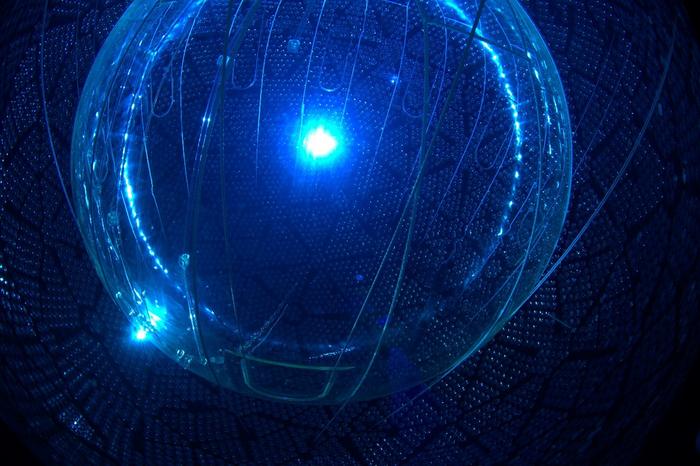
In the new research, the Oxford team captured them converting carbon into nitrogen in the controlled environment of an underground detector. The Oxford teams utilized the Sudbury, Canada SNOLAB, and its SNO+ detector in their work, located two kilometers underground within an operational mine.
SNO+ is an outgrowth of the original SNO experiment, which studied neutrinos as they journeyed from the Sun to the Earth, resulting in the 2015 Nobel Prize in Physics for lead investigator Arthur B. McDonald. Because neutrinos have extremely faint signatures, a location deep underground is necessary for their study, where large volumes of dirt and rock shield the lab from cosmic rays and background radiation that could otherwise contaminate the work.
Capturing the Interaction
The recent discovery was not accidental: a high-energy neutrino transforming a carbon-13 nucleus into nitrogen-13 about 10 minutes after contact is precisely what the team had been seeking, employing a method known as delayed coincidence.
In such an observation, researchers first look for a flash produced by the neutrino interacting with the carbon-13 nucleus, and then a second flash as radioactive decay converts the nucleus into nitrogen-13. Such a specific pattern enables scientists to confidently identify neutrino interactions, which can be challenging to discern from background noise.
“This discovery uses the natural abundance of carbon-13 within the experiment’s liquid scintillator to measure a specific, rare interaction,” said SNOLAB staff scientist Dr Christine Kraus. “To our knowledge, these results represent the lowest energy observation of neutrino interactions on carbon-13 nuclei to date and provides the first direct cross-section measurement for this specific nuclear reaction to the ground state of the resulting nitrogen-13 nucleus.”
Experiments at SNOLAB were conducted for 231 days, between May 4, 2022, and June 29, 2023. Going into the project, they estimated that they would observe 4.7 events and ended up with a very close figure of 5.6 events.
Further Explorations
“Capturing this interaction is an extraordinary achievement,” said lead author Gulliver Milton, a PhD student at the University of Oxford’s Department of Physics. “Despite the rarity of the carbon isotope, we were able to observe its interaction with neutrinos, which were born in the Sun’s core and travelled vast distances to reach our detector.”

Because of their ghostly nature, neutrinos are essential to advancing physics, and this research is a significant step toward their effective study. Continuing to press ahead will allow for improved understanding of mysterious physical processes such as nuclear fusion and the evolution of the universe.
“Solar neutrinos themselves have been an intriguing subject of study for many years, and the measurements of these by our predecessor experiment, SNO, led to the 2015 Nobel Prize in physics,” explained co-author Professor Steven Biller, of the University of Oxford Department of Physics.
“It is remarkable that our understanding of neutrinos from the Sun has advanced so much,” he added, “that we can now use them for the first time as a ‘test beam’ to study other kinds of rare atomic reactions!”
The paper, “First Evidence of Solar Neutrino Interactions on 13C,” appeared in Physical Review Letters on December 10, 2025.
Ryan Whalen covers science and technology for The Debrief. He holds an MA in History and a Master of Library and Information Science with a certificate in Data Science. He can be contacted at ryan@thedebrief.org, and follow him on Twitter @mdntwvlf.